Learn · Electrical
Meters and Metering Equipment
Part of Journeyman Electrician Exam Prep · step 45 of 73 · next: Panelboards and Load Centers
In learning paths: Journeyman Electrician Exam Prep
The watt-hour meter is the utility’s cash register: it measures energy, kilowatt-hours, flowing into the building. You will never wire the meter itself, the utility owns it and seals it, but you install and wire the meter socket it plugs into, and you are the one who has to understand what is hot on each side of it.
Why it matters on the job
Every service job runs through metering equipment. Setting a meter base plumb, landing line and load conductors on the correct lugs, and coordinating the utility’s cut and reconnect are routine apprentice tasks, and a swapped line and load is an expensive, dangerous mistake. The meter is also the first thing a customer points at when a bill is high, so knowing what it actually measures makes you the calm person in that conversation.
How metering works
A residential meter plugs into a meter socket with spring jaws. Utility conductors land on the line side lugs, the top jaws in a typical socket. Conductors continuing to the service disconnect land on the load side. Power flows through the meter’s measuring element on its way to the panel, and the register totals energy over time.
The meter counts kilowatt-hours: power multiplied by time. A 1 kW load running for 1 hour is 1 kWh. It does not measure voltage quality, and it does not limit current, there is no protection in a meter.
Large services do not push full load current through the meter. They use instrument transformers: current transformers (CTs) scale hundreds of amps down to a small signal the meter can read, in a CT cabinet the utility specifies.
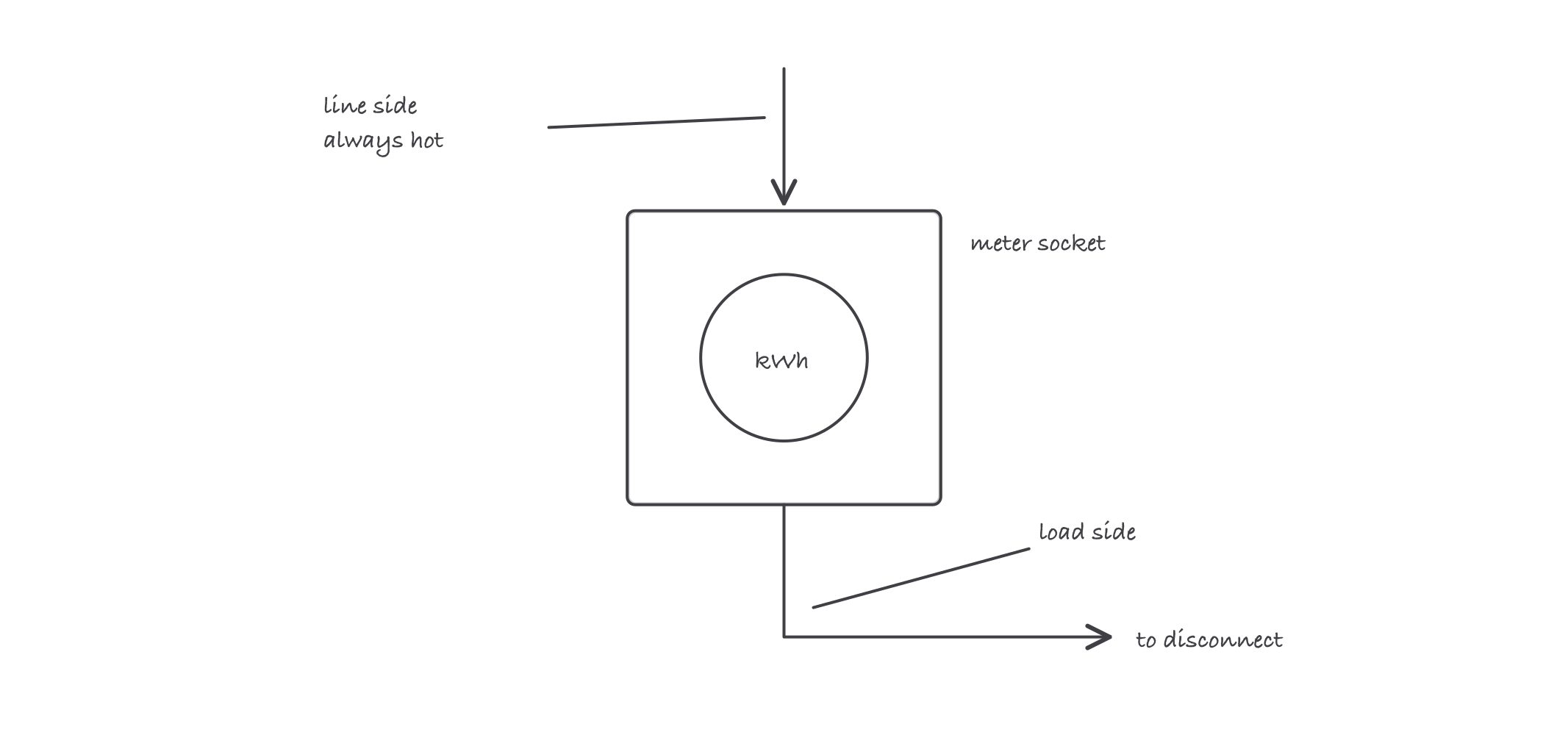
Line side stays live even with the main off: only the utility’s cut kills it
Worked example
A customer runs a 9.6 kW electric furnace for 3 hours: 9.6 kW × 3 h = 28.8 kWh through the meter.
Reading the register works by subtraction. Last month’s reading 44,850 kWh, this month’s 45,210 kWh: 45,210 − 44,850 = 360 kWh billed. If that furnace ran 3 hours a day for 30 days it alone accounts for 28.8 × 30 = 864 kWh, so a 360 kWh month tells you the furnace barely ran. That arithmetic settles most “my bill is wrong” calls.
Where it bites
- The line side is always hot. Turning off the main breaker kills the load side of the panel, not the meter socket. Only a utility disconnect, pulling the meter or cutting at the transformer, de-energizes the socket, and pulling a meter under load is a utility job, not yours.
- The seal is the utility’s. Cutting a meter seal without authorization is treated as tampering. Get the utility to pull the meter, or get written permission, before opening sealed equipment.
- kW and kWh are different claims. kW is a rate, kWh is a quantity. A meter that shows high usage is reporting time multiplied by load, so a “small” load running constantly often out-bills a big load that runs rarely.