Learn · Electrical
Finding Code Answers Fast
Part of Journeyman Electrician Exam Prep · step 68 of 73 · next: The Journeyman Electrician License
In learning paths: Journeyman Electrician Exam Prep
Assumes you know: NEC Definitions That Decide Answers, Reading NEC Tables
Finding a code answer fast is a repeatable four-move method: classify the question, jump to the owning chapter, pick the article, then walk the article’s internal structure to the section. The index and table of contents are your two entry doors, and knowing which door fits which question is most of the speed.
Why it matters on the job
Code fluency is measured in seconds. In the field, slow lookup means guessing, and guessing means rework or a red tag. On the exam it is arithmetic: a timed code portion with dozens of questions gives you only a couple of minutes each, so a lookup method that reliably lands in under a minute is the difference between finishing and failing. The chapter map from How the NEC Is Organized is the engine; this lesson is the driving technique.
The four moves
1. Classify the question. Every code question is about one of a few things: a definition (Article 100), a design quantity like circuits or loads (Chapter 2), a wiring method or its installation (Chapter 3), a piece of utilization equipment (Chapter 4), or a special occupancy, equipment, or condition (Chapters 5 through 7). Say the category to yourself before opening the book.
2. Choose the door. Structural questions, where you know the topic owns an article, go through the table of contents: motors, straight to 430; grounding, 250. Keyword questions, where you know the thing but not its home, go through the index, and the index rewards Code vocabulary: an “outlet” search behaves differently from “receptacle”, and the index speaks NEC terms, not slang.
3. Land on the article, scan its layout. Articles repeat an internal pattern: scope and general rules up front, installation rules in the middle, construction specifications at the back. Section numbering inside big articles is consistent between editions often enough that heavy hitters become addresses you just know: 210.52 receptacle placement, 250.66 grounding electrode conductor sizing, 310.16 ampacity.
4. Read the found rule completely. The rule, its exceptions, and any informational note pointing elsewhere. A fast lookup that stops one exception short of the answer is a wrong answer delivered quickly.
Two force multipliers: tabs on the workhorse articles (100, 110, 210, 220, 230, 240, 250, 300, 310, 314, 430, Chapter 9 tables), and drill: lookups are a motor skill, and ten practice questions a night for a month rewires how fast the book opens to the right place.
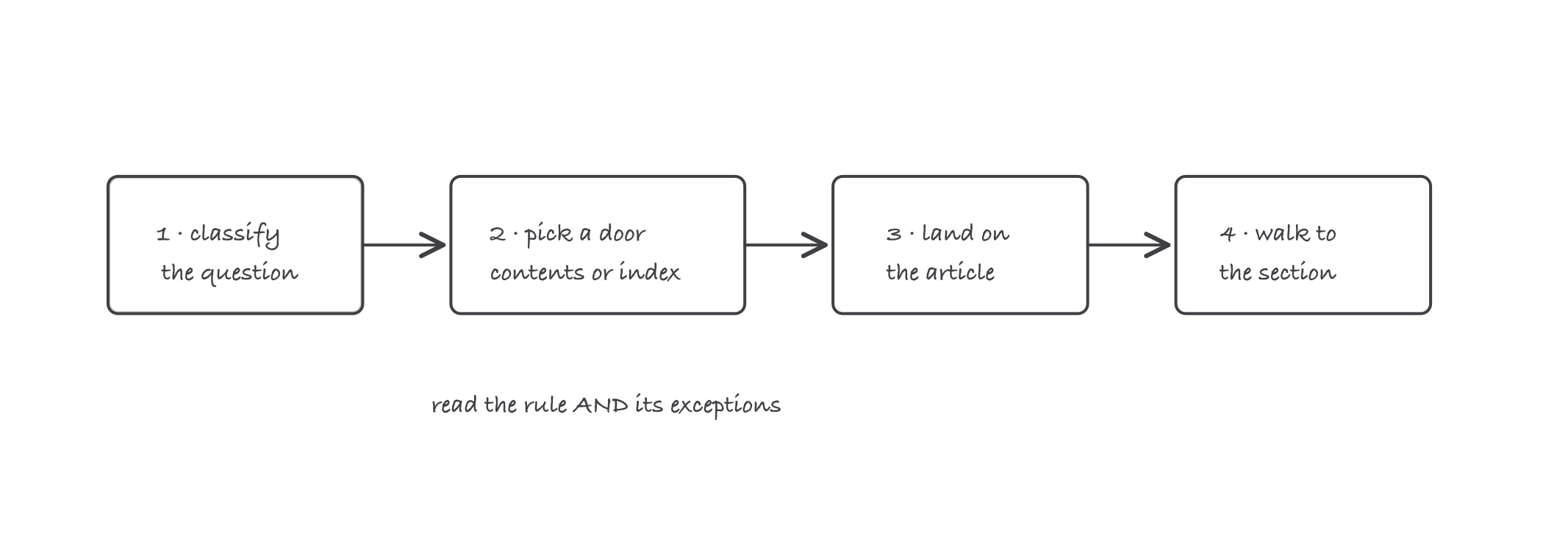
Classify, choose a door, land, walk: every lookup is the same four moves
Worked example
Question: how many receptacle outlets does a dwelling kitchen countertop require, and where?
Classify: receptacle placement in a dwelling is circuit design, Chapter 2. Door: you know branch circuits own outlet placement, so table of contents to Article 210; a colder start would go index, “Receptacles, dwellings”, which points into 210 anyway. Land and walk: inside 210, the section family on receptacle outlets is 210.52; scan its lettered subdivisions for the location category, countertops are (C). Read completely: the rule plus its subdivisions and exceptions give spacing and placement, and you verify you are reading dwelling rules, which is what the question asked.
Total motion: one classification, one jump, one scan. With 210.52 tabbed, that is a 30-second lookup; through the index cold, under two minutes. Both beat flipping.
Where it bites
- The index speaks Code, not jobsite. “Romex” is not in it; “Nonmetallic-sheathed cable” is. Building your index vocabulary is building your lookup speed.
- First plausible hit is a trap. Several articles can mention your keyword; only one owns your situation. Confirm the article’s scope line before trusting the section.
- Exceptions finish the rule. Exam questions are regularly written at the exception. Never answer from a general rule without checking what follows it.
- Edition drift moves furniture. Section addresses you memorized can shift between editions. The method survives every edition; specific addresses need re-verifying against the book in your hand.
Exam relevance
The timed, open-book code portion of journeyman and master exams is precisely this skill. Practice against the same edition your exam references, tab the workhorse articles the way your testing body permits, and rehearse the four moves until classification is instant. Speed drills matter more than rereading: passing candidates are rarely the ones who know the most rules, they are the ones who find any rule in under a minute.
Verified requirements
| Where | Expires | Renewal | Continuing education |
|---|---|---|---|
| Texas | Yes | 1 year | 4 hours per annual renewal cycle |
Information comes from issuing-authority sources. Confirm current rules, fees and eligibility with the authority before acting.