Learn · Electrical
Service-Entrance Cable
Part of Journeyman Electrician Exam Prep · step 31 of 73 · next: EMT
In learning paths: Journeyman Electrician Exam Prep
Assumes you know: Conductor Types and Insulation
Service-entrance cable is the heavy jacketed cable family that brings power in: SE for above ground, USE for underground, with the letters after SE telling you the shape and conductor count. It exists so that services and large feeders can be run as a cable instead of conduit and individual conductors.
Why it matters on the job
Every residential service upgrade, subpanel feed, and range or dryer circuit is a chance to pick from this family, and the choices are not interchangeable. USE indoors is a fire-rating violation. SEU used where a separate equipment ground is needed is a grounding violation. The cable names encode exactly what each assembly can do; learn the grammar once and the selection becomes automatic.
The family, decoded
SE style U (SEU) is the flat cable on every meter wall: two insulated hot conductors, wrapped by a bare concentric neutral, strands wound around the insulated pair, all under a sunlight-resistant jacket. Three conductors total. The concentric strands are gathered and twisted into a single neutral at each termination.
SE style R (SER) is round, with three insulated conductors plus a bare equipment ground: four wires. This is the feeder cable, because downstream of the service disconnect the neutral and the equipment ground must be separate conductors, a rule inherited from the grounding and bonding subject.
USE is underground service-entrance cable: moisture-rated for direct burial, and commonly dual-rated USE-2/RHW-2. What USE lacks is a flame-rated jacket, and that lack writes its main rule: USE stays outside and underground. It may not run through the interior of a building.
Inside a building, SE cable used for interior feeders and branch circuits follows cable-method rules similar to NM, including, in the pattern most codes now use, the 60 °C ampacity limit for smaller SE cable installed in thermal insulation, with 75 °C available otherwise. Your code’s exact conditions govern; the instinct to carry is that SE indoors is treated like a cable, not like conductors in conduit.
Where each one goes
- Service riser from weatherhead to meter to service disconnect, run on the building exterior: SEU, its bare concentric serving as the grounded service conductor, which the service bonding rules permit on the line side.
- Panel to subpanel, panel to range or dryer, any feeder past the main disconnect: SER, four wires, neutral insulated and ground separate.
- Buried lateral from a pole or pedestal: USE, emerging from the trench and stopping where the building interior begins.
Worked example
A house gets a 200 A service upgrade plus a 100 A subpanel in an attached garage:
- Weatherhead down to the meter can: SEU, jacket sunlight-resistant, concentric strands twisted and landed on the neutral lugs. Line side of the main, so the bare neutral doubling as the grounded conductor is permitted.
- Meter to the service disconnect: still line side, still SEU.
- Service disconnect to the garage subpanel: this is now a feeder. SER, four conductors. The insulated neutral lands on an isolated neutral bar; the bare ground lands on the grounded bar; the bonding stays separated exactly as the grounding subject taught.
- If the subpanel had been in a detached shop fed by trench: USE in the trench, transitioning at the building line, because USE cannot enter the interior.
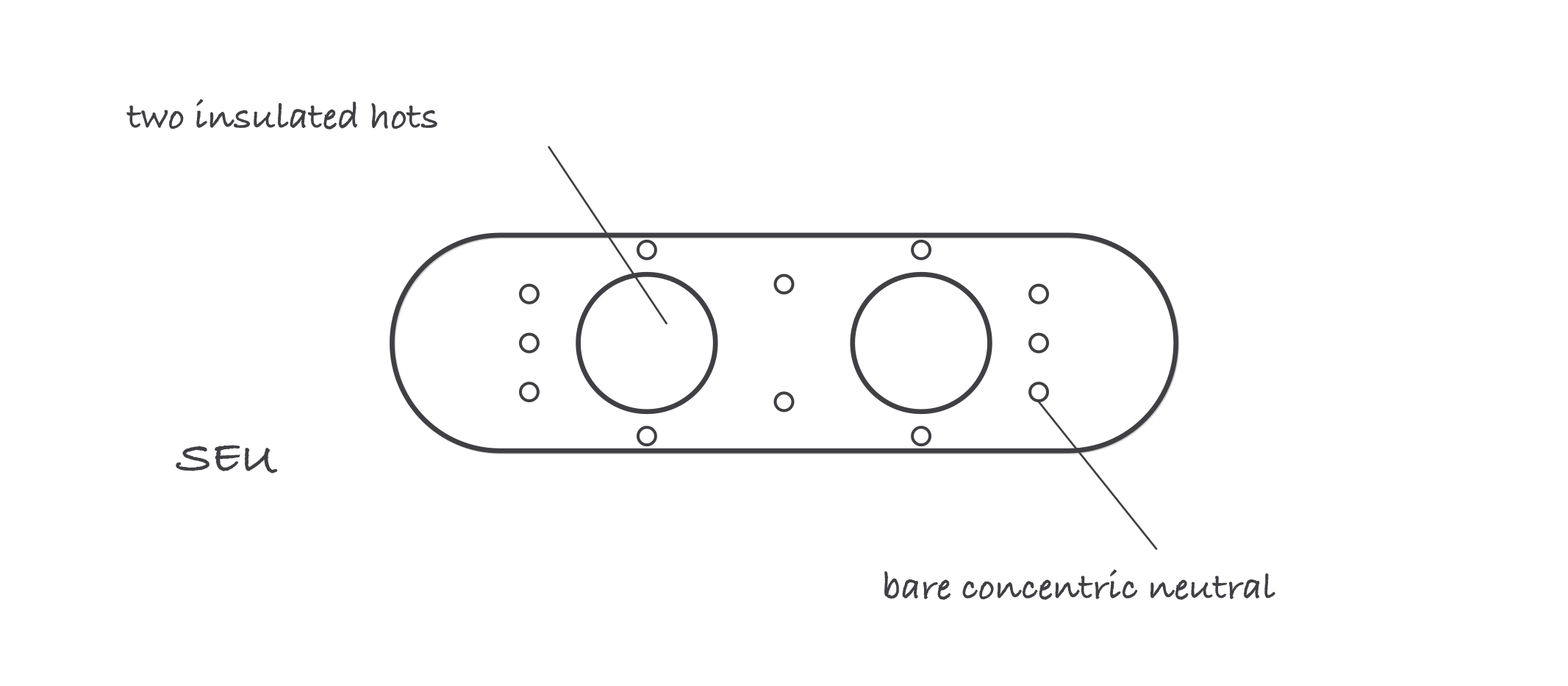
SEU in section: two insulated hots, and the neutral is the bare concentric wrap gathered at each end, a line-side-only trick
Where it bites
- USE through the wall. Pulling the buried cable on into the basement to the panel is the classic violation: no flame rating, no interior use. Transition to an interior-rated method at the building line.
- SEU as a feeder. Three-wire SEU to a subpanel forces neutral and ground together downstream of the service disconnect, recreating the parallel-path problem from the grounding subject. Feeders get SER’s four wires. Older installs grandfathered under three-wire rules are exactly that: older.
- Forgetting the concentric is the neutral. Every strand gets gathered and terminated. Stray strands left against the can are stray neutral paths.
- Ampacity by assumption. SE indoors does not automatically get the 75 °C column; insulation contact and cable size change the answer, and the code’s conditions decide. Look it up per installation.
- Sunlight resistance is a listing, not a color. The riser jacket must be marked sunlight-resistant; gray does not certify anything.
Verified requirements
| Where | Expires | Renewal | Continuing education |
|---|---|---|---|
| Texas | Yes | 1 year | 4 hours per annual renewal cycle |
Information comes from issuing-authority sources. Confirm current rules, fees and eligibility with the authority before acting.