Learn · Electrical
Service Entrances
Part of Journeyman Electrician Exam Prep · step 44 of 73 · next: Meters and Metering Equipment
In learning paths: Journeyman Electrician Exam Prep
Assumes you know: Service-Entrance Cable
The service entrance is everything that carries utility power from the street into the building: the overhead or underground conductors, the weatherhead or lateral, the metering equipment, and the service disconnect. It is the one part of the premises wiring system with no overcurrent protection ahead of it, which is why the NEC gives it an article of its own, Article 230, and why the rules here are stricter than anywhere else downstream.
Why it matters on the job
Service work is where you coordinate with the utility, where the inspector looks hardest, and where a mistake is not protected by any breaker. Knowing the parts by name, and knowing where utility responsibility ends and yours begins, keeps a service change from turning into a stand-off between you, the power company, and the AHJ.
The path, part by part
The service point is the legal boundary: utility wiring on one side, premises wiring (your side, and the NEC’s) on the other. Where it sits varies by utility, so confirm it before you quote a job.
Overhead services arrive on a service drop to a weatherhead (service head) at the top of a mast or on the building. Conductors leave the weatherhead facing down, with a drip loop so water falls off the wire instead of following it into the raceway. From there, service-entrance conductors, the SE cable or raceway conductors covered in Service-Entrance Cable, run down to the meter.
Underground services arrive on a service lateral or on underground service conductors to the meter base. No weatherhead, but the same logic: keep water out, protect unfused conductors.
The meter sits ahead of the disconnect so the utility measures everything. The service disconnecting means is the switch or main breaker that separates the whole building from the utility, and it must be readily accessible at or near where the conductors enter. Recent NEC editions added 230.85, an outdoor emergency disconnect requirement for one- and two-family dwellings, so first responders can kill power without entering.
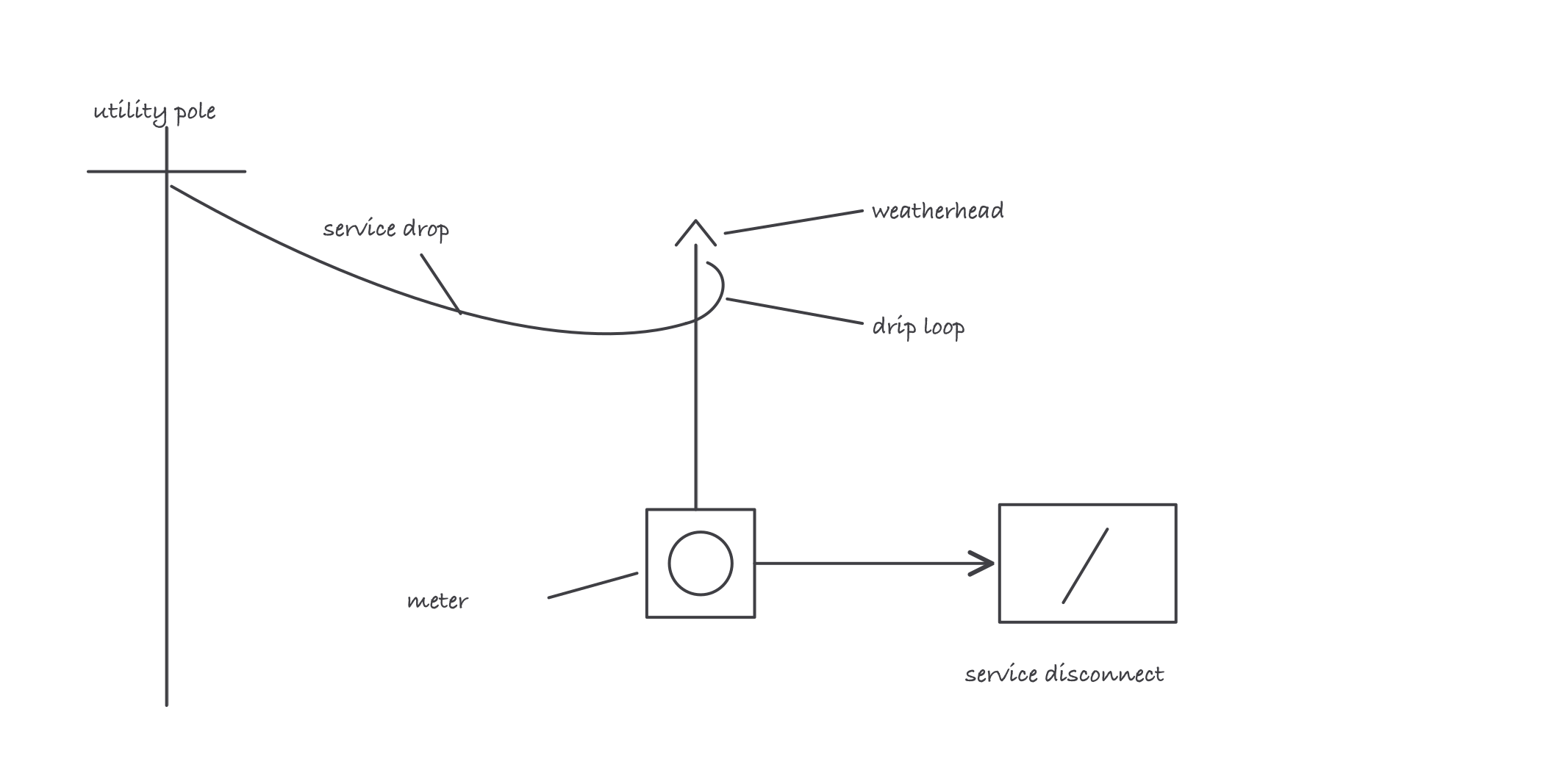
From service point to service disconnect: the only unprotected run in the building
Worked example
A house gets a 120/240 V single-phase, 200 A service. Maximum apparent power the service can deliver: 240 V × 200 A = 48,000 VA, or 48 kVA. That one number frames every load calculation the panel schedule will ever see.
Now trace a fault. A screwdriver dropped across the service-entrance conductors ahead of the main breaker has no OCPD protecting it: the only thing upstream is the utility transformer and its primary fuse. That is why service conductors are kept short, sleeved in approved wiring methods, and landed in equipment rated for the job, and why the disconnect must be at or near the point of entrance rather than three rooms away.
Where it bites
- “Service” is a defined word. Conductors past the service disconnect are feeders, not service conductors, and Article 230 stops applying. Calling a subpanel feed a “service” will fail you on exams and confuse inspectors.
- The service point moves. Overhead utility spans, underground utility laterals, customer-owned masts: who owns what differs by utility. Never assume the drop is yours to touch.
- The drip loop is not decoration. Water tracking a conductor into the meter base is one of the most common corrosion failures found in service changes.