Learn · Electrical
Pull and Junction Box Sizing
Part of Journeyman Electrician Exam Prep · step 37 of 73 · next: Boxes and Enclosures
In learning paths: Journeyman Electrician Exam Prep
Assumes you know: Conduit Fill Calculations
Pull and junction boxes for large conductors are sized by geometry, not volume: when a raceway contains conductors 4 AWG or larger, the box must be long enough for the wire to bend without damage. Two formulas cover almost everything: straight pulls need 8 times the largest raceway’s trade size; angle and U pulls need 6 times plus the other raceways in the row.
Why it matters on the job
A 500 kcmil conductor is a lever, not a string. Bent too sharply inside a box, its insulation stretches over the edge of the fitting on the outside of the bend and thins until it fails. The multipliers exist to guarantee the sweep. On the job this is a sheet-metal ordering problem: get the box size wrong and the correction involves a demolition bar. On exams it is a dependable calculation question with clean, checkable numbers.
The two formulas
Straight pull: conductors enter one wall and leave the opposite wall. The box’s length in the direction of the pull must be at least 8 × the trade size of the largest raceway. Nothing else enters the math: not the conductor size, not the count, just the biggest pipe.
Angle pull (enter one wall, leave an adjacent wall) and U pull (enter and leave the same wall): the distance from the entry wall to the opposite wall must be at least 6 × the largest raceway, plus the sum of the trade sizes of every other raceway on that same wall in the same row. Run the check for each wall that has entries.
One more distance rides along with angle and U pulls: raceways carrying the same conductor must be spaced at least 6 × the largest raceway’s trade size apart, measured between their nearest edges inside the box. That is the U-pull killer: the wire must sweep from one pipe to its neighbor without a hairpin.
These are the code-typical formulas as published tables and outlines state them; your code’s exact section governs, including its rounding and row rules.
Worked example
Straight pull. A 3-in conduit runs through a wireway-style pull box, in one end and out the other, carrying 4/0 feeders. Minimum length = 8 × 3 = 24 in. A 24 × 8 × 8 box passes; the width and depth just need to accept the locknuts and bushings.
Angle pull. A box turns a feeder 90°: a 3-in and a 2-in conduit enter the left wall, and matching 3-in and 2-in conduits leave the bottom wall.
- Left wall check: 6 × 3 + 2 = 20 in minimum from left wall to right wall.
- Bottom wall check: 6 × 3 + 2 = 20 in minimum from bottom wall to top wall.
- Same-conductor spacing: the two 3-in raceways (left and bottom) must sit at least 6 × 3 = 18 in apart edge to edge inside the box.
- Order the 20 × 20 box, and place the knockouts so the 18 in diagonal actually exists once locknuts are on.
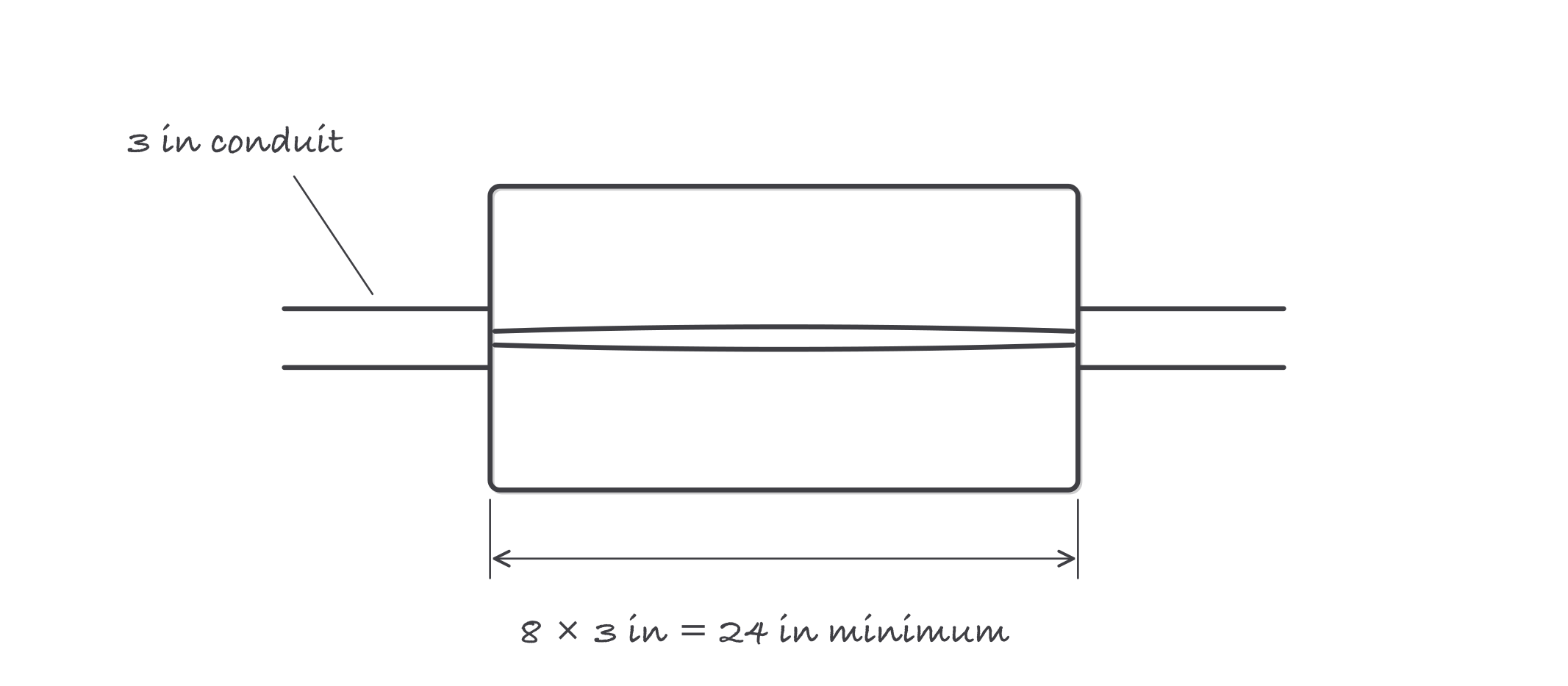
A straight pull is one multiplication: eight times the largest raceway, here 8 × 3 in = 24 in of box for the conductors to lie straight
Where it bites
- Volume rules and geometry rules are different laws. Box fill from the boxes lesson governs 6 AWG and smaller; these multipliers govern 4 AWG and larger in raceways. The trigger is conductor size, and exams switch rulebooks mid-question to catch autopilot.
- The multiplier takes the raceway size, not the wire size. 8 × the conduit’s trade size. Candidates who grab the conductor’s dimensions rebuild the formula from scratch and get novel wrong answers.
- Every wall gets its own check. An angle-pull box passing on the entry wall can still fail on the exit wall when the pipe mix differs. Run the 6× sum per wall and take the largest box that satisfies all of them.
- Forgetting the same-conductor 6× spacing. The box can meet both wall dimensions and still force a hairpin between two close-set knockouts. Knockout layout is part of the calculation.
- Real pulls want more than minimums. The formula box is legal, not comfortable. On long heavy pulls, sizing up saves hands, pulling compound, and insulation, and costs almost nothing at order time.
Verified requirements
| Where | Expires | Renewal | Continuing education |
|---|---|---|---|
| Texas | Yes | 1 year | 4 hours per annual renewal cycle |
Information comes from issuing-authority sources. Confirm current rules, fees and eligibility with the authority before acting.