Learn · Electrical
Sine Waves and Frequency
Part of Electrical Foundations · step 13 of 19 · next: Capacitance
In learning paths: Electrical Foundations
Assumes you know: Alternating Current
The sine wave is the shape of AC: voltage climbing to a positive peak, falling through zero to a negative peak, and returning, in one smooth repeating curve. Every AC number you use, starting with “120 volts”, is a particular way of measuring that curve, and knowing which way is the difference between reading a system and misreading it.
Why it matters on the job
The 120 V at a receptacle is not the top of the wave. The voltage there swings up to about 170 V, down through zero to about minus 170 V, 60 times a second. The 120 V figure is the RMS value, the working average that makes AC arithmetic behave. Meters read RMS, nameplates speak RMS, and insulation quietly endures the peaks. You cannot afford to conflate the two.
The measurements of the wave
Cycle, period, frequency. One complete rise-and-fall is a cycle. The time one cycle takes is the period. The number of cycles per second is the frequency in hertz. At 60 Hz the period is 1/60 of a second, about 16.7 milliseconds.
Peak value. The maximum instantaneous voltage, the very top of the curve.
Peak-to-peak. From positive peak to negative peak: twice the peak. Mostly an oscilloscope’s way of speaking.
RMS, the working value. RMS (root-mean-square) is the DC-equivalent heating value: a sine wave with an RMS of 120 V delivers exactly the same heat into a resistance as a steady 120 V DC would. That equivalence is why Ohm’s law and the power formulas carry straight over to AC using RMS numbers. For a sine wave the relationships are fixed:
- RMS = Peak × 0.707
- Peak = RMS × 1.414
Unless someone says otherwise, every AC voltage and current you will ever quote, 120, 208, 240, 277, 480, is RMS.
Worked example
What does a “120 V” circuit actually swing to?
- Peak = RMS × 1.414 = 120 × 1.414 = 169.7 V, call it 170 V
- Peak-to-peak: 2 × 169.7 = 339.4 V
Now a 480 V circuit:
- Peak = 480 × 1.414 = 678.7 V, call it 679 V
That last number is why insulation, test equipment, and clearances are rated with the peak in mind: gear on a “480 volt” system sees nearly 680 V at the crest of every cycle, 60 times a second. And going the other way: an oscilloscope shows a sine peaking at 170 V; RMS = 170 × 0.707 = 120.2 V, the familiar number recovered.
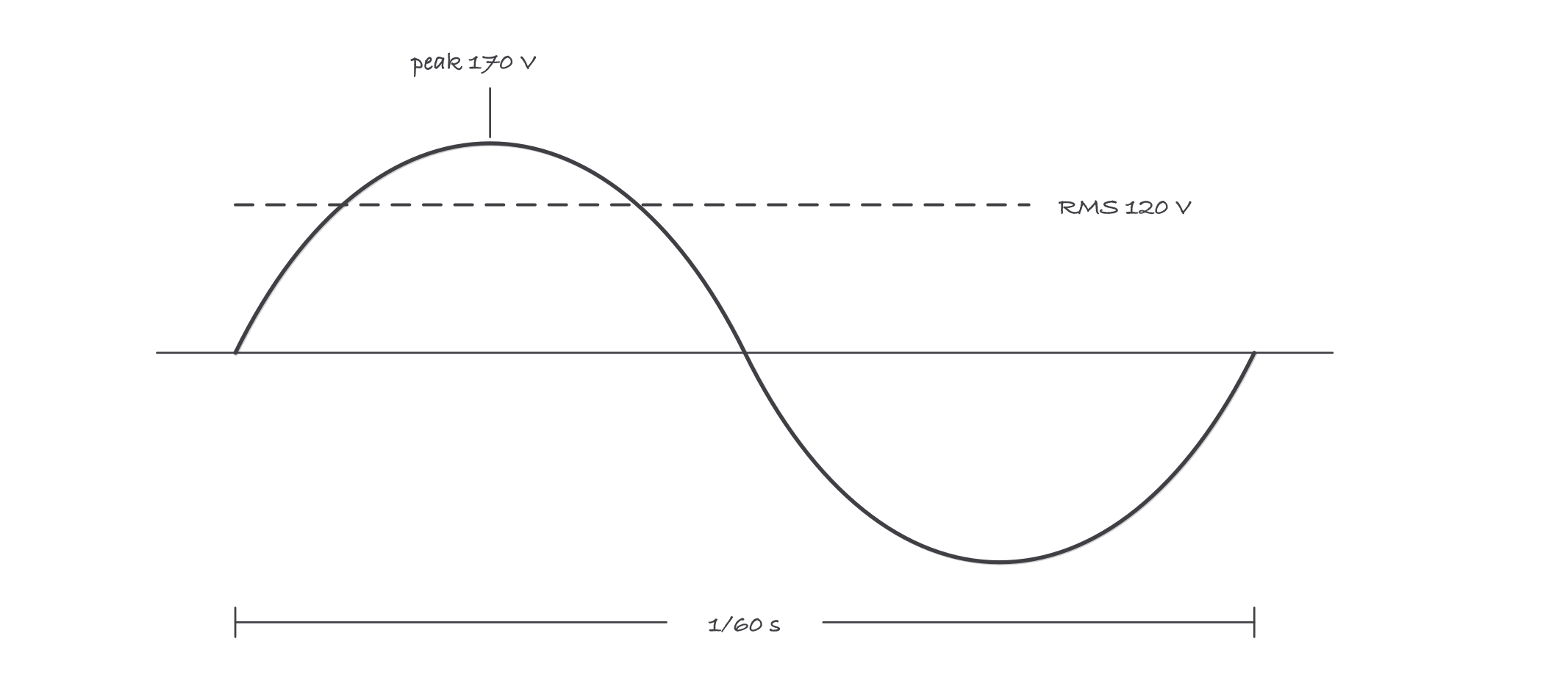
The wave tops out near 170 V; 120 V is its RMS working value
Where it bites
- The 0.707 and 1.414 factors belong to sine waves only. Dimmers, drives, and electronic loads chop the wave into other shapes, and on those an averaging meter guesses wrong. A true-RMS meter computes the real heating value regardless of shape; know which kind is in your pouch.
- Insulation lives at the peak, not at RMS. Voltage stress, breakdown, and spacing all answer to the crest of the wave. “It’s only a 120 volt circuit” is a 170 V statement.
- Zero crossings are real moments. The voltage passes through zero 120 times a second, which is why AC arcs tend to self-extinguish where DC arcs hang on, and why some switching gear is rated very differently for DC.
- Frequency is not voltage. 50 Hz equipment on a 60 Hz system, or the reverse, can run hot or at wrong speed even when the voltage matches the nameplate.
Exam relevance
Peak and RMS conversions are dependable exam material: multiply or divide by 1.414 or 0.707, with wrong answers built from picking the wrong factor. Anchor one fact, 120 RMS is about 170 peak, and you can always reconstruct which way the factors go. Period-frequency arithmetic, period equals one over frequency, appears in the same sections.