Learn · Electrical
Lockout/Tagout
Assumes you know: Safe Work Practices
Lockout/tagout is how a de-energized circuit stays de-energized while your hands are in it. Opening a disconnect makes a circuit dead for a moment; a lock makes it dead until you personally decide otherwise, because the key is in your pocket and no one else’s. LOTO is the bridge between “I turned it off” and “it cannot be turned on.” What follows is the shape of the practice; the version you must follow is your employer’s written energy-control program, learned through their training, not from a lesson page.
Why it matters on the job
The scenario LOTO exists for is mundane: you are in the panel, out of sight of the disconnect, and someone who does not know you are there restores power. A helpful operator, a returning shift, an automatic control. The lock does not make the circuit safer; it makes other people’s reasonable actions unable to kill you.
The anatomy of a lockout
One worker, one lock, one key. Every person exposed to the hazard puts on a personal lock, and each lock has exactly one key, held by its owner. Nobody’s safety depends on anyone else’s memory. Where several people work on one isolation point, a multi-lock hasp or a group lockbox scales the principle: the isolation cannot be restored until the last person has removed the last lock.
The tag is the voice of the lock. It says whose lock, why, and since when, with contact information. A tag alone, on equipment that physically accepts a lock, is a weaker control used only where the program justifies it and supplements it with other measures. If it can be locked, lock it.
The sequence in a typical energy-control procedure runs: notify affected people, shut down by normal means, open the disconnecting means, apply lock and tag, release any stored energy, and verify absence of voltage. That last step, the test-before-touch sandwich from the previous lesson, is what converts a locked-out circuit into a verified-dead one. Restoration reverses it: area clear, people out, locks off by their owners, affected people notified before re-energizing.
Stored energy is part of electrical LOTO. Capacitors in drives and power-factor banks hold charge after isolation; some equipment has springs, air, or elevated loads behind it. Isolating the incoming feed is not the whole job; the procedure lists every energy source for a reason.
Worked example: one motor, two trades
A 480 V motor starter needs its contactor replaced while a millwright works on the driven pump.
- Sources identified from the drawings: one power feed through a wall-mounted disconnect, plus 120 V control from a separate panel. Two isolation points, not one.
- Both trades shut down and open both isolation points. A hasp goes on each, and each worker adds a personal lock: four locks total across the two points, each keyed to one pocket.
- Stored energy: the drive’s DC bus capacitors get their manufacturer-specified discharge wait before verification.
- You verify absence of voltage at the starter, live-dead-live, every phase pair and each phase to ground. The millwright verifies the pump cannot start from its controls.
- The pump work finishes first. The millwright removes only their own two locks. Your locks remain; the starter stays isolated until your work ends and your key comes out of your pocket.
The system never asked anyone to remember who was still inside. The hardware kept the count.
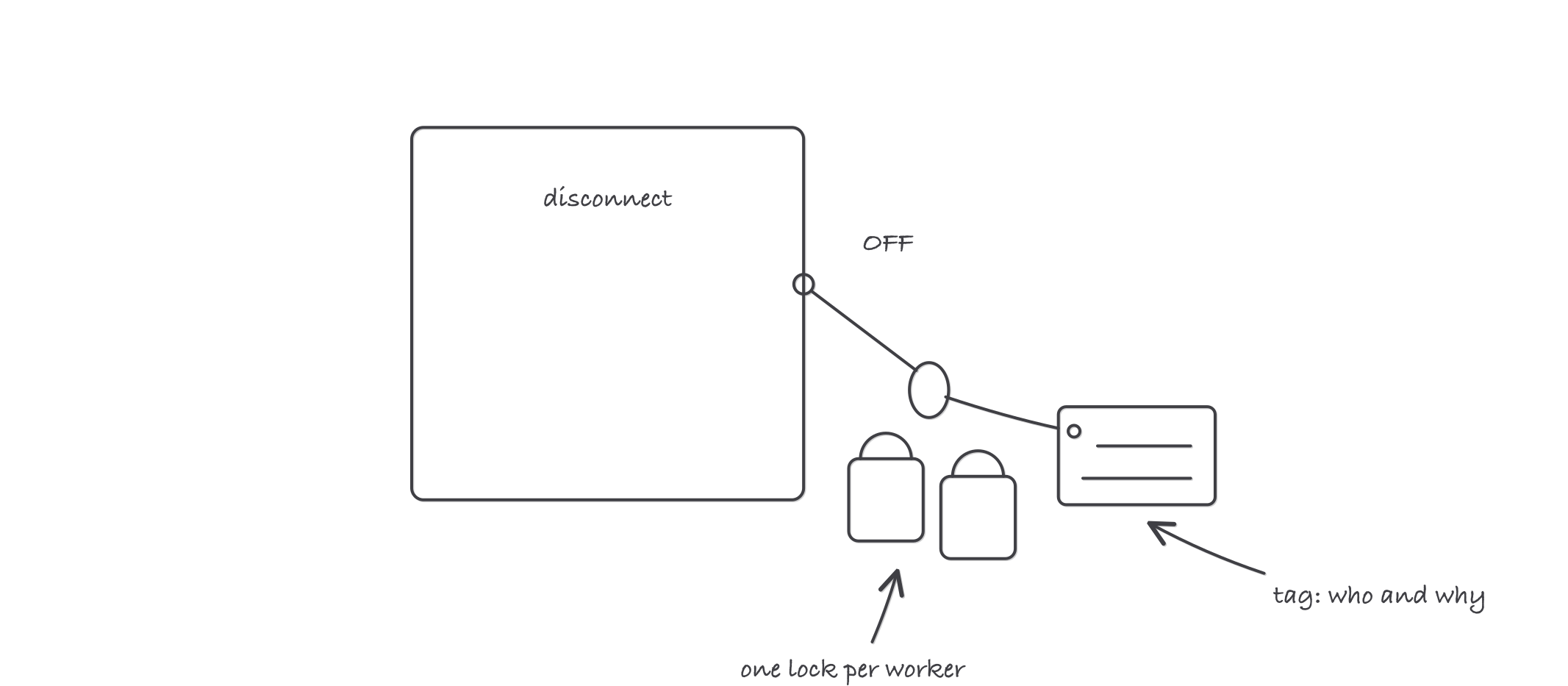
The whole principle in one fixture: each worker’s lock rides the same hasp, and the handle moves for nobody until every key has come back
Where it bites
- Removing someone else’s lock is the cardinal sin. Programs have a formal absent-worker procedure involving supervision and documented verification the person is clear. Bolt cutters on your own authority are how funerals get scheduled.
- Control-circuit stops are not isolation. A stop button, a VFD keypad, or an interlock opens a control path; the power conductors stay hot and one relay failure restores the load. Lock the disconnecting means, not the stop button.
- Your lock protects you at exactly one point. If the equipment has two feeds and you locked one, the second does not care about your feelings. The energy-source survey is the step that finds it.
- The lock does not verify anything. A locked-out circuit that was never tested dead is a live circuit with good paperwork. LOTO and test-before-touch only work as a pair.