Learn · Electrical
Shock Hazards and the Body
Assumes you know: Current
Current kills, not voltage. Voltage is the pressure that pushes current through you, but everything the body suffers in a shock is done by current, and the quantities involved are absurdly small. The receptacle circuits you rough in are protected at 15 or 20 A. The current that can stop a human heart is measured in thousandths of one amp. This lesson is background for judgment, not a qualification: only your employer’s training and procedures qualify you to work near energized equipment.
Why it matters on the job
“It’s only 120” has killed more electricians than 480 ever impressed. Understanding what milliamps do to a body is what turns safety rules from bureaucracy into obvious sense: why circuits get de-energized before work, why testers get verified, why GFCIs trip at the level they do. Respect scaled to the real hazard is the foundation the rest of the safety program stands on.
What the milliamps do
Effects vary with the person, the path, the duration, and the frequency, so established references give ranges rather than one number. For 60 Hz current across the body, the commonly taught landmarks run like this:
- About 1 mA: perception, a faint tingle.
- A few mA: uncomfortable, startling. The involuntary jerk can knock you off a ladder even when the shock itself does no harm.
- Roughly 6 to 16 mA: the let-go range. Current makes muscles contract, and above your personal let-go threshold you cannot release the conductor. Hand muscles clamp harder while the current keeps flowing.
- Tens of mA: breathing muscles can seize while contact continues.
- On the order of 50 to 150 mA or more: ventricular fibrillation becomes likely. The heart’s rhythm scrambles and does not restart on its own.
Two features of that list deserve a hard look. First, the fatal band sits below the trip point of every standard breaker; overcurrent devices protect wire, not people. That is the job of GFCIs, which open at around 4 to 6 mA, right at the bottom of the danger scale. Second, the let-go phenomenon means duration is not your choice. A shock you cannot release delivers its damage on its own schedule.
Worked example: the same cord, two days
Ohm’s law sets the current: I = V ÷ R, and your resistance is mostly skin.
- Dry, unbroken skin, hand to hand, might present around 100,000 Ω. On a 120 V fault: 120 ÷ 100,000 = 1.2 mA. A tingle you would report and walk away from.
- The next day you are sweating, and the same hand has a fresh cut. Skin resistance toward 1,000 Ω. Same fault: 120 ÷ 1,000 = 120 mA. That figure sits inside the fibrillation range, and if it lands above your let-go threshold on the way through, you never chose how long it lasted.
Nothing about the circuit changed. The margin between annoyance and fatality was moisture and a break in the skin, neither of which you can measure on the job. That is why the rules treat every energized conductor as the second day.
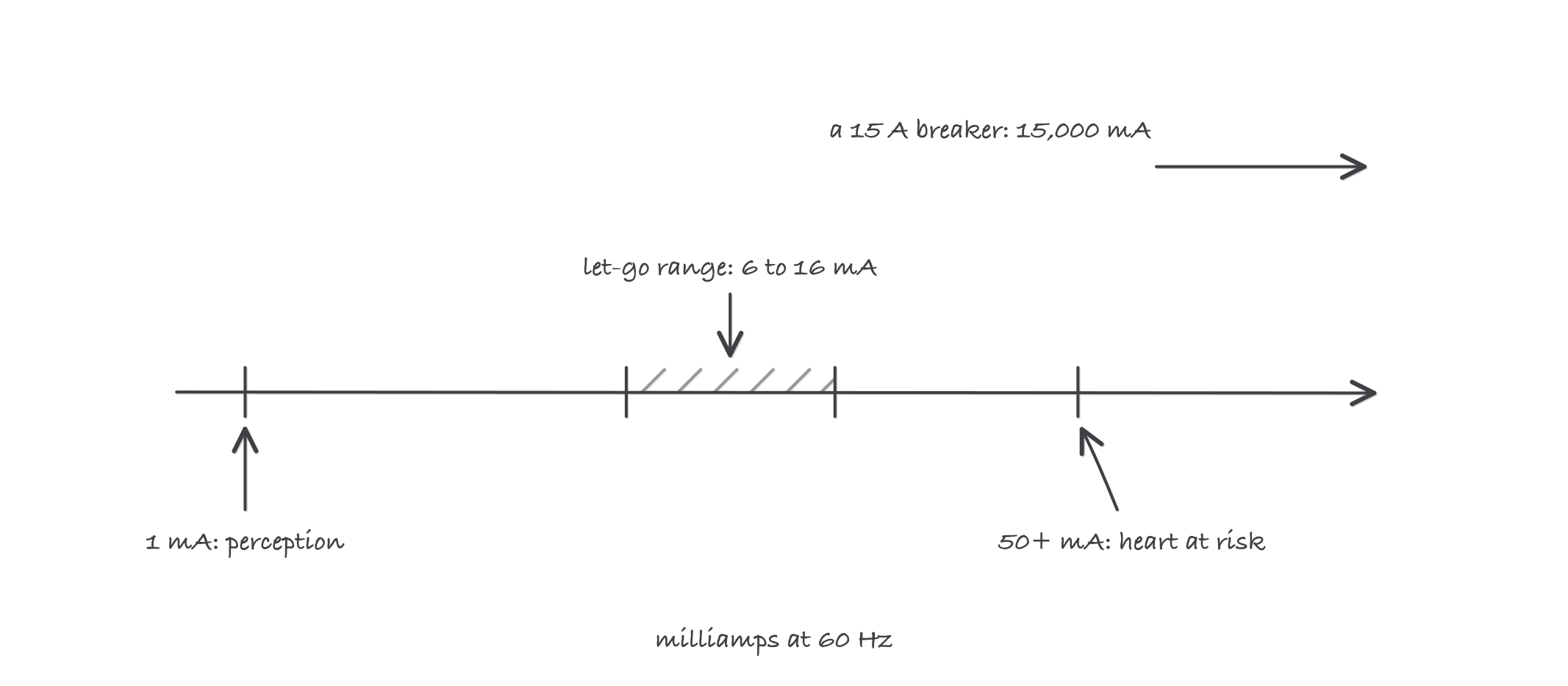
The whole hazard fits below one fifth of one amp: let-go is lost in the teens of milliamps and the heart is at risk before 150
Where it bites
- Path decides severity. Hand to hand and hand to opposite foot cross the chest. The same milliamps through a finger and out the same hand hurt; through the heart they kill. Working with one hand where feasible is an old habit with modern justification.
- Low voltage does not mean low hazard, and high voltage adds burns. At higher voltages, current also cooks tissue along the path, and skin resistance breaks down entirely, letting more current flow.
- The secondary injury is often the one that maims. Falls from the jolt, dropped loads, a head into strut. Assume any shock ends with a fall and position yourself accordingly.
- A shock with no visible mark still warrants medical evaluation. Cardiac rhythm effects can show up after the fact. Report every shock; employer procedures on this exist for a reason.