Learn · Electrical
Surge Protection
Part of Journeyman Electrician Exam Prep · step 54 of 73 · next: How Motors Work
In learning paths: Journeyman Electrician Exam Prep
Assumes you know: Overcurrent Protection Fundamentals
A surge protective device (SPD) is a pressure-relief valve for voltage: it sits connected between the conductors and ground doing nothing at normal voltage, and when a transient overvoltage spikes past its threshold it becomes a low-impedance path that diverts the surge energy to ground, then resets. Fuses and breakers answer too much current; SPDs answer too much voltage, arriving in microseconds, far too fast for any mechanical device.
Why it matters on the job
Buildings are now full of electronics that die at voltages the wiring itself shrugs off: appliances with control boards, EV chargers, LED drivers, everything with a power supply. Surges arrive from lightning in the area, utility switching, and big motor loads cycling inside the building itself. Recent NEC editions require surge protection for dwelling services (the dwelling-service requirement sits in Article 230, and the SPD rules themselves in Article 242), so SPDs moved from upsell to line item, and you install, replace, and explain them.
How an SPD works, and the types
The working component in most SPDs is the metal-oxide varistor (MOV): a ceramic block whose resistance collapses when voltage across it exceeds its threshold. Below threshold it leaks almost nothing; above, it conducts hard, clamping the voltage while the surge energy dumps through it to ground. Each surge event erodes the MOV slightly, which is why SPDs have status indicators and finite lives, an SPD that has eaten a major surge died protecting the circuit, and gets replaced.
The NEC (Article 242 in current editions; Articles 280 and 285 held these rules in older books) recognizes SPDs by installation point. Type 1: line side of the service disconnect. Type 2: load side of the service disconnect, the common panel-mounted unit. Type 3: point of use, cords and receptacle-style units at the equipment. Best practice is layered: a Type 1 or 2 at the service takes the bulk energy, Type 3 devices clean up the remainder at sensitive loads.
Installation detail that decides performance: lead length. The SPD’s clamping is measured at its terminals; every inch of conductor between the bus and those terminals adds impedance that lets the voltage at the protected bus rise above the clamp level during the fast edge of a surge. Mount the SPD as close to the busbar or breaker as physically possible, leads short and straight, no coils.
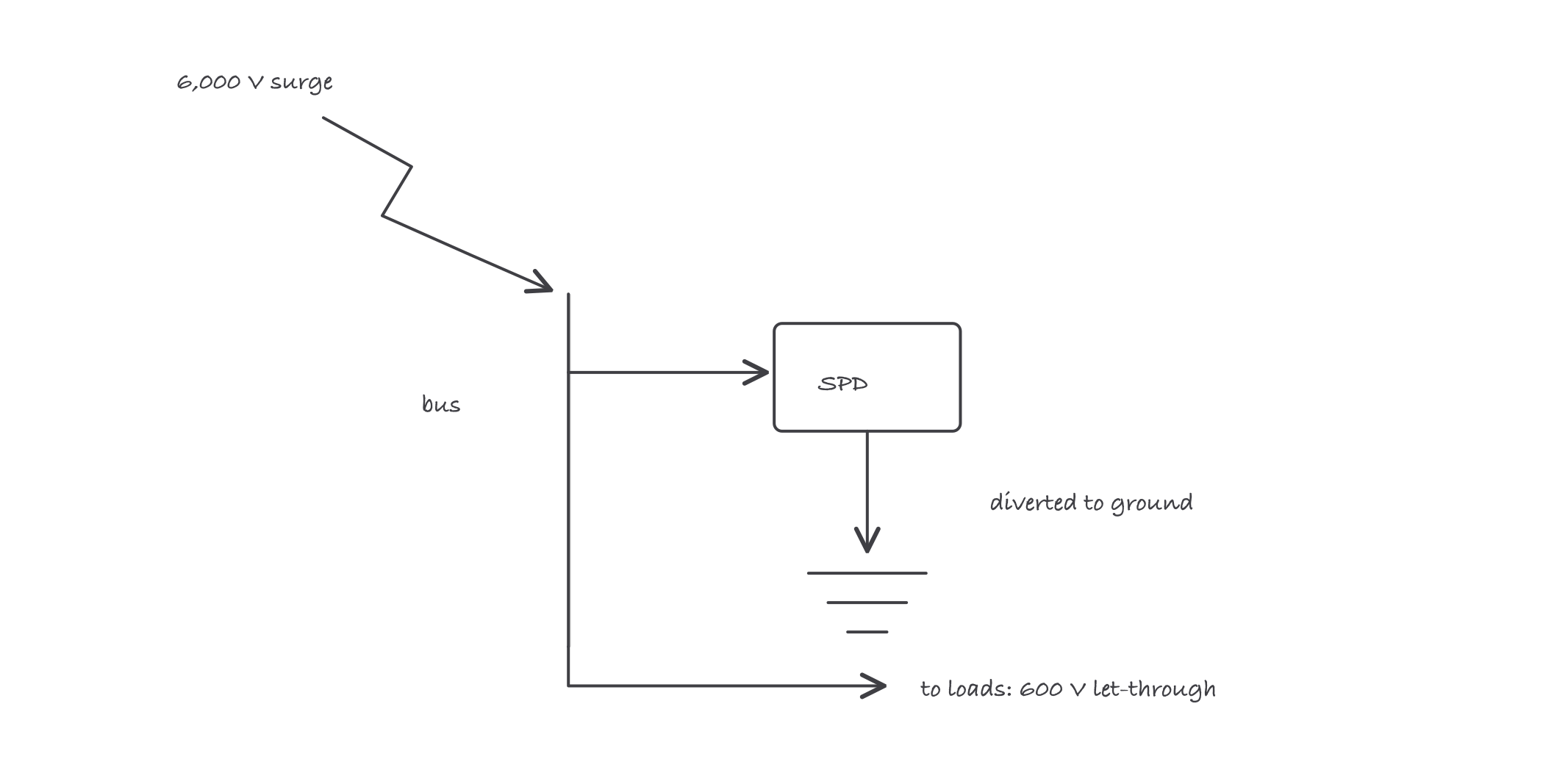
A valve across the line: normal voltage passes it by, surge voltage gets dumped to ground
Worked example
A 120 V circuit runs at a peak voltage of 120 × 1.414 = 170 V, every cycle, forever. The SPD’s threshold must sit safely above that, or it would conduct on normal power, so its maximum continuous operating voltage (MCOV) is rated above the nominal peak.
A switching transient hits the service at 6,000 V, the standard test-level voltage for service-entrance surge exposure. The SPD conducts, and its listed voltage protection rating (VPR) tells you what the downstream equipment actually sees: a unit with a 600 V VPR turns a 6,000 V event into a 600 V event, a 10-fold reduction, 6,000 ÷ 600 = 10. Equipment insulation and power supplies that would fail at thousands of volts ride through 600 V without noticing. Now add 2 ft of coiled lead to the installation and the effective let-through at the bus can climb well above the listed VPR: the rating was earned at the terminals, and your leads are in series with it.
Where it bites
- An SPD is not a lightning arrester for a direct strike. SPDs handle induced and conducted transients. A direct strike to the building is a lightning-protection-system problem, a different discipline and standard.
- Dead SPDs protect nothing, silently. The circuit works fine with a sacrificed SPD in place; only the indicator knows. Check status lights on service calls and after storm events.
- Clamping level, not joule number, is the spec that matters most. Marketing leads with joules; the VPR is what your equipment experiences. Compare like for like.
- Article renumbering trips up code lookups. Surge devices moved into Article 242 in recent editions after living in 280 and 285. In an older adopted edition, look in the old articles; the concepts map straight across.