Learn · Electrical
Parallel Circuits
Part of Journeyman Electrician Exam Prep · step 7 of 73 · next: Grounding vs Bonding
Part of Electrical Foundations · step 9 of 19 · next: Series-Parallel Circuits
In learning paths: Journeyman Electrician Exam Prep · Electrical Foundations
Assumes you know: How Ohm's Law Works
A parallel circuit gives current more than one path: every branch connected across the same two points. Two laws govern it completely. Every branch sees the same voltage, and the branch currents add up to the total. This is the circuit you actually build every working day, because every branch circuit in every building is loads in parallel.
Why it matters on the job
Every receptacle on a circuit, every luminaire on a lighting run, every appliance on a panel: parallel. That is why each load gets full line voltage no matter what else is plugged in, and why plugging in one more load raises the total current instead of dimming everything else. When a 20 A circuit trips because someone added a second heater, that is parallel arithmetic doing exactly what this lesson says it will.
The rules
Voltage is the same across every branch. Each branch connects to the same two points, so each sees the full source voltage. Nothing divides.
Branch currents add. Each branch draws what Ohm’s law says it should, independently, and the source supplies the sum:
It = I1 + I2 + I3 …
Total resistance shrinks with every added branch. The reciprocals add:
1/Rt = 1/R1 + 1/R2 + 1/R3 …
More paths means less total opposition, so Rt is always smaller than the smallest branch. Add a branch, and total current rises. For exactly two branches there is a shortcut, product over sum: Rt = (R1 × R2) / (R1 + R2).
Opening one branch leaves the others running. That independence is why one failed lamp does not darken the room, and why parallel is how buildings are wired.
Worked example
A 120 V source feeds a 20 Ω branch and a 30 Ω branch in parallel.
- First branch: I1 = E / R1 = 120 / 20 = 6 A
- Second branch: I2 = 120 / 30 = 4 A
- Total current: It = 6 + 4 = 10 A
- Total resistance from the source’s point of view: Rt = E / It = 120 / 10 = 12 Ω
- Check by reciprocals: 1/Rt = 1/20 + 1/30 = 3/60 + 2/60 = 5/60, so Rt = 60/5 = 12 Ω. Same answer, two roads.
Notice 12 Ω is smaller than either branch, and product over sum agrees: (20 × 30) / (20 + 30) = 600 / 50 = 12 Ω.
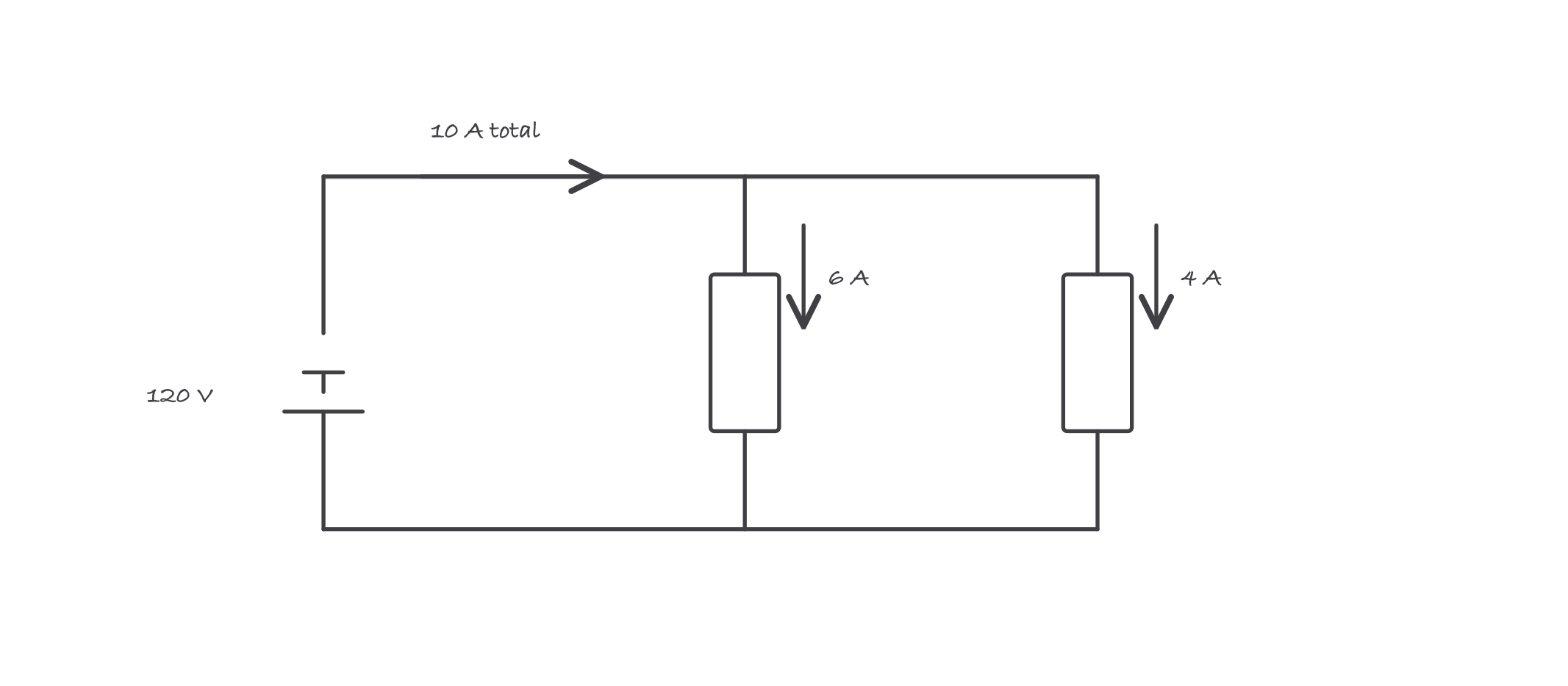
Same voltage on every branch; the source carries the sum
Where it bites
- “Current takes the path of least resistance” is folklore. Current takes every path, more where resistance is less. The 30 Ω branch above still carries 4 A; the easier path did not take it all.
- Total resistance below the smallest branch surprises people. If your computed Rt is bigger than any branch, the arithmetic is wrong. This one check catches most parallel mistakes.
- Product over sum works for two branches only. Chain it pairwise or use reciprocals for three or more; applying it to three at once gives a confident wrong answer.
- Overloads are additive, not dramatic. Nothing failed when the circuit tripped; the branches simply summed past the rating. Count the amps before blaming the breaker.
Exam relevance
Parallel resistance is a fixture of journeyman exam calculation sections: find Rt, find a branch current, find the total. The reciprocal method under time pressure is where errors happen, so practice until the two-road check in the worked example is automatic. Parallel thinking also hides inside every load-calculation question, because services and feeders are just big parallel sums.