Learn · Electrical
Inductance
Part of Electrical Foundations · step 15 of 19 · next: Impedance
In learning paths: Electrical Foundations
Assumes you know: Sine Waves and Frequency
Inductance is a circuit’s resistance to change in current. A coil of wire builds a magnetic field around itself as current flows, and that field fights every change: it resists the current rising, and it resists the current falling. On DC that is a brief stutter at switch-on. On AC, where the current never stops changing, the coil pushes back continuously, and that changes everything about how the circuit behaves.
Why it matters on the job
Coils are everywhere you work: motor windings, transformer windings, ballasts, solenoids, contactor coils. Every one of them is an inductor, which means every one of them opposes changing current, stores energy in a magnetic field, and shifts current out of step with voltage. Inductance is why motors draw more current than their wattage suggests, why opening a coil circuit draws an arc, and half the reason the impedance and power factor lessons exist.
The concept
Opposition that grows with frequency. The faster the current tries to change, the harder the field pushes back. This opposition is inductive reactance, XL, measured in ohms like resistance:
XL = 2πfL
where f is frequency in hertz and L is inductance in henrys (H). Double the frequency and XL doubles. At DC, where f is zero, XL is zero: a pure coil is just its winding resistance to a battery, which is why an ohmmeter tells you almost nothing about a coil’s AC behaviour.
The current shift. In a resistor, current and voltage rise and fall together, perfectly in step. In an inductor, the coil’s opposition to change makes the current late: in a pure inductor, current lags the voltage by 90 degrees, a quarter cycle. The memory aid that carries the whole AC group is ELI the ICE man: in an inductor (L), voltage (E) comes before current (I). ELI. The capacitor half, ICE, is the next lesson.
Real coils are never pure; winding resistance keeps the lag somewhere between 0 and 90 degrees. But the direction never changes: inductive current always arrives late.
Stored energy. The magnetic field is stored energy, and it must go somewhere when the circuit opens. It reappears as a voltage spike across the opening contacts, the inductive kick, which is what draws the arc when a loaded inductive circuit is broken.
Worked example
A coil with an inductance of 0.1 H sits on a 120 V, 60 Hz circuit. Ignore its winding resistance.
- XL = 2πfL = 2 × 3.1416 × 60 × 0.1 = 37.7 Ω
- Current: I = E / XL = 120 / 37.7 = 3.18 A, lagging the voltage by a quarter cycle
Now move the same coil to a 50 Hz system: XL = 2 × 3.1416 × 50 × 0.1 = 31.4 Ω, and current rises to 120 / 31.4 = 3.82 A. Same coil, lower frequency, less opposition, more current: one reason 60 Hz equipment can overheat on 50 Hz supplies.
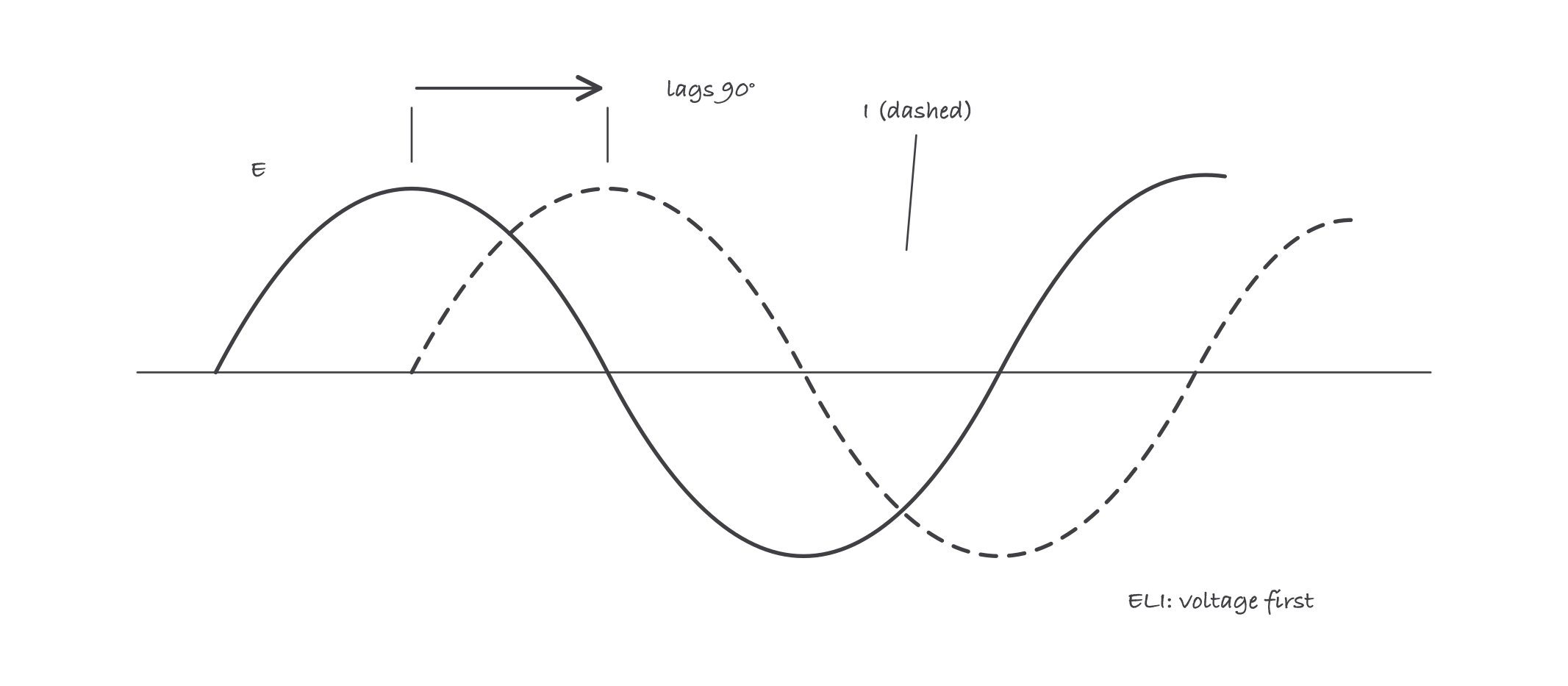
ELI: in an inductor, voltage leads and the current shows up late
Where it bites
- Winding resistance predicts nothing about running current. A motor winding might ohm at 2 Ω; plugging that into I = E/R promises an absurd current. The coil’s real AC opposition is its reactance and impedance, not its DC resistance.
- Opening an inductive circuit under load bites. The collapsing field forces the current to continue across the opening gap as an arc. This is why switches have inductive ratings, why contactors wear, and why control coils get suppression devices.
- The lag is invisible to separate meters. Your voltmeter reads 120 V, your clamp reads 3.18 A, and nothing warns you the two are out of step. The consequences appear only in the wattage, which is the power factor lesson.
Exam relevance
XL = 2πfL is a standing exam formula: compute reactance, then current, exactly as in the worked example. Concept questions probe the lag: exams expect “current lags voltage in an inductive circuit” cold, and ELI the ICE man is the accepted crutch. The frequency dependence, more hertz means more reactance, is a favorite true-false trap.