Learn · Electrical
Arc Flash
Assumes you know: Shock Hazards and the Body
An arc flash is an explosion made of electricity. When a fault current jumps an air gap, dropped tool across bus bars, a slipped probe, insulation finally giving up, the arc turns the air itself into a conductor of superheated plasma. Shock injures the person touching the circuit. An arc flash injures everyone standing near it. It is a different hazard with different physics, and it is why de-energizing is the control that matters, not just gloves. This lesson builds understanding; it does not qualify you for anything. Qualification comes from your employer’s training program.
Why it matters on the job
Most electricians will never see one, which is exactly the problem: the hazard is invisible right up until it is total. The energy released can inflict fatal burns at several feet, ignite ordinary clothing, and drive molten metal droplets and shrapnel outward with the pressure wave. Understanding arc flash as an energy event, something that can be calculated, bounded, and dressed for, is what NFPA 70E’s whole arc-flash apparatus is built on.
An energy event
Three things govern how bad an arc flash is, and none of them is voltage alone:
Available fault current. How much current the system can deliver into the arc. A small transformer far away feeds a weaker arc than a big service close to the utility.
Clearing time. How long the arc burns before the upstream device opens. Energy accumulates over time, so a fault cleared in one cycle releases a fraction of the energy of the same fault burning for half a second. Slow breakers and marginal faults make outsized explosions.
Working distance. Energy spreads out as it travels. The intensity your body receives falls off rapidly with distance, which is why arm’s-length tasks are calculated at the worker’s chest and face, not at the arc.
Incident energy and the boundary
The severity number that captures all three is incident energy: the thermal energy delivered onto a surface at a given distance from the arc, expressed in calories per square centimeter (cal/cm²). The benchmark burned into the discipline is 1.2 cal/cm², the level at which exposed skin takes the onset of a second-degree burn.
That benchmark defines the arc flash boundary: the distance from a prospective arc at which incident energy has fallen to 1.2 cal/cm². Inside the boundary, an unprotected person is expected to take at least second-degree burns if the arc happens. NFPA 70E uses this boundary as the trigger for arc-rated PPE, and the companion lesson on PPE and boundaries takes it from there.
Worked example: reading an arc flash label
Equipment likely to be examined or worked on while energized carries a label from the facility’s incident energy analysis. A typical panel label might read:
- Incident energy: 8.3 cal/cm² at 18 inches. At normal working distance, an arc would deliver about 7 times the second-degree-burn threshold onto your chest and face. PPE for the task is chosen to be rated at or above this number.
- Arc flash boundary: 48 inches. Four feet out, the calculated energy falls to 1.2 cal/cm². Anyone inside four feet during the task needs arc-rated protection; the label is telling passers-by where “near” begins.
The label numbers move with the system. Utility upgrades, transformer swaps, and breaker settings all change fault current and clearing time, which is why labels carry dates and analyses get reviewed.
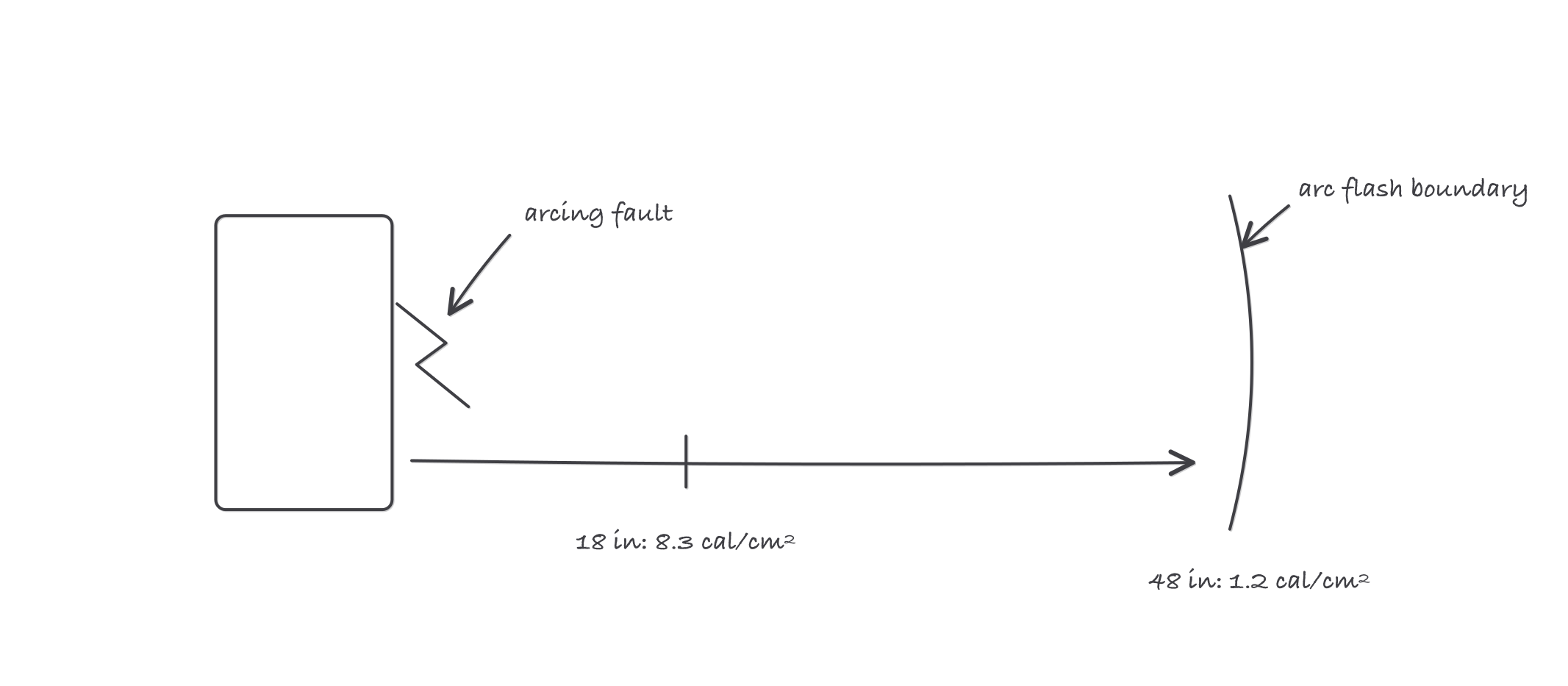
Energy falls with distance: 8.3 cal per square centimeter at the worker’s 18 inches, dropping to the 1.2 burn threshold at the 48 inch boundary
Where it bites
- De-energized is the only zero. Every calculation, boundary, and layer of PPE manages a residual risk that vanishes when the circuit is made electrically safe. PPE is the last line, never the plan.
- Racking and switching count. Operating breakers under load and racking equipment in or out are classic arc-flash moments even though “no one is working on anything.”
- The blast is more than heat. Pressure waves throw workers, rupture eardrums, and turn hardware into shrapnel. Arc-rated clothing addresses the burn; distance and de-energization address the rest.
- Old labels lie. An analysis from before the utility upgraded the transformer understates today’s energy. Check the label date against the one-line’s history before trusting it.