Learn · Electrical
Subpanels
Part of Journeyman Electrician Exam Prep · step 48 of 73 · next: Overcurrent Protection Fundamentals
In learning paths: Journeyman Electrician Exam Prep
Assumes you know: Panelboards and Load Centers, Equipment Grounding Conductors
A subpanel is any panelboard downstream of the service equipment, fed by a feeder instead of by service conductors. Electrically it is the same equipment you met in Panelboards and Load Centers; what changes is one rule that trips up more installers than any other: in a subpanel, neutrals and equipment grounds stay separate.
Why it matters on the job
Subpanels are everywhere: garages, additions, shops, tenant spaces, machine rooms. The neutral-to-ground separation is the classic inspection failure and the classic found-defect in service upgrades, and understanding why the rule exists, not just that it exists, is what lets you diagnose the weird symptoms a bonded subpanel causes: tingling appliance frames, nuisance GFCI trips, current on metal conduit.
One bond, at the service, only
The grounded (neutral) conductor and the equipment grounding system are connected together exactly once: the main bonding jumper at the service equipment. From that point downstream, the NEC (Article 250) keeps them apart so that normal load current has exactly one path back to the source, the neutral.
Practically, a subpanel installation means four things:
- Four-wire feeder: two hots, a neutral, and an equipment grounding conductor, the EGC you sized in Equipment Grounding Conductors.
- Bonding screw or strap removed so the neutral bar floats from the enclosure.
- Separate ground bar bonded to the enclosure for all EGCs.
- Neutrals on the neutral bar only, grounds on the ground bar only, never mixed.
Bond neutral to ground a second time in the subpanel and the two systems become parallel conductors. Neutral current now divides between the neutral and everything bonded to the EGC path: the ground wire, metal conduit, maybe water pipe. Metal parts you can touch become part of a current-carrying circuit.
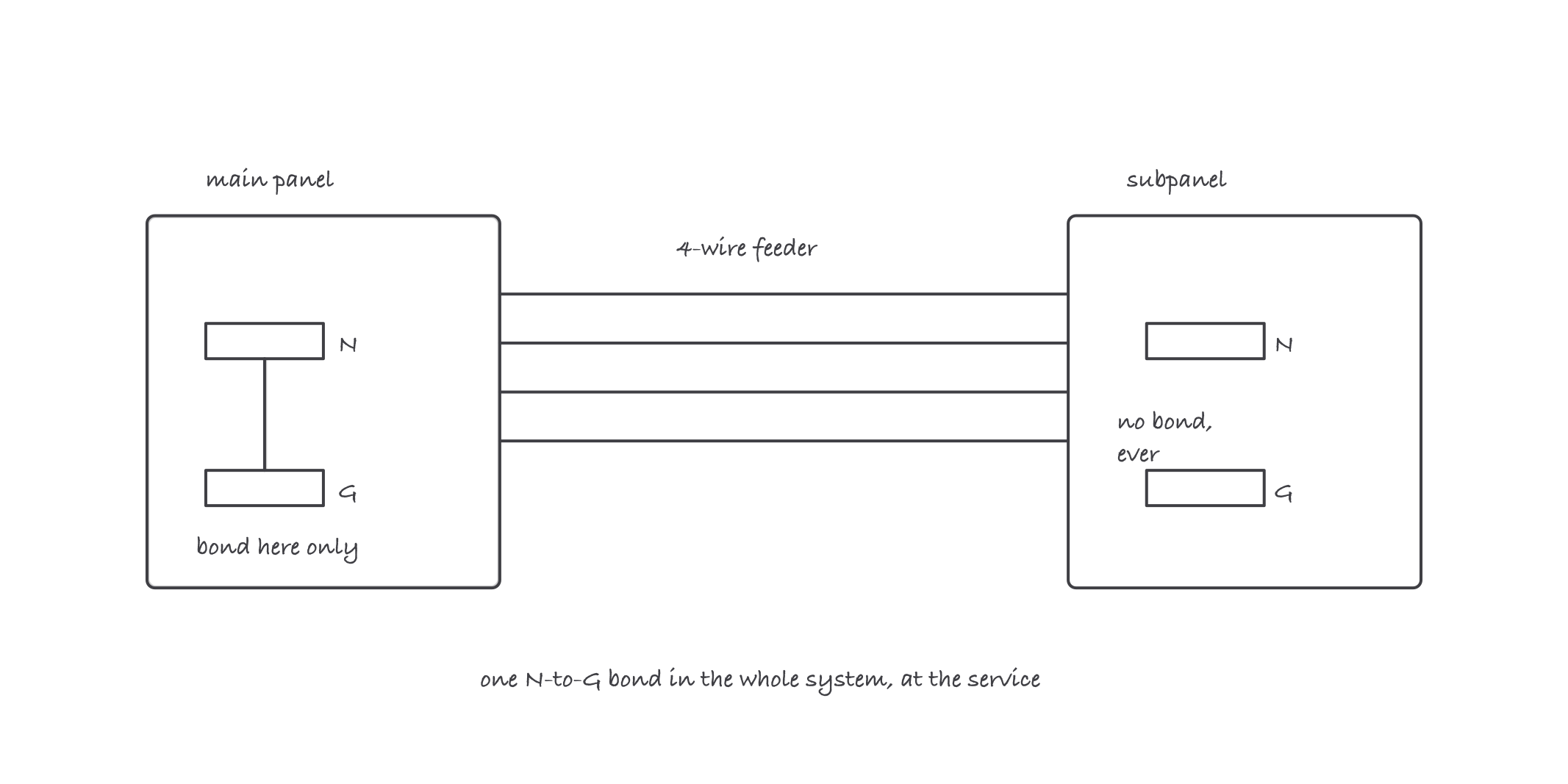
Four wires out, one bond total: neutral current has one intended path home
Worked example
A subpanel serves 120 V loads drawing a combined 20 A of neutral return current. Someone left the bonding screw in.
The neutral conductor and the EGC now run in parallel from subpanel to main panel. Suppose the two paths have equal resistance: current divides evenly, 20 ÷ 2 = 10 A flows on the equipment grounding conductor, its conduit, and every enclosure bonded along the way. If the EGC path had half the resistance of the neutral, it would carry two-thirds of the current: 13.3 A on parts never meant to carry load.
Now remove the bonding screw. EGC current returns to 0 A, all 20 A flows on the neutral, and the grounding system goes back to its real job: carrying fault current only, for the seconds a fault exists.
Where it bites
- Old three-wire feeds to detached buildings. Earlier Code editions permitted three-wire subpanel feeds with rebonded neutrals under conditions. Existing installs may be legal as installed, but new work is four-wire, and extending an old three-wire feed drags you into current rules.
- The bonding screw ships installed. Manufacturers include the bond because they cannot know where the panel will land. Removing it in a subpanel is on you, and it is the single most-missed step.
- “It works fine” proves nothing. A rebonded subpanel operates normally. The defect only shows up as stray current, corroded connections, and shock incidents. This is a rule you follow on principle, not symptoms.