Learn · Electrical
Resistance
Part of Journeyman Electrician Exam Prep · step 3 of 73 · next: How Ohm's Law Works
Part of Electrical Foundations · step 4 of 19 · next: How Ohm's Law Works
In learning paths: Journeyman Electrician Exam Prep · Electrical Foundations
Assumes you know: Atoms and Electric Charge
Resistance is opposition to current flow, measured in ohms (Ω). Every material has it: copper very little, rubber enormously, and everything in a circuit somewhere between. Resistance is why conductors are copper, why insulation works, why loads do their jobs, and why bad connections get hot.
Why it matters on the job
Resistance wears three different hats in your work, and telling them apart is the skill:
- In conductors, resistance is the enemy, it wastes voltage and makes heat. Wire tables, conductor sizing and the voltage-drop calculation all exist to manage it.
- In loads, resistance is the point. A heating element is a resistor doing its job; the resistance is where electrical energy becomes useful heat.
- In insulation, resistance is protection, material so opposed to flow that current stays where it belongs.
The same property, wanted or unwanted depending on where it appears.
The concept
Resistance depends on four things: material (copper conducts better than aluminum, far better than steel), cross-section (thicker wire, less resistance, the entire logic of wire gauge), length (twice the wire, twice the resistance, the seed of the voltage-drop lesson), and temperature (hotter conductors resist more, which is why a cold measurement understates a running circuit).
On your meter, resistance is the ohms range, measured only on dead circuits, because the meter works by pushing its own small current through the path.
Worked example
A heating element is rated 240 V, 4,800 W, by design its resistance works out to 12 Ω. Your meter reads it at 12.1 Ω: healthy. A second, identical element reads 24 Ω: elements are often built as two parallel sections, and when one section fails open the remaining path has double the resistance, so at the same 240 V it produces half the designed heat. A third reads OL (infinite): fully open, no path at all. One quantity, three diagnoses, this is why the ohmmeter is the heater tech’s best friend.
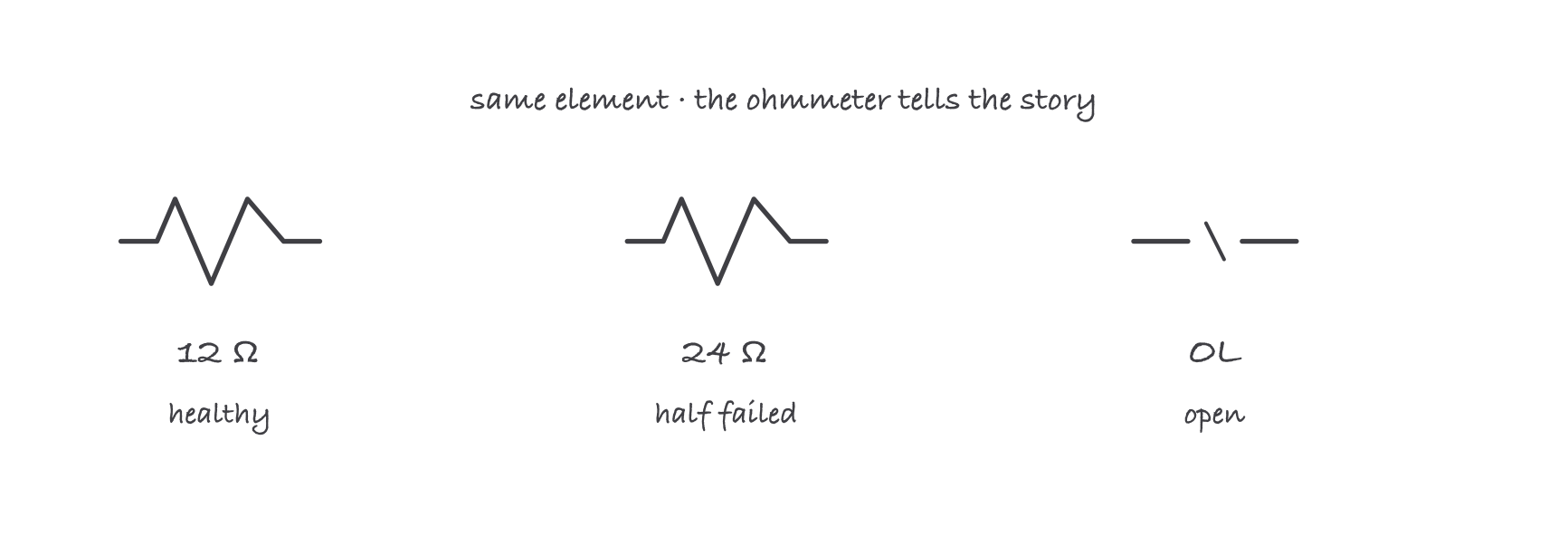
Same element, three futures: the ohms range reads them apart
Where it bites
- The dangerous resistance is the small, wrong one. A connection that should be near 0 Ω but reads 2 Ω does not sound like much, but at 20 A it drops 40 V and dissipates 800 W of heat at that single point. Warm terminations are resistance announcing itself.
- Never measure ohms on a live circuit, it endangers the meter and lies anyway.
- Body resistance varies enormously with skin, moisture and contact, which is why no fixed “safe voltage” exists.
Exam relevance
Resistance behaviour feeds directly into Ohm’s law, series/parallel combination rules, and conductor-property questions. The wire-length and cross-section relationships appear as calculation questions in their own right.