Learn · Electrical
Capacitance
Part of Electrical Foundations · step 14 of 19 · next: Inductance
In learning paths: Electrical Foundations
Assumes you know: Sine Waves and Frequency
Capacitance is a circuit’s ability to store charge, and with it, resistance to change in voltage. A capacitor is two conductive plates separated by an insulator: current cannot cross the gap, but charge piling up on one plate pushes charge off the other, so the circuit around the capacitor still sees current flow whenever the voltage is changing. On AC the voltage never stops changing, so a capacitor passes AC while blocking DC, and it does so with a twist that mirrors the inductor exactly.
Why it matters on the job
You meet capacitors as components: motor start and run capacitors, power factor correction banks, filter capacitors in drives and electronics. You also meet capacitance as a stored-energy hazard, because a charged capacitor does not care that the breaker is open. And conceptually, capacitance is the other half of reactance: without it, impedance and power factor are only half a story.
The concept
Opposition that shrinks with frequency. A capacitor’s opposition to AC is capacitive reactance, XC, in ohms:
XC = 1 / (2πfC)
where C is capacitance in farads (F); working sizes are microfarads (µF), millionths of a farad. Notice the formula is upside down compared with the inductor: raise the frequency and XC falls, because faster voltage swings shuttle more charge per second. At DC, where f is zero, XC is infinite: a healthy capacitor blocks steady current completely.
The current shift, mirrored. In a capacitor the current must arrive first: charge has to flow onto the plates before the voltage across them can rise. In a pure capacitor, current leads the voltage by 90 degrees. This is the second half of ELI the ICE man: in a capacitor (C), current (I) comes before voltage (E). ICE. Inductive current lags; capacitive current leads; the two shifts are opposites, and the impedance lesson uses that opposition directly.
Stored energy. A capacitor holds its charge, and its voltage, after the supply is removed. The energy in the electric field between the plates waits for a path, and that path can be you.
Worked example
A 50 µF motor run capacitor sits on a 240 V, 60 Hz supply.
- XC = 1 / (2πfC) = 1 / (2 × 3.1416 × 60 × 0.000050) = 1 / 0.01885 = 53.1 Ω
- Current: I = E / XC = 240 / 53.1 = 4.5 A, leading the voltage by a quarter cycle
That 4.5 A is a real, meterable current in the conductors feeding the capacitor, even though no electron ever crosses the gap between the plates. Halve the capacitance to 25 µF and XC doubles to 106.1 Ω, and the current falls to 2.3 A: one reason a weak run capacitor shows up as changed current draw and a motor that hums or underperforms.
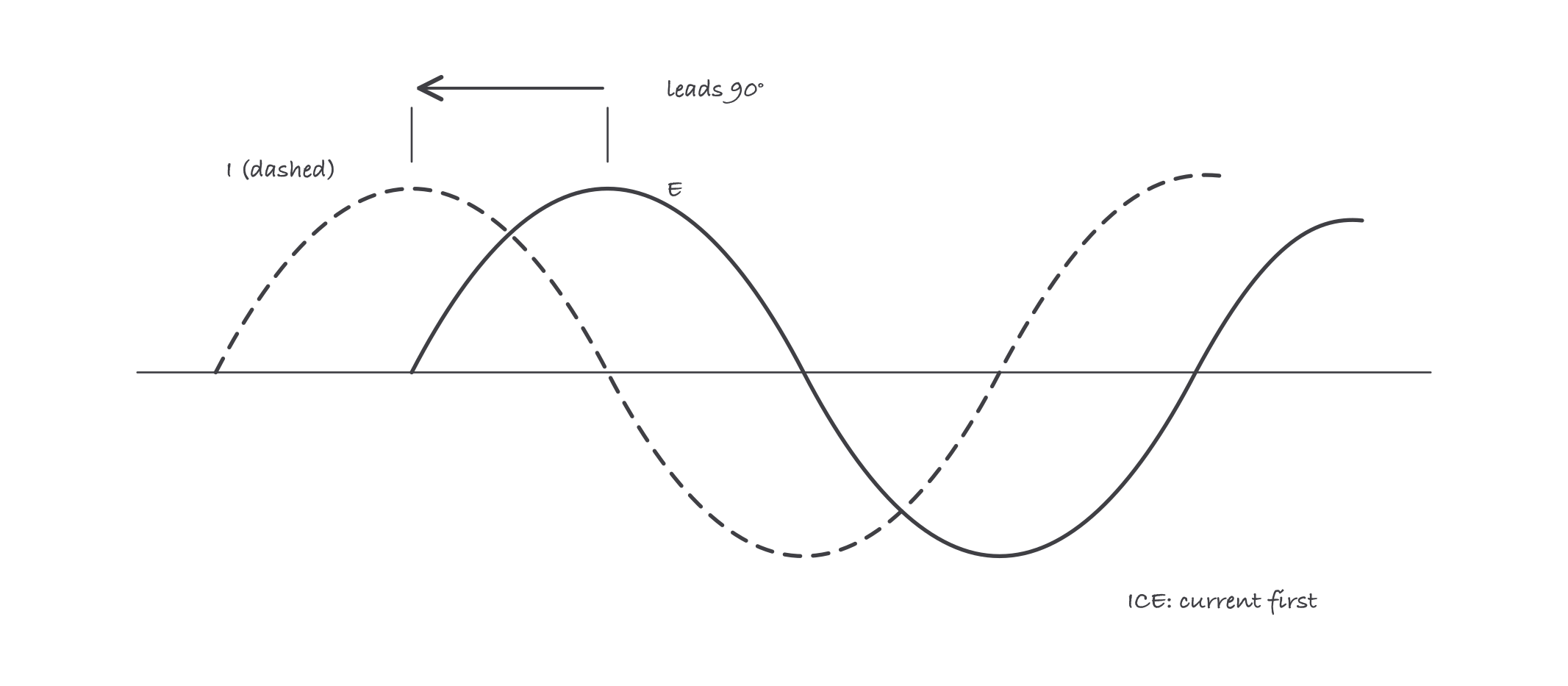
ICE: in a capacitor, current arrives first and voltage follows
Where it bites
- Capacitors stay charged. A start or run capacitor, or a drive’s DC bus, can hold a lethal charge long after disconnection. Treat capacitors as live until verified discharged; many have bleed resistors, none deserve blind trust.
- The µF rating is not decoration. Replacing a motor capacitor with a “close enough” value changes XC, the current, and the phase shift the motor was designed around. Match the rating, and the voltage class.
- Leads and lags trip people in the mirror. ELI the ICE man exists because the two shifts are perfectly opposite and easy to swap under exam pressure. Inductor: current late. Capacitor: current early.
- A capacitor across the line still draws current. New meter users see amps flowing into a device that “blocks current” and doubt the clamp. The clamp is fine; the charge is shuttling, not crossing.
Exam relevance
XC = 1/(2πfC) appears alongside its inductive twin, with unit conversion from microfarads as the built-in trap: 50 µF must become 0.000050 F before the arithmetic starts. Concept questions test the lead-lag pair, and “current leads voltage in a capacitive circuit” must be automatic. ELI the ICE man is worth the space it takes in your head.