Learn · Electrical
Residential Load Calculations
Part of Journeyman Electrician Exam Prep · step 27 of 73 · next: Conductor Types and Insulation
In learning paths: Journeyman Electrician Exam Prep
Assumes you know: Demand Factors
A residential load calculation totals a dwelling’s loads, applies the demand factors the code book grants, and produces the volt-amperes the service and feeder must carry. The standard method is a fixed sequence: general loads, appliances, dryer, range, heat or air conditioning, sum, convert to amps. Run in order, it is bookkeeping, not theory.
Why it matters on the job
Every service upgrade quote, every panel swap, every “can this house take a car charger” question starts here. Guess and you either sell a customer an upgrade they did not need or leave them with a service that cannot carry what is installed. The calculation is also a permit document: many jurisdictions want it on paper with the application.
The standard method, in order
1. General lighting and receptacles: 3 VA per square foot of dwelling area, using the outside dimensions and habitable space.
2. Small appliance and laundry circuits: 1,500 VA for each required small-appliance circuit (minimum two) and each laundry circuit (minimum one).
3. Apply the general demand factor to the sum of steps 1 and 2: first 3,000 VA at 100 %, the remainder at 35 %.
4. Fixed appliances: nameplate VA of everything fastened in place (water heater, dishwasher, disposal, built-in microwave) at 100 %, or at 75 % when there are four or more.
5. Dryer: nameplate or 5,000 VA, whichever is larger.
6. Range: from the range demand table, 8,000 VA for a single range up to 12 kW.
7. Heat or air conditioning, not both: they cannot run simultaneously, so only the larger rides in the total. Fixed electric heat at 100 %.
8. Sum and convert: total VA ÷ 240 V = service amperes; round up to a standard service rating.
Worked example
An 1,800 ft² house: two small-appliance circuits, one laundry circuit, water heater 4,500 VA, dishwasher 1,200 VA, disposal 900 VA, built-in microwave 1,400 VA, dryer 5,000 VA, 12 kW range, 10 kW electric heat, 4,800 VA air conditioner.
- General: 1,800 × 3 = 5,400 VA.
- Small appliance + laundry: (2 + 1) × 1,500 = 4,500 VA. Subtotal 9,900 VA.
- Demand: 3,000 + (6,900 × 0.35) = 3,000 + 2,415 = 5,415 VA.
- Appliances: 4,500 + 1,200 + 900 + 1,400 = 8,000; four appliances → × 0.75 = 6,000 VA.
- Dryer: 5,000 VA.
- Range: 8,000 VA.
- Heat 10,000 beats AC 4,800: 10,000 VA.
- Total: 5,415 + 6,000 + 5,000 + 8,000 + 10,000 = 34,415 VA. 34,415 ÷ 240 = 143.4 A → a 150 A service.
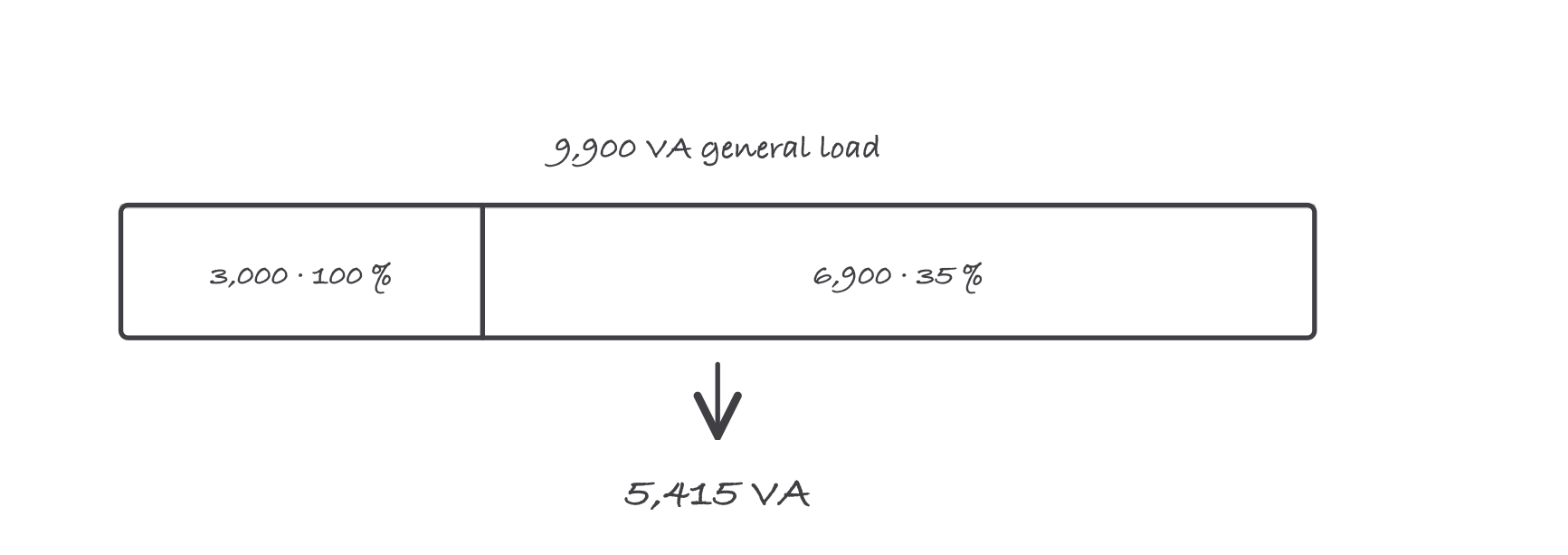
Step 3 is where the calculation earns its keep: everything past the first 3,000 volt-amperes counts at about a third
Where it bites
- Heat or AC, never both. Adding both is the single most common inflation error, and here it would have added 4,800 phantom volt-amperes.
- The 75 % appliance factor needs four appliances, counted before the dryer and range, which have their own rules and never join the appliance group.
- Square footage means the dwelling, not the lot, and open porches and garages do not count. Sloppy area measurement moves the answer.
- The optional method exists and disagrees. The code book’s optional calculation, allowed for dwellings with 100 A or larger services, uses different percentages and usually lands lower. Know which method the exam or the AHJ is asking for; mixing steps from the two is wrong in both.
Exam relevance
The full dwelling calculation is a signature master exam problem and appears in single-step fragments on journeyman exams: compute the general demand, or the range demand, or the final amperes. Errors cluster at step 3’s threshold, the heat-versus-AC choice, and dryer minimums. Lay the eight steps out in the same order every time and the long problem becomes eight short ones.
Verified requirements
| Where | Expires | Renewal | Continuing education |
|---|---|---|---|
| Texas | Yes | 1 year | 4 hours per annual renewal cycle |
Information comes from issuing-authority sources. Confirm current rules, fees and eligibility with the authority before acting.