Learn · Electrical
Equipment Grounding Conductors
Part of Journeyman Electrician Exam Prep · step 13 of 73 · next: The Grounding Electrode System
In learning paths: Journeyman Electrician Exam Prep
Assumes you know: Equipment Grounding
The equipment grounding conductor, the EGC, is the conductor that ties equipment metal to the fault-clearing network, and it is sized from the rating of the overcurrent device protecting the circuit, not from the circuit conductors. It can be a green wire, a bare wire, or the raceway itself; what matters is that it can carry the fault current the breaker’s rating implies, for as long as the breaker takes to open.
Why it matters on the job
You install an EGC with nearly every circuit you pull, and its sizing logic is the exact opposite of the GEC you learned in the last lessons. The GEC serves lightning and is sized from service conductors. The EGC serves breakers and is sized from the breaker. Mixing up the two sizing bases is the most common wrong answer on grounding exam questions, and in the field an undersized EGC is a conductor that fuses open mid-fault, leaving the enclosure energized at the worst possible moment.
Sizing and the forms it takes
Wire-type EGCs are sized from the NEC’s EGC table, keyed to the overcurrent device ahead of the circuit. The pattern for copper: 14 AWG for 15 A, 12 AWG for 20 A, 10 AWG for up to 60 A, 8 AWG for up to 100 A, 6 AWG for up to 200 A, and on up. Notice the EGC is allowed to be smaller than the circuit conductors on larger circuits: a 60 A circuit runs 6 AWG hots but only a 10 AWG EGC, because the EGC only works for seconds at a time.
One refinement matters: if you upsize the circuit conductors, for voltage drop on a long run, for example, the EGC must be upsized proportionally. The path’s impedance has to keep pace with the circuit it protects.
Raceway and cable-armor EGCs. Rigid metal conduit, IMC, EMT, and certain armored cables are themselves permitted as the EGC. A continuous, properly fitted metal raceway is a genuinely excellent fault path, more metal cross-section than any wire you would pull. Its weakness is every coupling, set screw, and locknut along the way: the permission assumes workmanship that stays tight for decades. Many spec jobs require a wire EGC inside metal raceway anyway, using the raceway as a parallel path rather than the only one.
Worked example
A detached garage gets a 60 A, 120/240 V feeder on 6 AWG copper, run 150 ft. Voltage drop math pushes the installer to upsize the hots to 4 AWG.
- Base EGC from the table for a 60 A overcurrent device: 10 AWG copper.
- The circuit conductors were upsized from 6 AWG (26,240 circular mils) to 4 AWG (41,740 circular mils): ratio = 41,740 ÷ 26,240 = 1.59.
- The EGC’s area must scale by the same ratio: 10 AWG is 10,380 circular mils; 10,380 × 1.59 = 16,504 circular mils.
- The smallest standard conductor at or above 16,504 circular mils is 8 AWG copper (16,510 circular mils). The feeder gets an 8 AWG EGC.
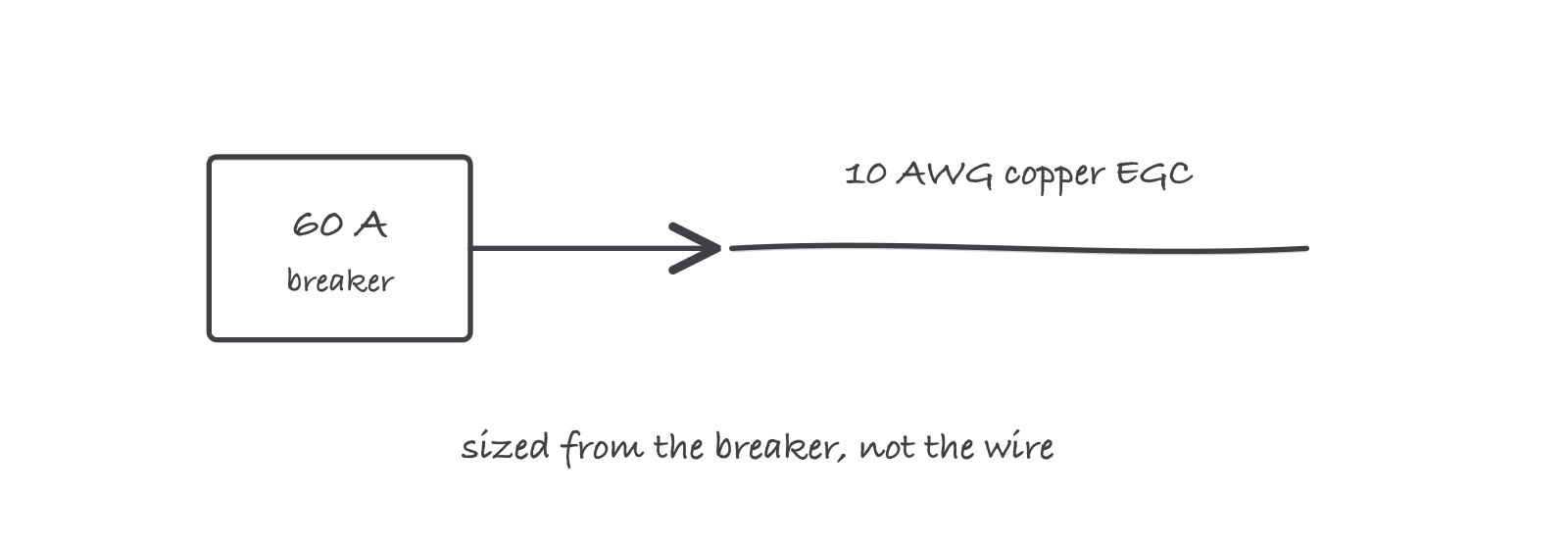
The EGC keys on the overcurrent device: a 60 A breaker calls for a 10 AWG copper EGC no matter what size the circuit conductors are, until you upsize them
Where it bites
- EGC sized from the conductors instead of the breaker is the standing classic error, in both directions: oversizing wastes copper, undersizing builds a fuse into your safety path.
- The proportional upsizing rule is the one everyone forgets. Long runs get fat hots for voltage drop; the EGC quietly stays at table size and the installation is wrong. The ratio math takes one minute.
- Flexible metal conduit is the trap within the raceway permission. Flex and liquidtight qualify as EGCs only in short lengths on smaller circuits with fittings listed for grounding; most flex whips to motors and equipment need a wire EGC pulled inside.
- One EGC can serve multiple circuits in the same raceway, sized for the largest overcurrent device among them, a legitimate saving that surprises people who have never read the permission.
Exam relevance
EGC sizing from the overcurrent device table is tested on every journeyman and master exam, usually several times: straight lookups, then the proportional upsizing calculation like the worked example, which is a master-exam staple. Expect questions on which raceways qualify as EGCs and the flex limitations, and definition items separating the EGC from the grounded conductor. Know the copper table pairings by heart; the circular-mil ratio method earns the harder marks.
Verified requirements
| Where | Expires | Renewal | Continuing education |
|---|---|---|---|
| Texas | Yes | 1 year | 4 hours per annual renewal cycle |
Information comes from issuing-authority sources. Confirm current rules, fees and eligibility with the authority before acting.