Learn · Electrical
The Effective Fault-Current Path
Part of Journeyman Electrician Exam Prep · step 10 of 73 · next: Equipment Grounding
In learning paths: Journeyman Electrician Exam Prep
Assumes you know: Grounding vs Bonding
The effective ground-fault current path is a deliberately built, low-impedance metal route that carries fault current from the point of failure back to the source, so much current that the overcurrent device has no choice but to open. It is the single mechanism that makes bonding a life-safety system, and the NEC names it as a concept because everything else in this subject exists to build it.
Why it matters on the job
Every bonding rule you will ever apply, jumpers, bushings, green screws, conductor sizing, exists to keep this one path intact and low-impedance. When a fault happens, electrons do not read code books. They take the paths available, in proportion to impedance. Your job is to make sure the best path by far is the one you built on purpose: metal, continuous, and aimed straight back at the source. A missing locknut or a painted enclosure surface is not a detail; it is a break in the only system that turns a fault into a tripped breaker instead of an energized cabinet.
What makes the path effective
Three properties, and losing any one of them loses the protection:
It is permanent and continuous. Every joint, from the faulted enclosure through raceways, conductors, and busbars back to the source, must stay conductive for the life of the installation. Paint, rust, loose fittings, and plastic bushings all interrupt it.
It has ample capacity. The path must survive the fault current long enough for the breaker to open. This is why equipment grounding conductors are sized to the overcurrent device: a path that fuses open during the fault protects nothing.
It is low impedance, back to the source. Fault current returns to the transformer that produced it, not to the earth. Low impedance is what forces the current high enough to reach the breaker’s instantaneous trip range, and high current is the whole point: a fast trip needs a violent surge.
Worked example
A 120 V circuit on a 20 A breaker faults hot-to-enclosure in a metal junction box.
- The bonded path back to the source, EGC to panel, main bonding jumper, service neutral to the transformer, totals about 0.08 Ω of impedance.
- Fault current = 120 V ÷ 0.08 Ω = 1,500 A.
- That is 75 times the breaker’s 20 A rating. A typical thermal-magnetic breaker’s instantaneous element fires at roughly 10 times rating, so 1,500 A trips it in about a cycle, under 20 milliseconds.
The enclosure is energized for less time than it takes the light to flicker. Compare the earth-only route from the previous lesson, 4.8 A forever, and you see the entire safety system in two numbers.
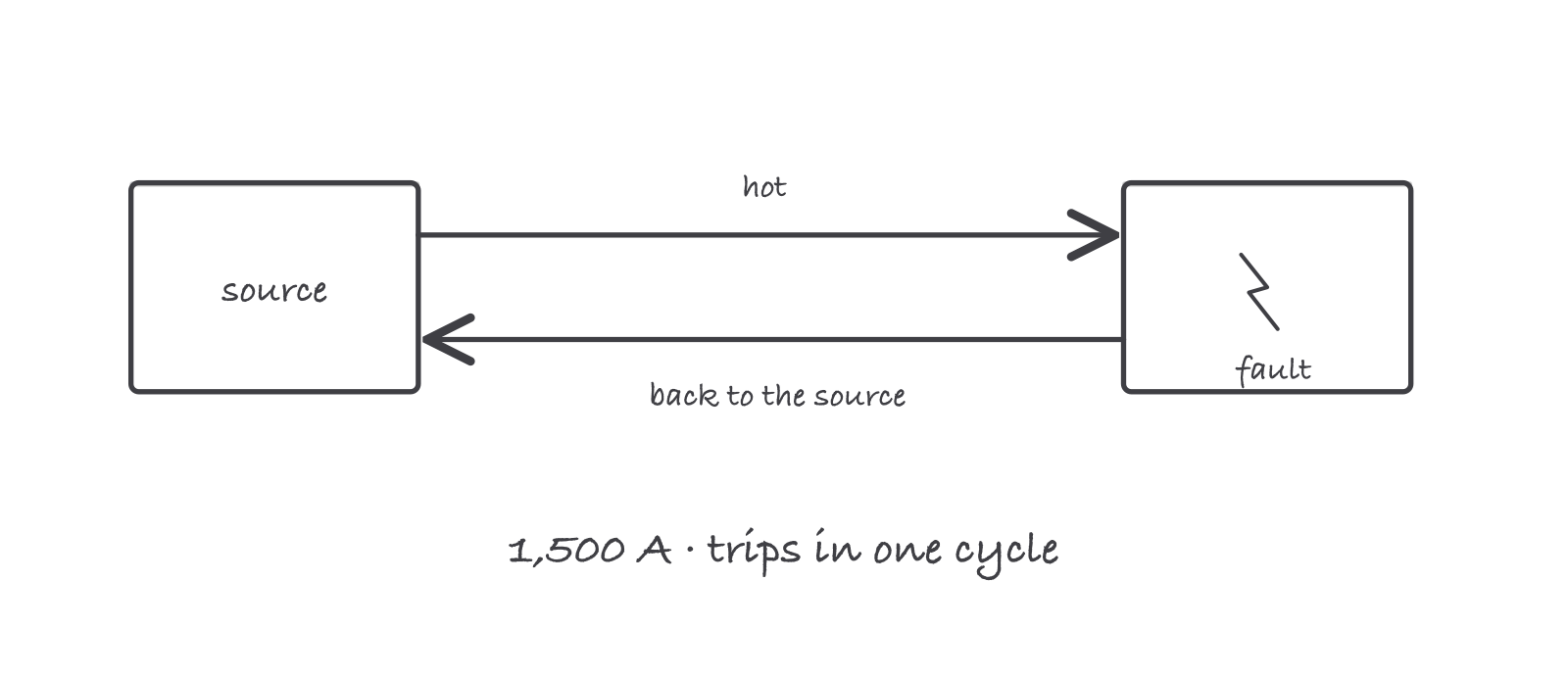
Fault current is a round trip: out on the hot, a spark at the failure, and home to the source on the bonded path, huge and brief by design
Where it bites
- Current returns to the source, not to earth. The phrase “current wants to go to ground” is folk physics. It wants to return to the transformer winding it left. Design every path with that destination in mind.
- The path is series-connected, so one bad joint ruins all of it. Ten perfect fittings and one rusted one add up to an open circuit at the worst moment. Impedance you cannot see is still impedance.
- Wire-pulling shortcuts show up here. An EGC left off “because the conduit is the ground” is legal only when the conduit run genuinely qualifies and is genuinely continuous, every coupling, every set screw.
- High impedance does not mean no shock, it means endless shock. A marginal path that lets 30 A flow may never trip a 20 A breaker quickly, while the enclosure sits at a divided but still dangerous voltage.
Exam relevance
Exams quote the NEC’s performance language nearly verbatim: the path must be permanent, continuous, of ample capacity, and low impedance, facilitating overcurrent device operation, and answer options drop one property at a time. Calculation items give you a system voltage and a path impedance and ask for fault current and whether the device opens. Master-level questions push further: identifying which installation defects break the path, and why the earth is never permitted as the sole equipment grounding path.
Verified requirements
| Where | Expires | Renewal | Continuing education |
|---|---|---|---|
| Texas | Yes | 1 year | 4 hours per annual renewal cycle |
Information comes from issuing-authority sources. Confirm current rules, fees and eligibility with the authority before acting.