Learn · Electrical
Current
Part of Journeyman Electrician Exam Prep · step 2 of 73 · next: Resistance
Part of Electrical Foundations · step 3 of 19 · next: Resistance
In learning paths: Journeyman Electrician Exam Prep · Electrical Foundations
Assumes you know: Atoms and Electric Charge
Current is the flow itself: charge in motion, measured in amperes. Voltage pushes; current is what actually moves. Wires are sized for it, breakers trip on it, and it is the thing that does the damage when electricity hurts someone. Amps are what the trade is built to control.
Why it matters on the job
Every conductor you pull, every breaker you set, every motor you connect is rated in amps. Overload a conductor and it heats; that is why ampacity tables exist and why oversized loads on undersized wire start fires. When you clamp a meter around a conductor, you are asking the only question that matters to the copper: how much charge is moving through here right now?
The concept
Current is the rate of charge flow, one ampere is one coulomb of charge passing a point each second, though in practice you will never count coulombs; you will read amps. Continuing the water analogy: voltage is pressure, current is flow rate, gallons per minute through the pipe.
What sets the flow? The pressure available and the opposition in the path: exactly Ohm’s law, two lessons from now. For now, three working truths:
- Current is the same everywhere in a single loop. In one unbroken series path, the amps entering any point equal the amps leaving it. Current does not get “used up” by a load, energy does; the charge keeps moving.
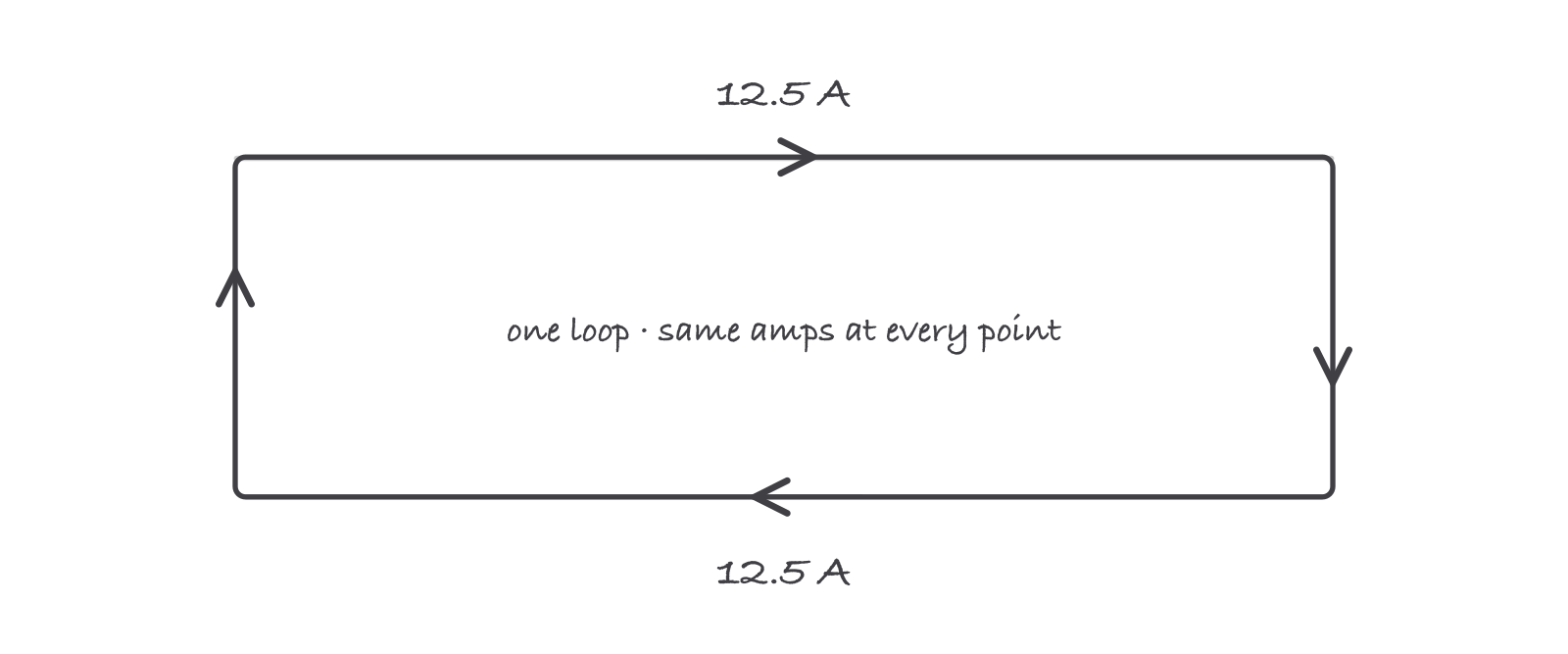
Clamp the meter anywhere on this loop and the number is the same 2. Current takes every available path, dividing between them, not only “the path of least resistance,” but more where resistance is less. That division rule is the parallel-circuits lesson. 3. Current is what heats and what harms. Conductor heating rises steeply with amps, and the human body is damaged by remarkably small currents, thousandths of an ampere across the chest. Voltage sets up the danger; current delivers it.
Worked example
A space heater draws 12.5 A on a 120 V circuit. The circuit’s conductor is rated (after applying its conditions) for 15 A: the heater alone fits. Add a 6 A air mover on the same circuit and total current is 18.5 A, the 15 A breaker will carry it briefly, heat, and trip. Nothing is broken; the arithmetic of current simply exceeded the rating, which is precisely what the breaker exists to notice.
Where it bites
- Amps, not volts, size everything. Two loads at the same voltage can differ tenfold in current; the wire cares only about the amps.
- A clamp meter reads one conductor. Clamp around a whole cable and the opposing fields cancel, the classic zero-amps-on-a-running-load mistake.
- Small numbers are not safe numbers when the path is a person.
Exam relevance
Current behaviour in series and parallel paths, conductor heating, and load calculations all build directly on this lesson, and the exams assume it the way they assume arithmetic.