Learn · Electrical
PVC Conduit
Part of Journeyman Electrician Exam Prep · step 34 of 73 · next: Flexible Raceways
In learning paths: Journeyman Electrician Exam Prep
Assumes you know: EMT
PVC conduit is rigid nonmetallic raceway: plastic pipe, solvent-welded joints, immune to corrosion and indifferent to water. Underground and in wet locations it is the default raceway, and its three quirks, no ground path, big thermal movement, and glued joints, generate every rule worth knowing about it.
Why it matters on the job
Every trench you will ever open gets PVC unless something unusual is going on. Services laterals, parking-lot lighting, feeds to detached buildings, pool equipment: wet, buried, corrosive environments are PVC’s home field. It is also the cheapest raceway per foot, which means estimators love it and exams test whether you know what the low price does not include: the equipment grounding conductor you now must pull.
Nonmetallic changes the circuit
Steel raceways can carry fault current; plastic cannot. Every PVC run contains an equipment grounding conductor, sized per the EGC table and pulled with the circuit conductors. This is the single most consequential difference from the metal raceways: the raceway stopped being part of the circuit, so a wire takes over the job.
Two schedules cover the mechanical side. Schedule 40 is the general-purpose wall. Schedule 80, thicker-walled with a smaller interior, goes where the conduit is exposed to physical damage: the risers coming up out of the ground at a pole or a building wall are the everyday example. The smaller Schedule 80 interior also changes conduit-fill answers, a direct callback to the fill lesson.
Burial depth is a cover table
Underground raceway rules are written as cover: the distance from the top of the conduit to finished grade. The code-typical pattern for PVC conduit is 18 in of cover in ordinary locations, more under driveways and roads, less in specific carved-out cases such as residential branch circuits with GFCI protection and small breakers. The numbers come from your code’s cover table, and the table’s column headings, what kind of circuit, what kind of surface above, are the exam’s favorite hiding places.
PVC moves with temperature
Plastic expands and contracts roughly five times more than steel. The code-typical coefficient is about 4 in of movement per 100 ft per 100 °F of temperature swing. Buried pipe stays at a stable temperature; exposed runs do not, and a long run glued rigid at both ends will bow in summer and pull a coupling apart in winter. Where the expected movement exceeds the small figure the code allows you to ignore, roughly a quarter inch in the classic pattern, an expansion fitting, a glued barrel with a free-sliding piston, absorbs the travel.
Worked example
A 100 ft Schedule 40 run leaves a building, feeds a detached shop, and returns above grade at both ends. The exposed wall sections face the sun:
- Trench: 18 in of cover, pattern value, checked against the cover table for the circuit type.
- Risers at each end: Schedule 80, exposed to damage where lawn equipment lives.
- Conductors: circuit conductors plus an EGC, all wet-location rated, THWN-2 from the insulation lesson.
- The 40 ft of exposed run on the sunny wall sees a 75 °F seasonal swing. Movement = 4 in × (40 ÷ 100) × (75 ÷ 100) = 1.2 in. That is far past the ignore threshold: one expansion fitting, piston set to mid-travel at moderate temperature during install.
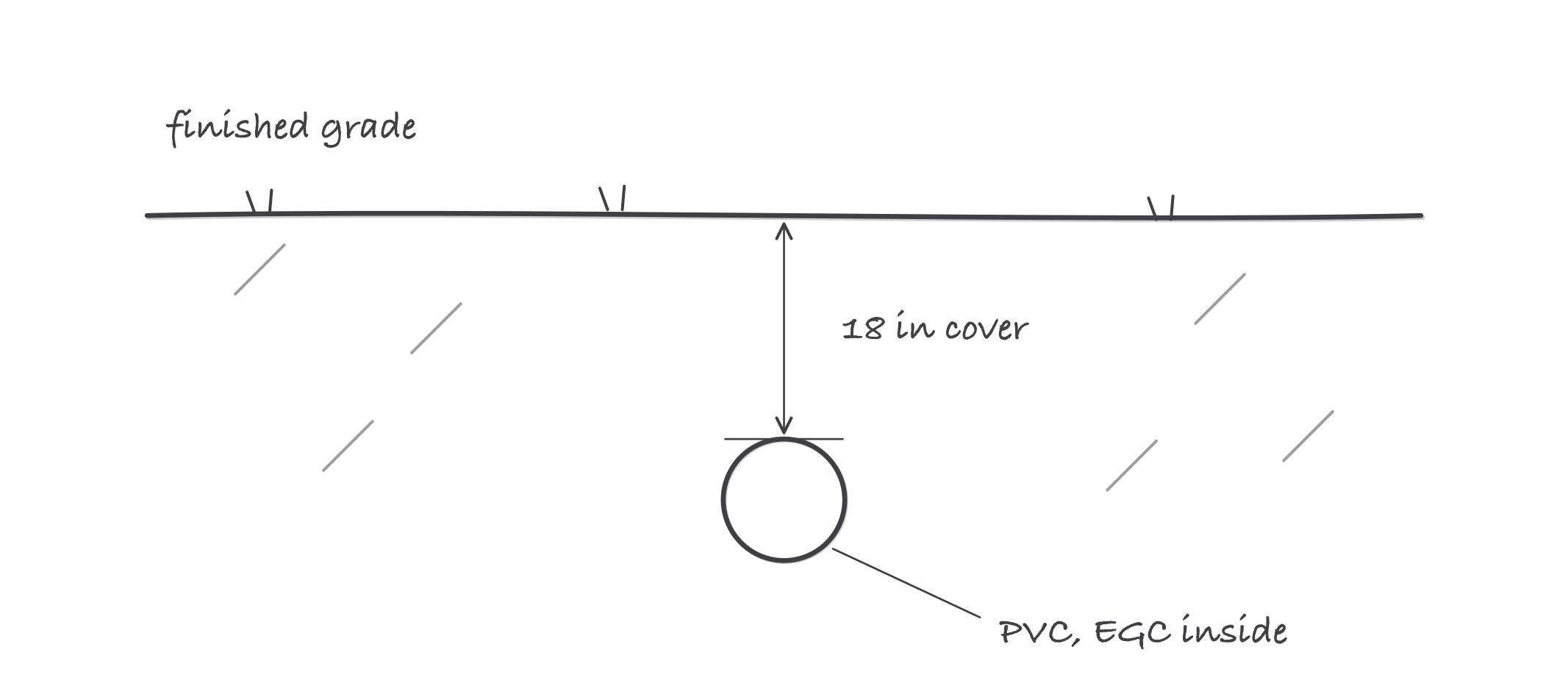
Cover is measured from the top of the pipe to finished grade: 18 in is the classic pattern for PVC, and the cover table’s columns change it
Where it bites
- The forgotten EGC. Years of metal-raceway habit make this the defining PVC mistake. No green wire, no fault path, and nothing about the finished job looks wrong from outside.
- Expansion on the wall, not in the ground. Buried PVC never needs expansion fittings; exposed PVC frequently does. Crews who learned in the trench glue exposed runs solid and meet them again, bowed, the next July.
- Cover measured to the wrong thing. Cover is grade to the top of the raceway, not to the trench bottom, and backfilling the difference does not move the pipe.
- Cold-weather cement habits. Solvent welding has temperature limits and cure times per the cement listing. A joint wiped together at 20 °F and pulled on immediately is a future dig-up.
- Schedule 40 risers. The trench part passes; the exposed stub is where damage happens and where Schedule 80 is required. Inspectors look at grade level first.
Verified requirements
| Where | Expires | Renewal | Continuing education |
|---|---|---|---|
| Texas | Yes | 1 year | 4 hours per annual renewal cycle |
Information comes from issuing-authority sources. Confirm current rules, fees and eligibility with the authority before acting.