Learn · Electrical
Equipment Grounding
Part of Journeyman Electrician Exam Prep · step 11 of 73 · next: System Grounding
In learning paths: Journeyman Electrician Exam Prep
Assumes you know: The Effective Fault-Current Path
Equipment grounding is the practice of connecting every piece of metal that could become energized, enclosures, raceways, frames, housings, to the fault-clearing network, so that a fault turns into a tripped breaker instead of an energized surface. Despite the name, it works by bonding: its power comes from the metal path back to the source, not from any connection to soil.
Why it matters on the job
Insulation fails. Wires get pinched under covers, terminals loosen, drills wear through jackets. When the failure happens, the hot conductor touches whatever metal is nearest, and one of two futures follows. Bonded metal: the fault current spikes, the breaker snaps open, and the failure becomes a service call. Unbonded metal: the enclosure quietly sits at line voltage until a hand arrives. Equipment grounding is the difference, and it is the part of the electrical system whose only job is protecting people.
How it protects
The equipment grounding network does two things at the moment of a fault, and both matter.
It clears the fault. The bonded path gives fault current a low-impedance route back to the source. Current rises far above the overcurrent device’s rating, and the device opens fast. This is the effective ground-fault current path doing its work through the metal you bonded.
It holds touch voltage down while the fault lasts. For the cycle or two before the breaker opens, the faulted enclosure and everything bonded to it rise and fall together. A person touching the enclosure and nearby bonded metal spans a small voltage difference, because the bond ties the two surfaces to nearly the same potential. Bonding does not just end the fault; it tames it while it lives.
Every normally non-current-carrying metal part that is likely to become energized gets connected to this network. Normally is the key word: the network carries current only during a fault. Any arrangement that puts everyday load current on it, like a neutral bonded to a subpanel enclosure, corrupts the system.
Worked example
A metal-cased shop grinder develops a fault: the hot lead contacts the case.
With an equipment grounding conductor. The bonded path presents about 0.15 Ω back to the source. Fault current = 120 V ÷ 0.15 Ω = 800 A. The 20 A breaker’s instantaneous element opens it in roughly a cycle. The user hears a pop and resets nothing until the tool is repaired.
Without one, an old two-wire cord: the case sits at 120 V. A user with sweaty hands and a body resistance of 1,000 Ω, standing on a damp concrete floor, completes the circuit through their chest. Current = 120 V ÷ 1,000 Ω = 120 mA. Currents in the tens of milliamps can hold muscles locked and stop a heart; 120 mA is squarely lethal, and the 20 A breaker never feels it.
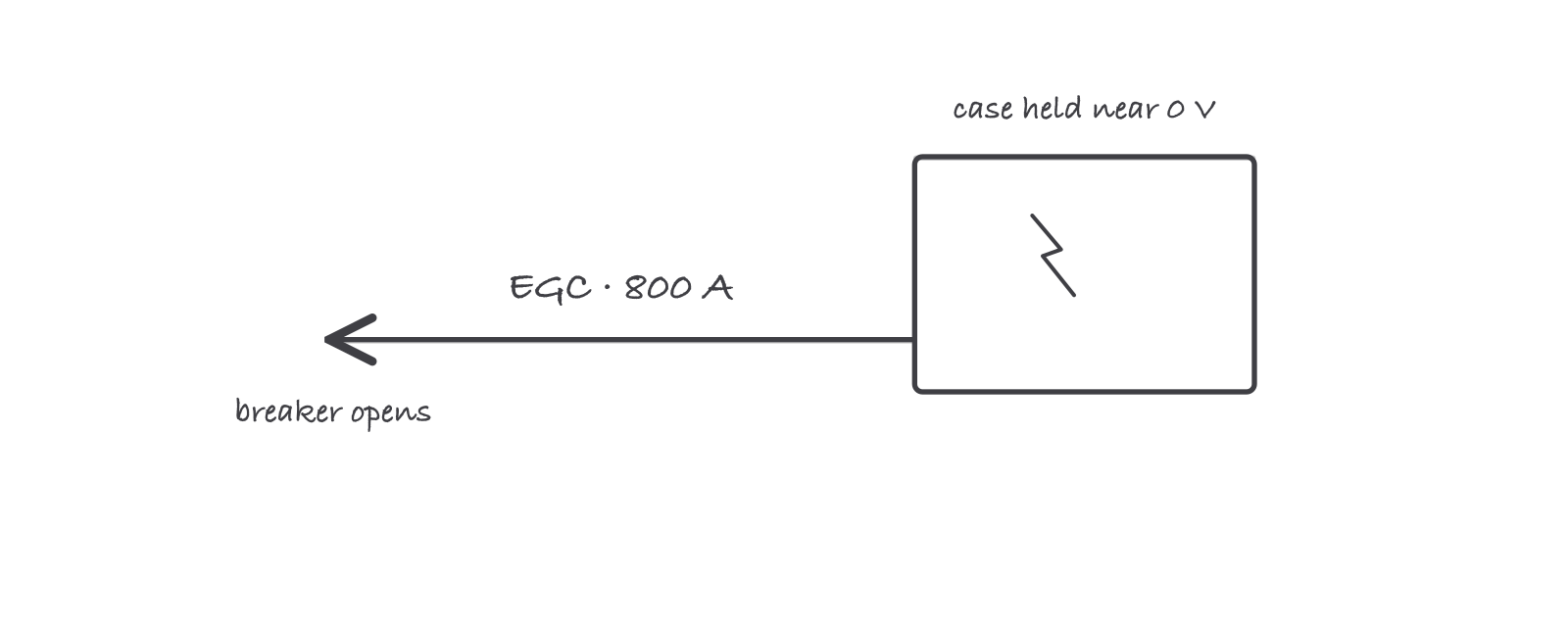
The bonded case turns a fault into a trip: current floods back on the equipment grounding conductor while the case stays near earth potential
Where it bites
- The name says grounding, the mechanism is bonding. Students who take the name literally start believing rods protect people. The case is safe because of where the green wire goes, the source, not because of the dirt.
- Double-insulated tools skip the EGC by design; their protection is the plastic case, not a bonded path. Do not add one, and do not assume metal-look housings are metal.
- A bonded network is only as good as its worst joint. Paint under a lug, a missing bonding screw, or a corroded fitting leaves an island of metal outside the system, looking identical to protected metal.
- GFCIs complement, not replace, equipment grounding. A GFCI trips on milliamps of leakage and protects even without an EGC, which is why it is the retrofit fix for old two-wire circuits, but it does not hold touch voltage down or clear high-current faults the way bonding does.
Exam relevance
Expect definition questions distinguishing the equipment grounding conductor from the grounded (neutral) conductor, and scenario questions asking what happens when each is missing, miswired, or interchanged. The lethal-current arithmetic in the worked example appears in safety-oriented items: compute body current at a given voltage and resistance and classify the hazard. Master exams probe the edge cases: double-insulated equipment, auxiliary electrodes, and why load current on the equipment grounding network violates the design.
Verified requirements
| Where | Expires | Renewal | Continuing education |
|---|---|---|---|
| Texas | Yes | 1 year | 4 hours per annual renewal cycle |
Information comes from issuing-authority sources. Confirm current rules, fees and eligibility with the authority before acting.