Learn · Electrical
Circuit Breakers
Part of Journeyman Electrician Exam Prep · step 51 of 73 · next: Short-Circuit Current and AIC Ratings
In learning paths: Journeyman Electrician Exam Prep
Assumes you know: Overcurrent Protection Fundamentals
A circuit breaker is a switch that opens itself on overcurrent and can be reset and reused, and the standard thermal-magnetic breaker is really two protective devices sharing one handle: a thermal element for overloads and a magnetic element for faults. Understanding which element trips, and why, is the difference between troubleshooting a circuit and just resetting it repeatedly.
Why it matters on the job
Breakers are the overcurrent device you touch daily. You select them, torque them onto buses, diagnose their trips, and explain them to customers. A breaker’s behavior, slow on mild overloads, instant on faults, warm to the touch under load, is exactly the behavior Overcurrent Protection Fundamentals demands of any inverse-time device, and the two-element design is how the breaker delivers it mechanically.
Two trip elements, one latch
Thermal element: a bimetal strip that load current heats. Sustained overload bends the strip until it releases the latch, and because heating takes time, the response is naturally inverse-time: 135% of rating might hold for minutes, 200% trips much sooner. Ambient temperature matters; a hot panel trips a little earlier.
Magnetic element: an electromagnet in series with the load. Fault-level current, typically several times rating and up, generates enough magnetic pull to trip the latch instantly, within a cycle or so. No waiting for heat.
Two behaviors worth memorizing. Trip-free: a breaker trips internally even if someone holds the handle closed; you cannot defeat it by force. And a tripped handle sits in a middle position: reset means pushing fully OFF first, then ON.
Beyond the standard breaker, the same frame carries added electronics in GFCI breakers (people protection, milliamp-level ground-fault sensing) and AFCI breakers (arc-signature detection), plus listed tandem breakers where panels permit them. Larger commercial breakers replace the fixed elements with adjustable electronic trip units, same two jobs, tunable settings.
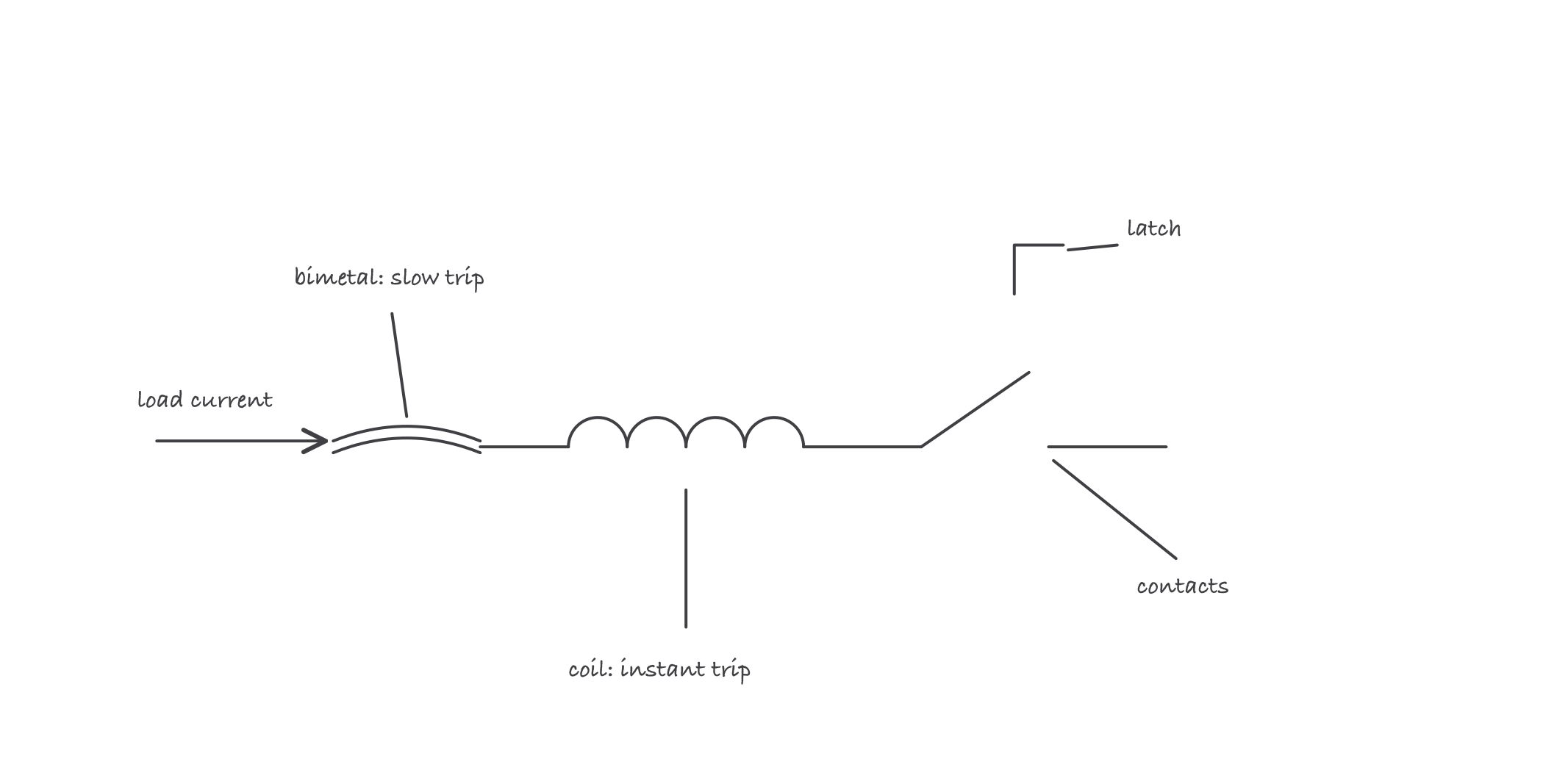
Two sensors, one latch: heat trips it slowly, magnetism trips it instantly
Worked example
A 20 A one-pole breaker, three events:
16 A continuous load. 16 ÷ 20 = 80% of rating. The bimetal warms and bends but never reaches release. Holds forever, by design, and 80% is exactly the continuous-load level circuits are designed to.
40 A overload (two heaters plus a vacuum): 40 ÷ 20 = 200% of rating. Thermal territory. The strip needs seconds to tens of seconds to bend far enough, so brief surges pass but this sustained doubling trips it. The delay is the diagnostic clue: a breaker that holds a while and then trips is telling you overload.
500 A short circuit: 500 ÷ 20 = 25 times rating. The magnetic element operates in under a cycle; the trip is instantaneous and often audible. A breaker that snaps the moment you reset it is telling you fault, stop resetting and find it.
Where it bites
- A warm breaker is normal; a hot one is a finding. Load current legitimately warms the thermal element. Excess heat usually means a loose termination or bus stab, not a bad breaker.
- Repeated resetting is not troubleshooting. Each reset closes the contacts into whatever caused the trip. Read the pattern, delayed trip or instant, then investigate accordingly.
- Multiwire and 240 V circuits need common disconnection. Two-pole breakers or listed handle ties ensure both hots open together; two independent breakers side by side do not satisfy that.
- Breakers wear. Clearing real faults erodes contacts. A breaker that has interrupted a serious fault may deserve replacement, not just a reset, and one that trips below rating has earned retirement.