Learn · Electrical
Conductor Sizing
Part of Journeyman Electrician Exam Prep · step 20 of 73 · next: Voltage Drop Calculations
In learning paths: Journeyman Electrician Exam Prep
Assumes you know: Ampacity
Conductor sizing is the method that turns a load into a wire size: compute the required ampacity, then pick the smallest conductor whose table value meets it. The arithmetic is one multiplication; the marks and the safety live in doing the steps in the right order.
Why it matters on the job
Undersize a conductor and it runs hot for the life of the installation. Oversize everything “to be safe” and you price yourself out of work and fight fat wire into small terminations. The sizing method exists so you can hit the correct size, first time, and defend it to an inspector with three lines of arithmetic.
The method
Step 1: find the load current. From the nameplate, the plans, or watts divided by volts. Know whether the load is continuous, meaning it runs for 3 hours or more, like store lighting, water heaters, or EV chargers.
Step 2: apply the 125 % continuous factor. The minimum conductor ampacity (and the branch-circuit device rating) is 100 % of the noncontinuous load plus 125 % of the continuous load. A breaker sitting at full load for hours heats its enclosure, so the code book builds in headroom by inflating the continuous portion.
Step 3: pick from the 75 °C column. Find the smallest conductor whose 75 °C ampacity meets the Step 2 number. From your code book’s table, the copper values you will use constantly: #12 = 25 A, #10 = 35 A, #8 = 50 A, #6 = 65 A, #4 = 85 A, #3 = 100 A.
Step 4: check the overriding rules. Small-conductor caps (#14/15 A, #12/20 A, #10/30 A), termination ratings, and, on long runs, voltage drop. Any one of these can force the size up a notch from what Step 3 gave you.
Worked example
A 240 V electric heater draws 40 A and runs continuously in cold weather.
- Continuous load, so required ampacity = 40 × 1.25 = 50 A.
- Smallest 75 °C copper conductor at 50 A or better: #8 (exactly 50 A).
- Breaker: also sized at 125 % = 50 A, a standard rating. #8 copper on a 50 A breaker.
- Overriding checks: no small-conductor issue at #8, terminations 75 °C, run is short. Done.
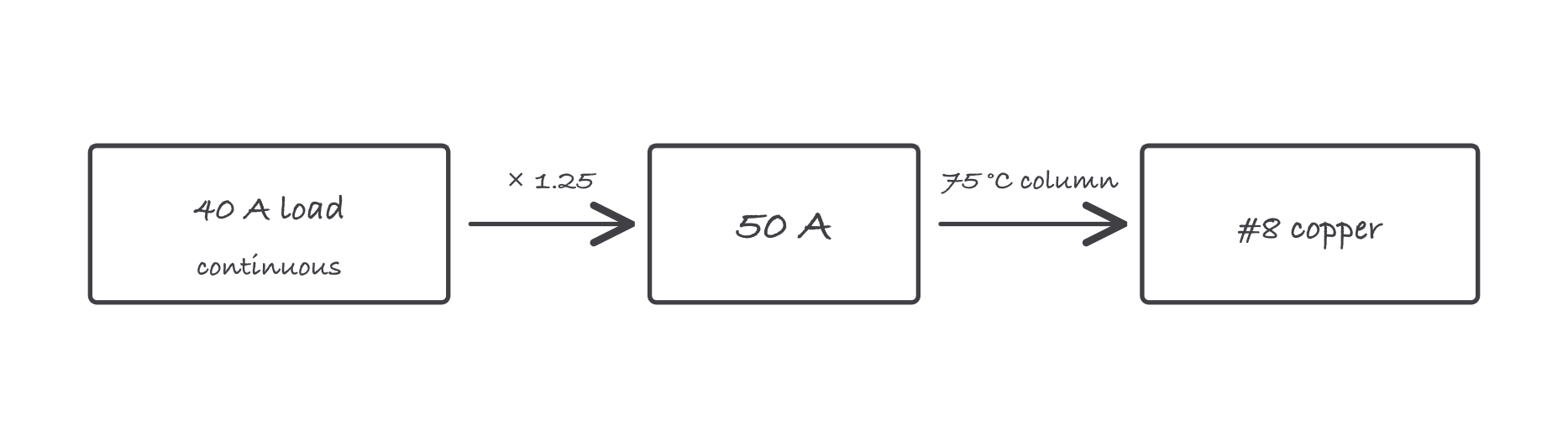
The sizing chain: load, times 125 percent if continuous, then the smallest wire that covers it
Now the contrast case: the same heater cycles on a thermostat and qualifies as noncontinuous. Required ampacity is just 40 A, and #8 at 50 A still wins because #10 tops out at 35 A. The factor did not change the wire this time, but you only know that by running the method, not by guessing.
Where it bites
- The 125 % applies to the continuous portion only. A circuit with 20 A continuous and 10 A noncontinuous needs 20 × 1.25 + 10 = 35 A, not 30 × 1.25 = 37.5 A. Mixing the two inflates the answer and the wire.
- Round up to the wire, not down to the load. If the arithmetic says 51 A, #8 at 50 A has failed by 1 A and #6 is the answer. There is no “close enough” in a table lookup.
- Sizing the wire is not sizing the breaker. They usually land together, but derating, motor rules, and taps all split them apart. Compute each on its own rule.
- Voltage drop is a separate, silent check. The method above satisfies heat. A 200-foot run can pass every step and still starve the load; run the voltage drop numbers on anything long.
Exam relevance
This is the exam’s bread and butter: a load, a duty cycle, and four wire sizes as answer options. The distractors are always the same three errors: forgetting the 125 %, applying it to the whole mixed load, or ignoring the small-conductor caps. Write the two-line calculation before looking at the options and the distractors lose their power.
Verified requirements
| Where | Expires | Renewal | Continuing education |
|---|---|---|---|
| Texas | Yes | 1 year | 4 hours per annual renewal cycle |
Information comes from issuing-authority sources. Confirm current rules, fees and eligibility with the authority before acting.