Learn · Electrical
Atoms and Electric Charge
Part of Electrical Foundations · step 1 of 19 · next: Voltage
In learning paths: Electrical Foundations
Everything in the trade traces back to one fact: atoms carry charge, and in some materials part of that charge is free to move. Electricity is not a mysterious fluid. It is loose electrons responding to a push. Understand the atom and you understand why copper conducts, why rubber does not, and what is actually moving when a circuit works.
Why it matters on the job
Every material decision in the trade rests on this lesson. Conductors are chosen because their electrons move easily; insulation is trusted because its electrons do not. When you strip a wire, you are exposing a material full of mobile charge and holding a material that has almost none. Knowing the difference at the atomic level is what makes the rest of electrical theory make sense instead of being a list of rules.
The concept
An atom has a nucleus of protons and neutrons with electrons around it. Protons carry positive charge, electrons carry an equal negative charge, and neutrons carry none. Two rules govern everything: like charges repel, and unlike charges attract. An atom with equal protons and electrons is electrically neutral.
The electrons that matter to you live in the outermost layer, the valence shell. In a conductor, those valence electrons are loosely held. Copper has a single valence electron so weakly bound that it wanders freely from atom to atom; a copper wire is a lattice of atoms swimming in a sea of free electrons, ready to drift the moment something pushes them. In an insulator such as glass, rubber, or PVC, the valence electrons are held tightly and stay home. Semiconductors sit in between, which is a story for electronics, not for this lesson.
Charge is measured in coulombs (C). One coulomb is the combined charge of about 6.24 × 10^18 electrons. An object with extra electrons is negatively charged; one with a shortage is positively charged. Charge sitting still as an imbalance is static electricity. Charge in motion is current, and the next two lessons, voltage and current, are about what pushes it and how the flow is measured.
Worked example
One ampere is one coulomb of charge passing a point every second. So when your clamp meter reads 10 A on a conductor, 10 coulombs pass the jaw each second: 62.4 billion billion electrons, 6.24 × 10^19 of them, every second.
Yet each individual electron drifts through the copper slower than a millimeter per second. The push travels at nearly the speed of light; the electrons themselves barely crawl. Picture a pipe already packed with marbles: push one in at this end and one pops out the far end instantly, even though no single marble moved more than a nudge. That is why a light responds the instant the switch closes.
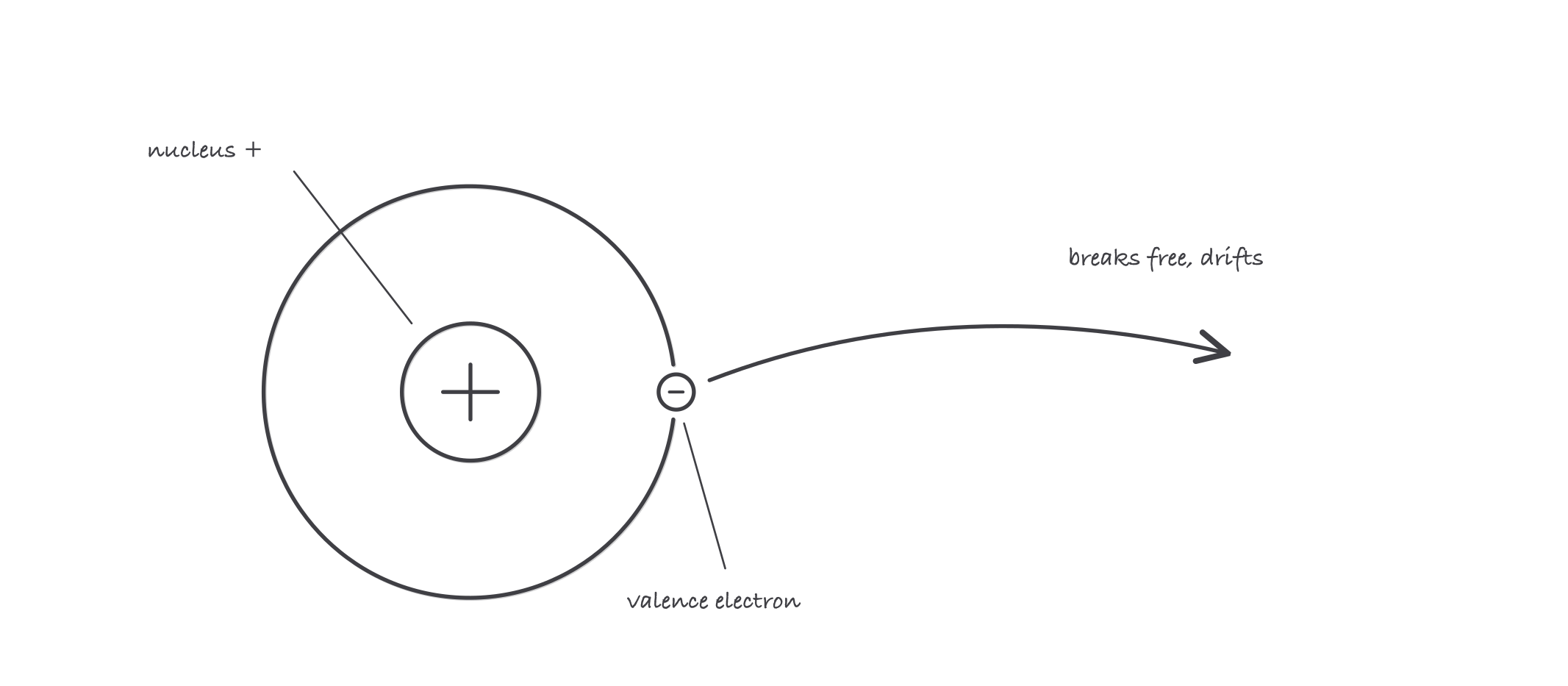
Copper’s single loosely held valence electron is the whole reason wires work
Where it bites
- The energy moves fast; the electrons do not. “Electricity travels at the speed of light” is true of the push, not the particles. Nothing physical races down the wire.
- Diagrams lie politely about direction. Conventional current is drawn flowing positive to negative; the electrons actually drift negative to positive. Every formula in the trade works either way, so follow the convention and do not lose sleep.
- Insulators are conditional, not absolute. Push the voltage high enough and any insulator breaks down and conducts. That is why insulation carries a voltage rating and why “it’s insulated” is never the whole safety story.
- Static charge bites without a circuit. An imbalance of charge with no path is still energy waiting; fuel-truck bonding straps and grounding wrist straps both exist because of this lesson.
Exam relevance
Direct atomic-theory questions are rare and easy: conductors have few loosely held valence electrons, insulators hold theirs tightly, like charges repel. What matters more is that every later topic, voltage, current, resistance, silently assumes this picture. Get it settled now so nothing built on it wobbles.