Learn · Electrical
Three-Phase Power
Part of Electrical Foundations · step 18 of 19 · next: Single-Phase vs Three-Phase Systems
In learning paths: Electrical Foundations
Assumes you know: Sine Waves and Frequency
Three-phase power is three sine waves sharing one system, each shifted one third of a cycle, 120 degrees, from the next. Three hot conductors, each cresting in turn, delivering power in an overlapping relay that never lets the total fall to zero. It is how power is generated, transmitted, and fed to every serious commercial and industrial load you will ever touch.
Why it matters on the job
Commercial and industrial work is three-phase work: panelboards with three phase busbars, motors with three leads and no starting switch, transformers in banks of three. Reading a three-phase system means knowing two voltages at once, line-to-neutral and line-to-line, and knowing why they differ by the strangest constant in the trade: the square root of 3, about 1.732. That number is not decoration; it falls straight out of the 120 degree spacing, and it runs every three-phase calculation.
The concept
Three windings, one shaft. A three-phase generator carries three identical windings spaced 120 degrees apart, so one rotation produces three identical sine waves, each displaced a third of a cycle. Phase A crests, then B, then C, then A again, an endless overlapping sequence.
Wye and delta. The three windings connect in one of two patterns. In a wye (Y), one end of each winding ties to a common neutral point; each hot then offers two voltages, line-to-neutral across one winding and line-to-line across two. In a delta, the windings close into a triangle, and line-to-line is the only native voltage. Wye is where the √3 relationship shows itself most plainly:
Line-to-line voltage = line-to-neutral voltage × √3
The factor is not 2 because the two windings crest 120 degrees apart: their voltages partially oppose, and the geometry of combining them yields 1.732.
Three-phase power. For a balanced load, total power sums across the three phases into one formula:
P = √3 × VL × IL × PF
with VL the line-to-line voltage and IL the line current.
Worked example
The workhorse commercial service: 208Y/120 V.
- Line-to-neutral: each winding delivers 120 V, so lighting and receptacles connect hot to neutral exactly as in a house.
- Line-to-line: 120 × √3 = 120 × 1.732 = 207.8, the nominal 208 V, for motors and larger equipment across any two hots.
- A balanced three-phase heater bank draws 24 A per line at 208 V, PF 1.0. Total power: P = √3 × VL × IL × PF = 1.732 × 208 × 24 × 1.0 = 8,646 W, about 8.6 kW.
Run the check backwards: 8,646 / (1.732 × 208) = 24 A. The formula inverts cleanly, which is exactly how exam questions ask it: given the kW, find the line current.
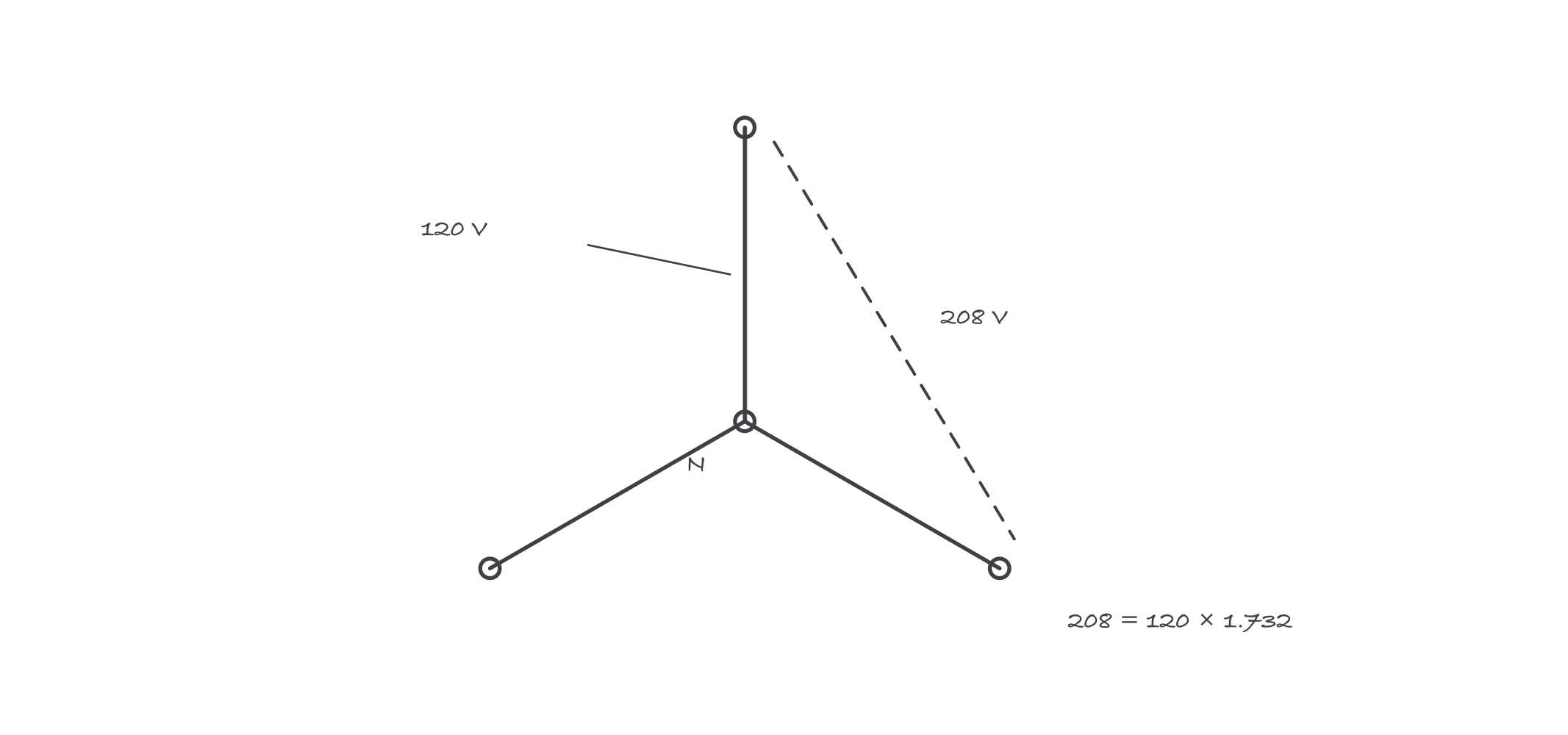
One wye, two voltages: 120 V across a winding, 208 V across two
Where it bites
- 208 V is not 240 V. A 240 V rated heating element on 208 V delivers (208/240)², about 75%, of its rated watts. Equipment “runs fine” and underperforms, and the callback says the heat is weak. Check nameplates for dual ratings.
- The neutral carries the imbalance, not the sum. In a balanced wye the three line currents cancel in the neutral. Loads never balance perfectly, so the neutral carries the difference, and on harmonic-rich loads it can carry more than expected. Never assume the neutral is idle.
- √3 belongs to line quantities in balanced systems. Applying 1.732 to a single-phase branch off the three-phase panel, or doubling 120 to guess 240 where the system delivers 208, both produce confident wrong answers.
- Phase rotation is real. Swap any two hots and every three-phase motor downstream runs backward. Rotation gets checked before energizing, not after the pump self-destructs.
Exam relevance
Three-phase calculations anchor journeyman and master exam math: P = √3 × VL × IL × PF forward and backward, and the 120/208 relationship by heart. Distractor answers are built from using 2 instead of 1.732, dropping the √3 entirely, or mixing line and phase quantities. Memorize 1.732, and let 120 × 1.732 = 208 be the fact that anchors the rest.