Learn · Electrical
Single-Phase vs Three-Phase Systems
Part of Electrical Foundations · step 19 of 19
In learning paths: Electrical Foundations
Assumes you know: Three-Phase Power
Single-phase and three-phase are the two shapes electrical service comes in, and the split is clean: homes get single-phase, serious commercial and industrial loads get three-phase. The difference is not voltage or quality; it is geometry. One alternating wave versus three overlapping ones, and that geometry decides how smoothly power flows, how motors start, and how much copper it takes to deliver a load.
Why it matters on the job
You will stand in front of unfamiliar services and equipment for your whole career, and the first question is always which system you are looking at. Two hots and a neutral, or three hots and a neutral? A motor with a start capacitor, or three bare leads? Choosing equipment, counting conductors, and quoting work all begin with the phase question, and so does the classic expensive mistake: buying a three-phase machine for a building with a single-phase service.
The comparison
Single-phase: one wave. Residential service in the US is single-phase 120/240 V, called split-phase: one transformer winding, center-tapped, giving two 120 V halves that stack into 240 V across the outside legs. The catch is in the wave: every cycle, the power delivered dips to zero at each zero crossing, 120 times a second. Lamps and heaters do not care. Motors do: a single wave produces no rotating push of its own, so single-phase motors need starting components, capacitors, extra windings, a switch, to get spinning, and those components are the parts that fail.
Three-phase: three overlapping waves. With three waves spaced 120 degrees apart, at least one phase is always pushing strongly; the combined delivery to a balanced load is smooth and constant, never dipping to zero. Three-phase motors are the payoff: the three phases create a naturally rotating magnetic field, so the motor starts itself, runs smoother, and carries no starting switch or capacitor to wear out. Simpler machine, longer life, less maintenance.
Copper. Three-phase also moves more power per pound of conductor. Delivering the same watts, a three-phase circuit divides the work across three conductors carrying less current each, which is why feeders and large equipment circuits go three-phase whenever the service allows.
Worked example
Deliver 30 kW of resistive load, PF 1.0, both ways.
Single-phase at 240 V:
- I = P / E = 30,000 / 240 = 125 A in each of the two current-carrying conductors
Three-phase at 208 V:
- I = P / (√3 × VL) = 30,000 / (1.732 × 208) = 30,000 / 360.3 = 83.3 A per line
Same watts delivered, and each three-phase conductor carries a third less current: 83.3 A against 125 A. Smaller conductors, smaller raceways, less I²R heating in every foot of run. Scale the load up and the argument only gets louder, which is why no factory runs single-phase.
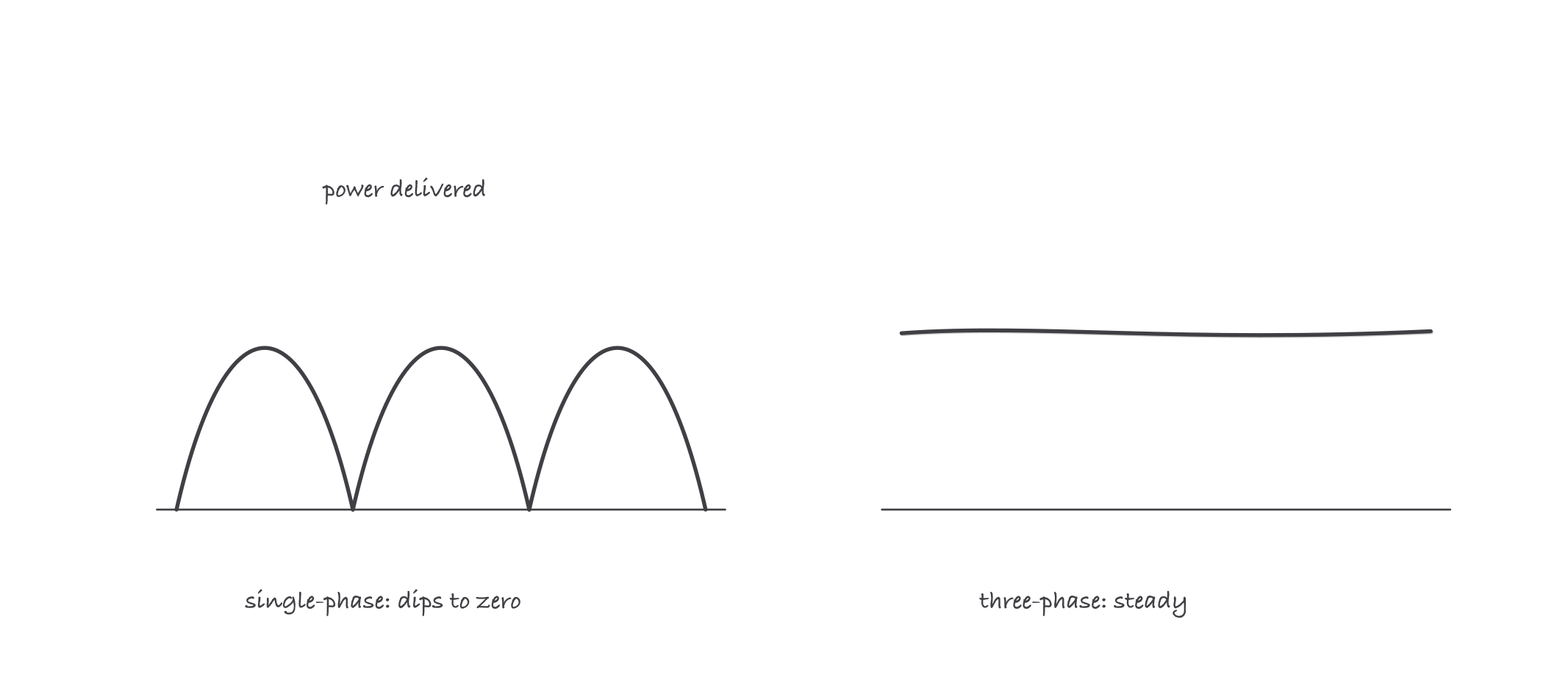
Single-phase power pulses to zero 120 times a second; three phases overlap into steady delivery
Where it bites
- Split-phase is not two-phase. Residential 120/240 V is one phase, center-tapped; the two legs are mirror images of the same wave, not phases 120 degrees apart. Calling it two-phase is wrong on exams and in orders.
- Three-phase equipment on a single-phase service does not run, and converting, with a rotary or electronic phase converter or a VFD, is an engineering decision with real cost. Verify the service before the equipment ships.
- Counting wires can deceive. Two hots and a neutral is single-phase residential; three hots is three-phase; but a three-phase panel also serves single-phase loads from any one hot and neutral. Identify the system at the service, not at the receptacle.
- Lost phase, called single-phasing, kills motors. A three-phase motor that loses one supply phase keeps running on two, overheats, and burns its windings. It is a leading cause of motor failure, and why three-phase equipment gets phase-loss protection.
Exam relevance
Exams test the comparison directly: which service type suits which load, why three-phase motors need no starting components, and current calculations in both systems, exactly the worked example’s pair. The split-phase versus two-phase distinction and the single-phasing failure mode are both reliable question material. Keep the two current formulas adjacent in your head: P/E for single-phase, P/(√3 × VL) for three-phase.