Learn · Electrical
Alternating Current
Part of Electrical Foundations · step 12 of 19 · next: Sine Waves and Frequency
In learning paths: Electrical Foundations
Assumes you know: How Ohm's Law Works
Alternating current reverses direction: the charge in the conductor surges one way, slows, stops, and surges back, over and over. In the US grid it completes 60 of those cycles every second. Every building you will ever wire runs on AC, and the reason is one device: the transformer, which only works when current keeps changing.
Why it matters on the job
You work on AC systems almost exclusively, and AC behaves in ways DC theory alone does not predict. Motors, transformers, and dimmers exist because of the alternation; power factor, inductive kick, and impedance exist because of it too. This lesson is the doorway to the whole AC group: get the picture of a current that is always changing, and the later lessons on inductance, capacitance, and three-phase power have something to stand on.
The concept
Direct current, DC, flows steadily in one direction: batteries, vehicle systems, electronics after their power supplies. Alternating current changes direction on a fixed rhythm. A generator makes it naturally: spin a coil in a magnetic field and the induced voltage rises, falls, and reverses in the smooth repeating shape called a sine wave, which the next lesson takes apart properly.
The pace is the frequency: 60 cycles per second, 60 hertz (Hz), in North America. Since each cycle contains one forward and one reverse surge, the current in your receptacle circuit reverses 120 times each second. Loads mostly do not care about the direction; a heating element makes the same heat either way, which is why the alternation is invisible until it is not.
AC won because of transmission. Power lost in a line is I²R: it depends on the square of the current, not on the voltage. A transformer trades voltage for current almost for free, so the utility steps voltage up for the journey, current falls, losses collapse, and a transformer near you steps it back down to usable levels. Transformers only induce across their windings when the field is changing, so this only works with AC. DC had no such lever when the grids were built.
Worked example
A feeder must deliver 240 kW through lines with 1 Ω of total resistance. Compare two transmission voltages.
At 2,400 V:
- I = P / E = 240,000 / 2,400 = 100 A
- Line loss: I²R = 100 × 100 × 1 = 10,000 W lost as heat, about 4.2% of the power
At 24,000 V:
- I = 240,000 / 24,000 = 10 A
- Line loss: 10 × 10 × 1 = 100 W, about 0.04%
Ten times the voltage, one tenth the current, one hundredth the loss: the square in I²R is the entire economics of the grid, and the transformer is what makes the trade possible.
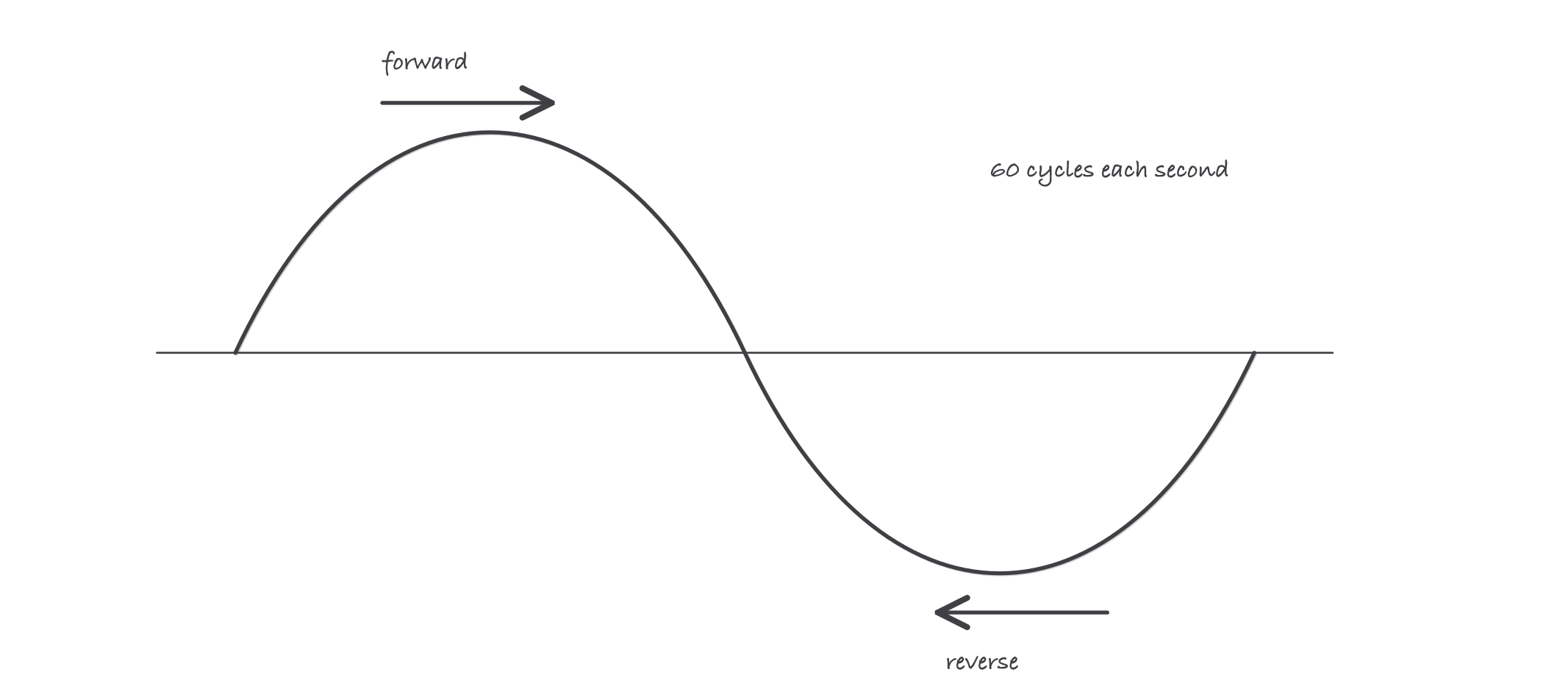
One cycle: a surge each way, 60 of these every second
Where it bites
- AC is not just wiggly DC. Ohm’s law still holds at every instant, but coils and capacitors react to the constant change in ways pure resistance never does. That is the inductance and capacitance lessons, and skipping them leaves motors unexplainable.
- “It reverses, so it lets go” is false and dangerous. 60 Hz AC is notoriously good at causing muscle grip and disrupting heart rhythm. The alternation makes it more dangerous at these levels, not less.
- Frequency is fixed and everything trusts it. Motors, clocks, and transformers are built for 60 Hz; equipment built for 50 Hz countries runs hot or wrong here. Check nameplates on imported gear.
Exam relevance
Exams assume the AC picture silently: why transformers exist, why transmission is high voltage, what 60 Hz means. Direct questions are usually the transmission-loss arithmetic in the worked example, I²R with a transformer in the story, and they are gift marks if the square is respected.