Learn · Electrical
Series-Parallel Circuits
Part of Electrical Foundations · step 10 of 19 · next: Meters and Measurement
In learning paths: Electrical Foundations
Assumes you know: Series Circuits, Parallel Circuits
A series-parallel circuit is both at once: parallel groups strung into a series path, or series strings sitting in parallel branches. No new physics arrives with it. Series rules govern the series parts, parallel rules govern the parallel parts, and the whole skill is knowing which rule applies where.
Why it matters on the job
Real circuits are combinations. A branch circuit’s conductor resistance is in series with a set of parallel loads. A control circuit strings series switches ahead of parallel pilot lights. Nearly every voltage-drop complaint you will ever chase is a series-parallel problem: the wire in series, the loads in parallel, and the symptom living exactly where the two meet. Solving these on paper is also the calculation style licensing exams lean on hardest in the theory section.
The method
Reduce, then rebuild. Every series-parallel problem yields to the same three passes:
- Collapse each parallel group into one equivalent resistance using reciprocals or product over sum. The circuit becomes a plain series loop.
- Solve the series loop: add the resistances, find the one loop current, find each voltage drop.
- Rebuild: the voltage across each collapsed group is now known, so open the group back up and find each branch current with Ohm’s law.
Work in that order every time. The most common failure is reaching for a formula before the circuit has been reduced to something a formula fits.
Worked example
A 120 V source feeds an 8 Ω resistance in series with a parallel pair: 20 Ω and 30 Ω.
Collapse the pair:
- Rp = (20 × 30) / (20 + 30) = 600 / 50 = 12 Ω
Solve the series loop:
- Rt = 8 + 12 = 20 Ω
- I = E / Rt = 120 / 20 = 6 A through the source and through the 8 Ω
- Drop across the 8 Ω: 6 × 8 = 48 V
- Drop across the pair: 6 × 12 = 72 V. Check: 48 + 72 = 120 V.
Rebuild the pair:
- 20 Ω branch: 72 / 20 = 3.6 A
- 30 Ω branch: 72 / 30 = 2.4 A
- Check: 3.6 + 2.4 = 6 A, exactly the loop current. The books balance at every stage.
Both branches see 72 V, not 120 V, because the series 8 Ω already took its 48 V share. That single sentence is the whole lesson.
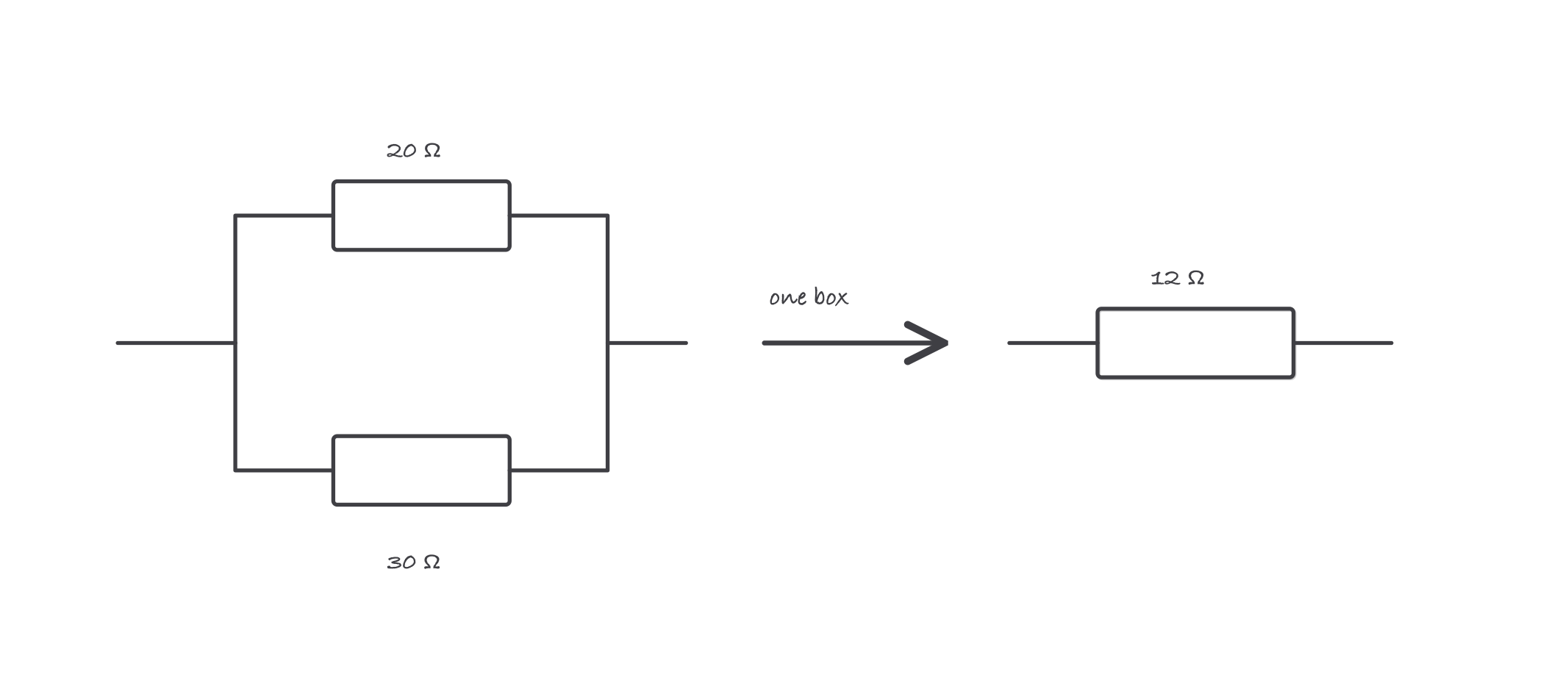
Collapse the parallel group first and the rest is a plain series loop
Where it bites
- Applying source voltage to a branch inside the combination is the error this topic exists to kill. The branch sees what is left after the series elements take their drops: 72 V here, never 120 V.
- Skipping the reduction step and hunting for one formula that fits the whole circuit. There is no such formula; there is only the method.
- Losing track of which current is which. The loop current, 6 A, and the branch currents, 3.6 A and 2.4 A, are different numbers answering different questions. Label them as you go.
- Field version: the shared conductor. When two loads share a too-small or failing conductor, the conductor is the series element, and every load added to the parallel side raises the current through it and the voltage it steals. Lights that dim when the microwave runs are this worked example wearing drywall.
Exam relevance
Series-parallel reduction is a staple of journeyman theory sections, usually as find-the-total-resistance or find-a-branch-current questions. Examiners build the wrong answers from the predictable mistakes: source voltage on a branch, product over sum on three resistors, drops that do not sum to the source. Run the three-pass method and check the books balance at each stage; the checks are free marks.