Learn · HVAC/R
How Superheat Works
Part of EPA 608: All Four Exams · step 8 of 20 · next: How Subcooling Works
Part of HVAC Technician from Zero · step 8 of 49 · next: How Subcooling Works
In learning paths: EPA 608: All Four Exams · HVAC Technician from Zero
Assumes you know: Evaporators, Pressure-Temperature Relationships
Superheat is how many degrees a refrigerant vapor is above its boiling point at its current pressure. It is one number, read with two tools, and it tells you the single most important thing about a running system: whether liquid refrigerant is getting back to the compressor, and how well the evaporator is being fed.
Why it matters on the job
Compressors pump vapor. Liquid does not compress, and liquid arriving at a compressor washes out its oil and slugs its valves. Superheat is your proof that the refrigerant leaving the evaporator has fully boiled off, with room to spare. It is also half of every charging decision you will make: too little superheat says the evaporator is overfed or underloaded; too much says it is starving. Diagnosis and charging both start here.
The concept
At a given pressure, a refrigerant boils at one temperature: its saturation temperature. Inside most of the evaporator, liquid and vapor coexist, so the refrigerant sits at saturation. Near the outlet, the last droplet boils off, and from that point on, the vapor keeps absorbing heat and its temperature rises above saturation. That rise is superheat:
Superheat = measured line temperature − saturation temperature at measured pressure
Saturation temperature comes from pressure, via a PT chart or the gauge scale. Line temperature comes from a probe strapped and insulated to the pipe. Superheat is always a difference between those two, never a direct reading.
Worked example
An R-410A system, cooling mode. At the evaporator outlet you measure:
- Suction pressure: 118 psig. On the R-410A scale, 118 psig saturates at about 40 °F.
- Suction line temperature at the same point: 50 °F.
- Superheat = 50 − 40 = 10 °F.
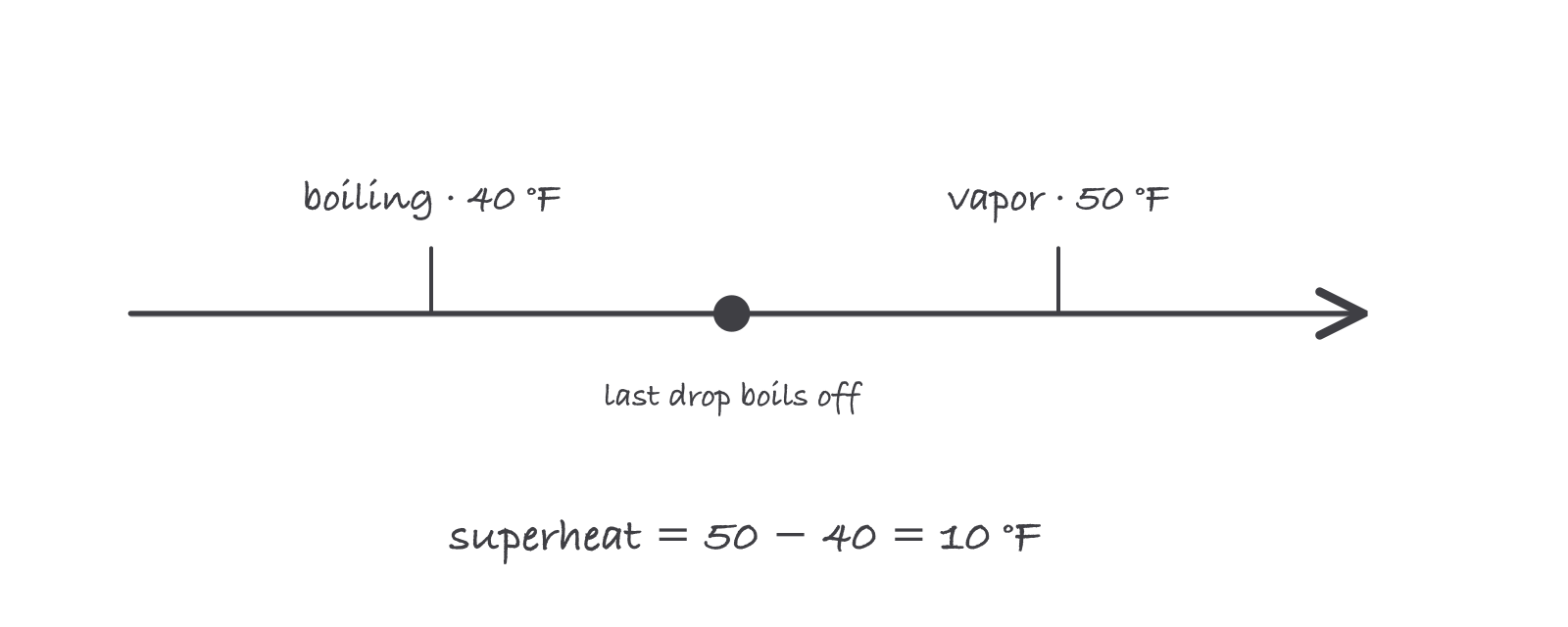
Both measurements and the subtraction, on the machine where you take them: everything left of the boil-off point sits at saturation; superheat only exists after it
Ten degrees of superheat at the evaporator outlet on a running air conditioner is a healthy reading on many systems. The same measurement showing 2 °F would say the coil is flooding toward the compressor; 25 °F would say the coil is being starved of refrigerant or overwhelmed with heat.
Where it bites
- Evaporator superheat and total superheat are different numbers. Measured at the evaporator outlet, you are reading how the coil is fed. Measured at the compressor, the vapor has picked up extra heat in the suction line. Know which one a spec sheet means before you chase a number.
- A TXV controls superheat; charge does not set it. On a TXV system, evaporator superheat should hold roughly steady while the valve does its job, so you charge by subcooling instead. Charging a TXV system to a superheat target is a classic wrong procedure. Fixed-orifice systems are the ones charged by superheat.
- Bad measurement beats bad theory every time. An uninsulated clamp probe reads the air, not the pipe. A gauge reading taken while the system is still stabilising is a lie. Five patient minutes beats an hour of chasing phantom numbers.
- Saturation depends on the refrigerant. 118 psig means 40 °F on R-410A and something entirely different on R-32 or R-454B. With A2L blends arriving, reading the right scale matters more, not less.
Exam relevance
EPA 608 tests the concept lightly; NATE and field-competency exams test it hard, usually as applied diagnosis: given pressures and temperatures, compute superheat and say what the system is doing. Practice the subtraction with a real PT chart until it is reflex.