Learn · HVAC/R
Metering Devices and TXVs
Part of EPA 608: All Four Exams · step 6 of 20 · next: Evaporators
Part of HVAC Technician from Zero · step 6 of 49 · next: Evaporators
In learning paths: EPA 608: All Four Exams · HVAC Technician from Zero
Assumes you know: How the Refrigeration Cycle Works
The metering device is a deliberate bottleneck: a restriction that drops the refrigerant from high pressure to low pressure, turning warm liquid into the cold mixture the evaporator needs. It is the border between the system’s two sides, and, on TXV systems, the only component actively steering.
Why it matters on the job
Metering is where feeding the evaporator right or wrong happens: too much refrigerant and liquid survives to the compressor; too little and capacity starves while superheat climbs. Reading superheat is, in practice, grading the metering device’s work. And the industry’s shift from fixed orifices to TXVs (and now electronic valves) changed the charging procedure, which is exactly the trap the superheat and subcooling lessons flagged.
The concept
Squeeze liquid through a small opening into a low-pressure region and two things happen at once: pressure collapses, and a fraction of the liquid instantly boils off, flash gas, stealing heat from the rest and chilling the whole mixture to the new, lower saturation temperature. Warm 100 °F liquid enters; a cold 40 °F mist leaves. No magic: the PT relationship at work, downhill.
The three families:
- Fixed orifice / piston / cap tube, a hole of fixed size. Simple, cheap, unadjustable: feeding accuracy depends on conditions, so charge is set by superheat.
- TXV (thermostatic expansion valve), a sensing bulb on the evaporator outlet modulates the valve to hold superheat roughly constant. The valve controls superheat, so charge is set by subcooling.
- EEV (electronic expansion valve), the TXV idea with a stepper motor and a board doing the thinking; standard in modern variable-speed equipment.
Worked example
R-410A again: liquid enters the metering device at 365 psig and 100 °F. On the far side, pressure is 118 psig, saturation 40 °F. Roughly a fifth of the liquid flashes to vapor on the spot, and the remaining mixture arrives in the evaporator at 40 °F, ready to boil. The 60-degree temperature drop happened in an inch of travel, without any heat exchange at all, pure pressure physics.
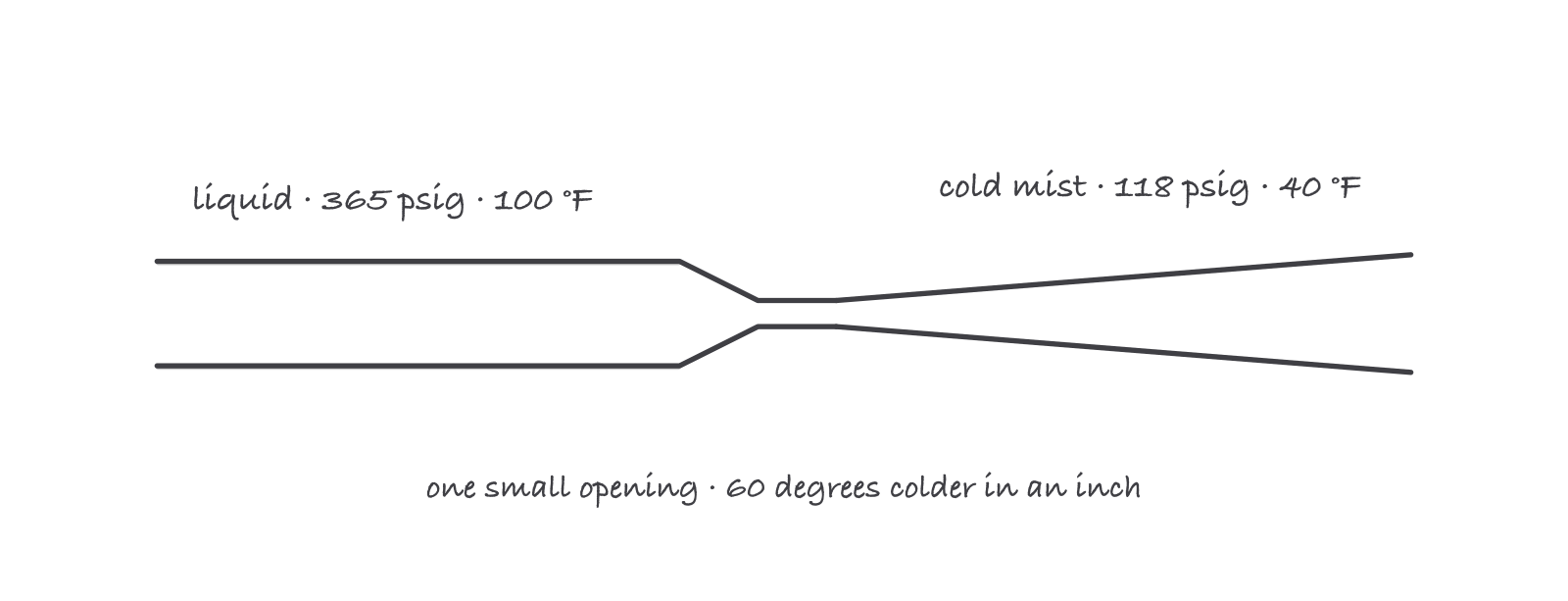
Sixty degrees colder in an inch of travel, on pressure physics alone
Where it bites
- A starving TXV and an undercharge look similar (high superheat); subcooling separates them, low subcooling points at charge, healthy subcooling with high superheat points at the valve or its bulb.
- Bulb discipline decides TXV behaviour: strapped tight, positioned right, insulated. A loose bulb reads warm air and floods the coil.
- Flash gas upstream is sabotage: bubbles in the liquid line (low subcooling, restriction, long lift) mean the device meters foam and everything downstream wanders.
Exam relevance
Device families and their charging methods are a NATE staple, and diagnosis questions lean on the starved-vs-flooded logic that begins at this valve.