Learn · HVAC/R
Contactors and Relays
Part of HVAC Technician from Zero · step 22 of 49 · next: Control Board Diagnostics
In learning paths: HVAC Technician from Zero
Assumes you know: Reading HVAC Schematics
A contactor is where the 24 V circuit takes command of the line-voltage circuit. It is an electromagnet and a set of spring-loaded contacts: energize the coil with 24 V and the magnet pulls the contacts closed, completing the line-voltage path to the compressor and fan. The two circuits meet in one device without ever touching electrically.
Why it matters on the job
The contactor in a condensing unit switches the largest load in the house dozens of times a day, every day, for years. Its contacts arc a little on every break, pitting and burning as they age. It is one of the most frequently failed and most easily tested components in the trade: two voltage readings sort a bad contactor from a bad coil circuit in under a minute.
Contactor versus relay
Both are coil-and-contact switches. The difference is what they can carry. A relay switches small loads: blower relays, fan relays, control circuits, typically up to around 15 to 20 A. A contactor is a relay built heavy: larger contacts, stronger springs, ratings of 30 or 40 A, sized for compressors. Use the schematic name, but read the nameplate rating when replacing either.
Contacts come in normally open and normally closed forms, and “normally” means the coil is de-energized. An HVAC contactor is normally open: no call, no cooling. Many relays carry both NO and NC contacts on one armature, so one coil can start one thing and stop another in the same throw.
Residential contactors are often single-pole: they break only one leg of the 240 V while the other leg stays connected through an unbroken bar. The compressor cannot run on one leg, but its windings and the run capacitor stay live to ground. That matters for safety and for diagnosis both.
Testing with two questions
A contactor can only fail two ways: the coil circuit is not asking, or the contacts are not answering.
Is the coil being fed? Measure across the coil terminals. About 24 V means the thermostat and safety chain are doing their job. Near 0 V means the problem is upstream, not the contactor.
Are the contacts passing power? With the coil energized, measure across each set of contacts, line lug to load lug on the same pole. A closed healthy contact drops nearly nothing: expect 0 to a few volts. Full line voltage across a “closed” contact means the contact is open or burned away.
Worked example: hummer with no cooling
Condenser dead, contactor buzzing.
- Across the coil: 25.1 V. The call is present, the coil is trying.
- Line side, L1 to L2: 243 V. Supply is good.
- Load side, T1 to T2: 243 V. Power is crossing, yet the compressor is silent. Move on: this rules out the contactor’s poles.
- Wait: the buzz. Pull the disconnect, kill the 24 V call, and inspect. An insect carcass sits between the armature and the frame, holding the contacts a hair apart under a chattering magnet. Readings taken mid-chatter can flicker between 0 and 243 V.
Chatter is the third failure mode hiding inside the two questions: the coil is fed, the contacts try to answer, and something mechanical is in the way. Debris, a weak coil, or low control voltage all chatter; each shows a different signature on the meter.
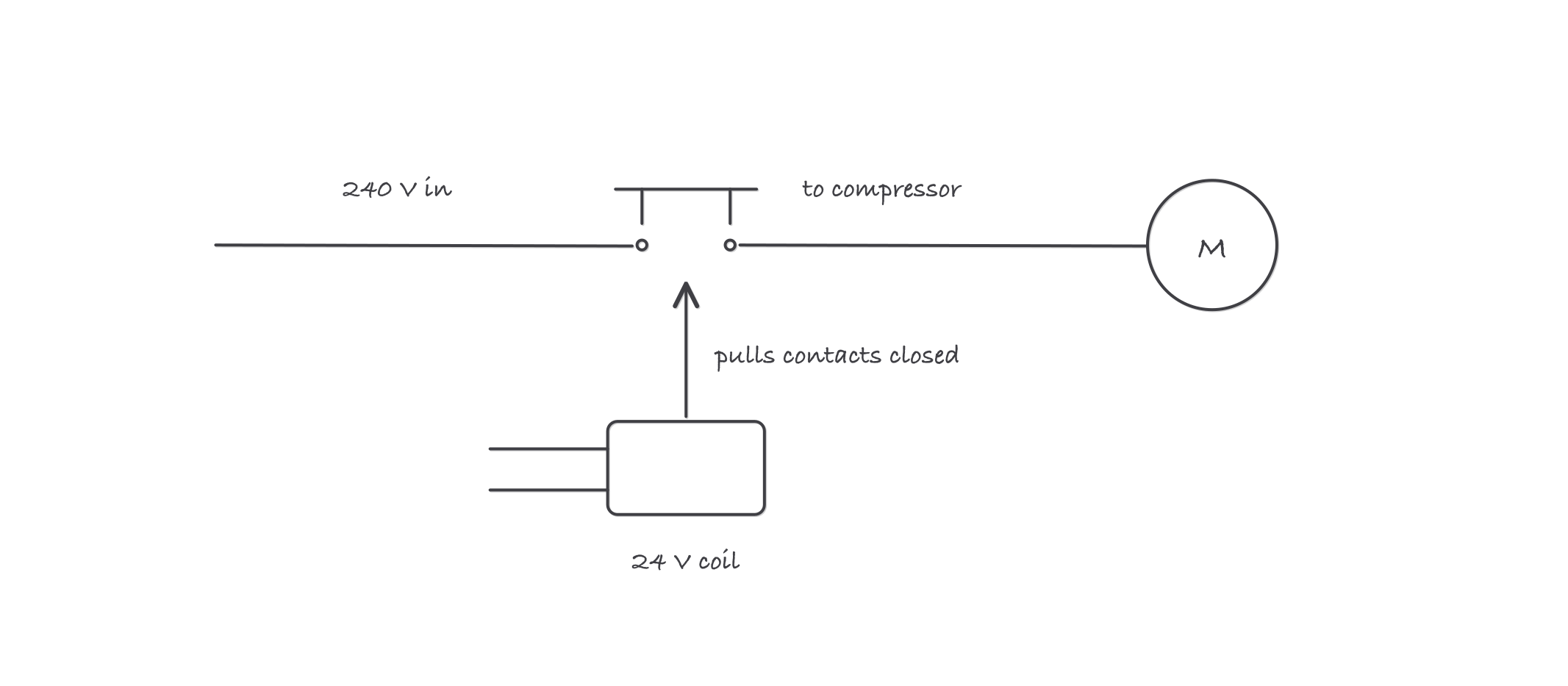
Two questions in one device: is the coil fed its 24 V, and do the closed contacts pass the 240 V with almost no drop
Where it bites
- A single-pole contactor leaves one leg hot. De-energized is not dead: verify at the compressor terminals, not at the contactor, before touching anything downstream.
- Pitted contacts fail under load, not under a meter. A contactor can read closed with no load and still drop half its voltage under compressor amps. Test under load when the symptom is weak or hot running.
- Coil voltage must match coil rating. A 24 V coil on a 120 V circuit dies instantly; a 120 V coil on 24 V never pulls in. Replacement contactors must match coil voltage, contact rating, and pole count.
- Chatter murders compressors. Every bounce is a start attempt. Find the cause the first time you hear it, before the compressor windings pay for it.