Learn · HVAC/R
What Oversizing Actually Costs
Part of HVAC Design Fundamentals · step 9 of 9
In learning paths: HVAC Design Fundamentals
Assumes you know: Manual D: Sizing the Ducts
An oversized system satisfies the thermostat before it finishes the job it was bought to do. It reaches set point quickly, shuts off, and leaves behind the moisture, the mixing and the even temperatures that only come from running. Every symptom below follows from that one fact.
Why it matters on the job
Oversizing is the default failure rather than a rare one: installers oversize to be sure there is ample capacity and to avoid a callback that means changing out a whole system. The Department of Energy and ENERGY STAR both document what it buys instead. Oversized equipment lowers efficiency and raises power bills, it can cause moisture problems, and short cycling inflicts excessive wear on the compressor and shortens equipment life. The callback avoided at sizing time returns later as a comfort complaint that cannot be fixed with a service visit.
Why runtime is the product
An air conditioner dehumidifies by condensing moisture on a cold coil. That takes time: the coil has to get cold and stay cold with air moving across it, and the first minutes of a cycle produce little condensate because the coil is still cooling down. Long cycles remove moisture. Short cycles remove temperature.
The same logic covers comfort. A system that runs steadily mixes air between rooms and holds a flat temperature. One that blasts and stops swings the temperature between cycles and leaves the far bedroom to its own devices.
Worked example
A house with a 24,000 Btu/h cooling load at the design condition, and two candidate machines: one that delivers 24,000 Btu/h and one that delivers 36,000.
- At the design condition, the matched unit runs 24,000 / 24,000 = 100% of the time
- The oversized unit runs 24,000 / 36,000 = 67% of the time
- On an ordinary day at half load (12,000 Btu/h), the matched unit runs 12,000 / 24,000 = 50%
- The oversized unit runs 12,000 / 36,000 = 33%
- Across a season, the oversized machine spends a third less time running for the same heat removed, in shorter bursts, with a start at the front of each one
Design days are rare. Almost every operating hour is somewhere down at part load, which is exactly where the oversized machine’s cycles get shortest and its dehumidification gets worst.
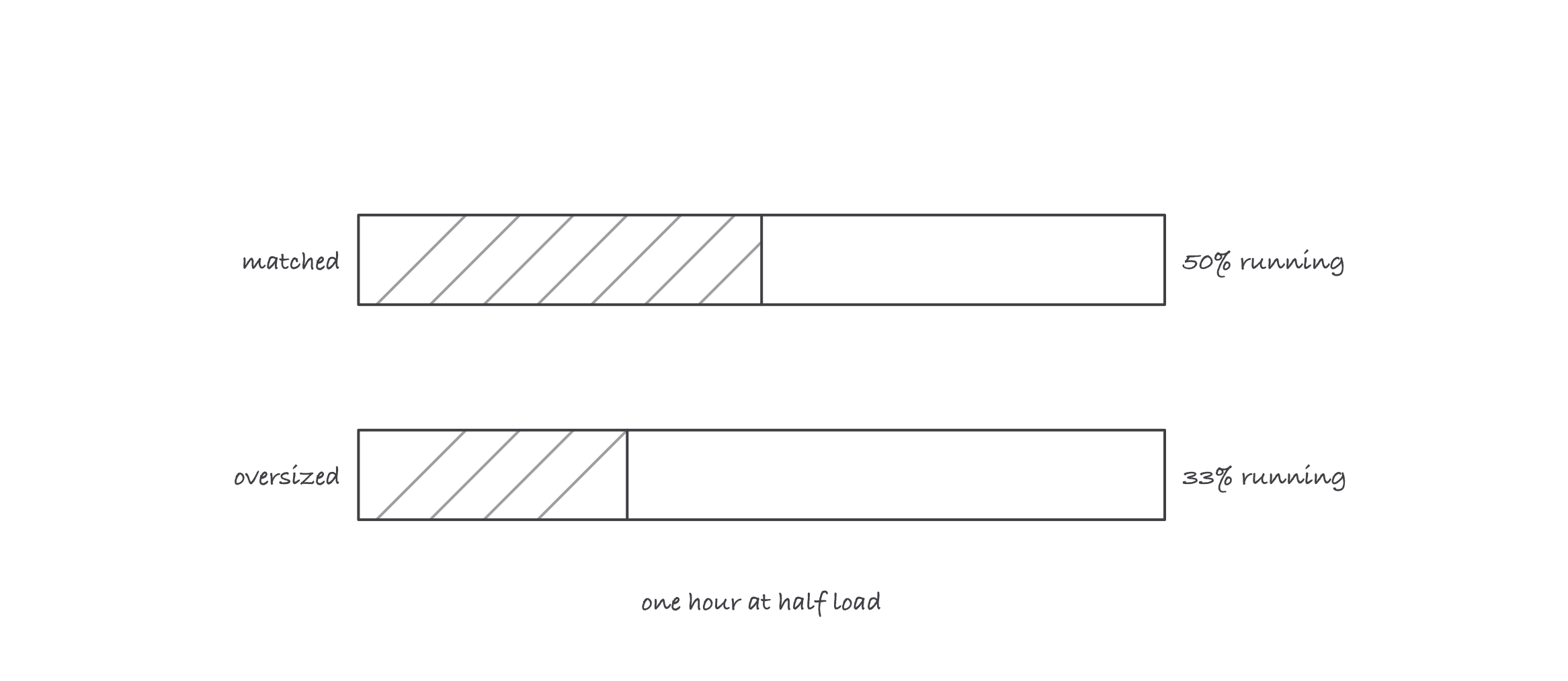
Same heat removed, a third less running to remove it, and the moisture stays behind
Where it bites
- “Bigger is safer” inverts the risk. The oversized system is the one that fails to keep a humid house comfortable, and no amount of capacity fixes a latent problem caused by short runtime.
- A whole-house dehumidifier is a second purchase to correct the first. It works, and it is an expensive way to buy back what correct sizing gives for free.
- Like-for-like replacement inherits an old guess. The house has probably had windows, air sealing or insulation since. Recalculate rather than reading the old nameplate.
- Variable capacity is not permission to oversize. Modulating equipment has a minimum output too, and an oversized modulating system spends the shoulder seasons cycling at its floor.
- Square feet per ton describes nothing. It carries no information about orientation, glazing, insulation or leakage, which are the variables that decide the answer.