Learn · HVAC/R
Heat Transfer Basics
Part of EPA 608: All Four Exams · step 1 of 20 · next: Pressure-Temperature Relationships
Part of HVAC Technician from Zero · step 1 of 49 · next: Pressure-Temperature Relationships
In learning paths: EPA 608: All Four Exams · HVAC Technician from Zero
Heat moves from hot to cold. Always, only, and without exception. Every machine you will ever service, air conditioner, heat pump, walk-in cooler, is a device for exploiting that one-way traffic, and every diagnosis you will ever make starts by asking where the heat is going.
Why it matters on the job
Air conditioning does not “make cold.” It moves heat: out of the house in summer, into it in winter (run backwards, that is a heat pump). The moment you internalise that, the equipment stops being a mystery box. A system that “isn’t cooling” is a system failing to move heat, and there are only a few places the movement can break down.
The concept
Three rules run everything:
- Heat flows from hot to cold, never the reverse on its own. A 95 °F attic pushes heat into a 75 °F room; the room never pushes heat back unaided.
- Bigger temperature difference, faster flow. The hotter the attic, the harder your equipment works. This is why design temperatures matter and why performance complaints spike on the worst days.
- Moving heat uphill costs energy. Getting heat from a 75 °F room into a 95 °F outdoors is against the natural flow, that is the compressor’s entire job, and it is why the machine has a power bill.
Heat moves three ways, conduction (through material), convection (carried by moving fluid or air), radiation (across space), and an HVAC system uses the first two constantly: refrigerant conducts heat through coil walls, blowers convect it across coils.
Worked example
A room sits at 75 °F. The evaporator coil in the airstream runs at about 40 °F. Return air at 75 °F crosses a 40 °F coil: a 35-degree difference, so heat pours from the air into the coil, and leaves the air cooler. Outside, the condenser coil runs around 120 °F against 95 °F outdoor air: a 25-degree difference the other way, so the heat collected indoors pours out. Cold coil indoors, hot coil outdoors: the machine is a heat conveyor, and those two temperature differences are the loading docks.
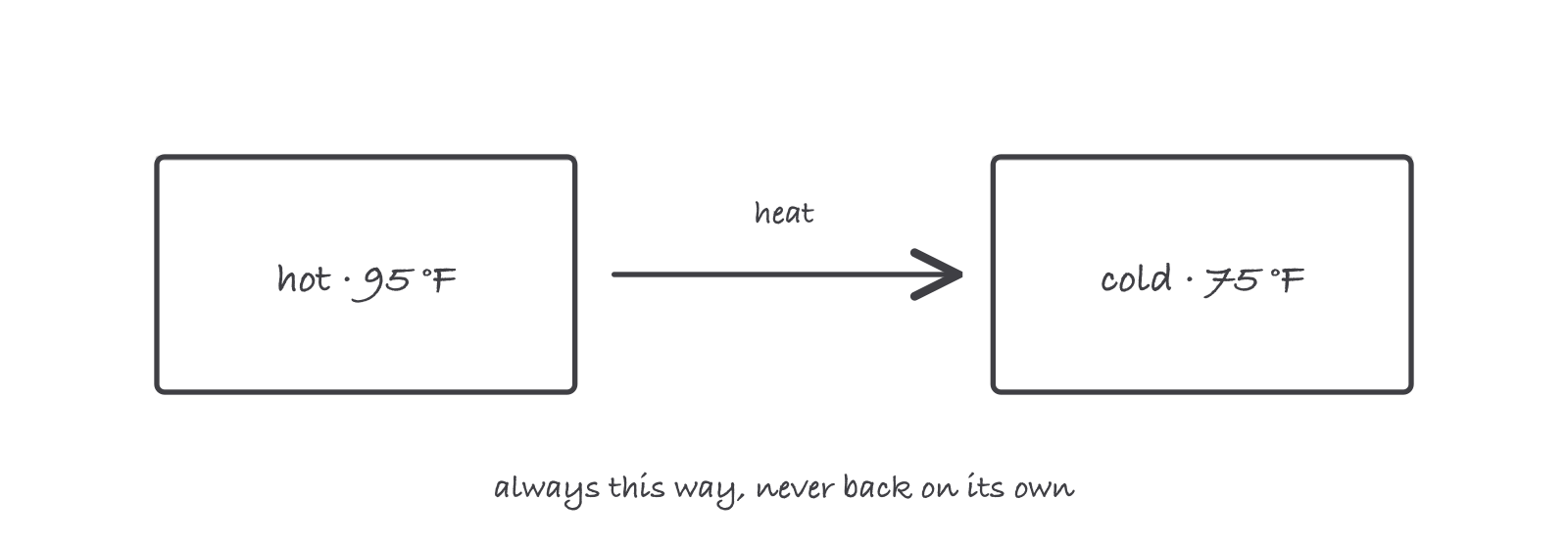
The one-way traffic every machine you service exploits
Where it bites
- “Adding cold” thinking leads to wrong diagnoses. Nothing adds cold; something fails to remove heat. Ask where the heat path is blocked: airflow, coil surface, refrigerant flow.
- The temperature difference is the driver. A dirty condenser shrinks its temperature advantage over outdoor air, and capacity falls before anything “breaks.”
Exam relevance
Heat-transfer direction and the temperature-difference principle underpin every performance question on EPA 608, NATE and licensing exams, usually silently, inside questions that look like they are about components.