Learn · HVAC/R
How the Refrigeration Cycle Works
Part of EPA 608: All Four Exams · step 3 of 20 · next: Compressors
Part of HVAC Technician from Zero · step 3 of 49 · next: Compressors
In learning paths: EPA 608: All Four Exams · HVAC Technician from Zero
Assumes you know: Pressure-Temperature Relationships
The refrigeration cycle is four components in a loop, and refrigerant changing state as it goes round: boiling where you want heat removed, condensing where you want heat dumped. Learn the loop once, properly, and every air conditioner, heat pump, fridge and chiller you ever touch is the same machine in different clothes.
Why it matters on the job
Every gauge reading, every temperature you clamp, every diagnosis you make lands somewhere on this loop. Technicians who can place a symptom on the cycle, “high superheat means the evaporator is being starved”, troubleshoot; technicians who cannot are changing parts on guesswork.
The loop
Follow the refrigerant from the compressor:
- Compressor, takes in low-pressure vapor and squeezes it to high pressure. Compression also makes it hot: hotter than outdoors, which is the point, because heat must flow from hot to cold.
- Condenser, the hot high-pressure vapor meets outdoor air, dumps its heat, and condenses to liquid. Pressure stays high; the refrigerant leaves as warm liquid.
- Metering device, a deliberate restriction. Liquid squeezes through and its pressure collapses; some flashes to vapor and the mixture turns cold, colder than the room air it is about to meet.
- Evaporator, the cold liquid-vapor mix absorbs heat from indoor air and boils back to vapor. Pressure stays low; the vapor returns to the compressor and the loop repeats.
Two pressures, two jobs: the high side (compressor discharge through condenser to metering device) is where heat leaves; the low side (metering device through evaporator to compressor suction) is where heat is collected. The metering device and the compressor are the two borders between them.
Worked example
Place a real R-410A cooling system on the loop: suction 118 psig, so the evaporator boils at about 40 °F, absorbing heat from 75 °F room air. Discharge 365 psig, so the condenser condenses at about 110 °F, dumping heat into 95 °F outdoor air. Both heat flows run downhill, 75 into 40, 110 into 95, and the compressor is what paid for the arrangement.
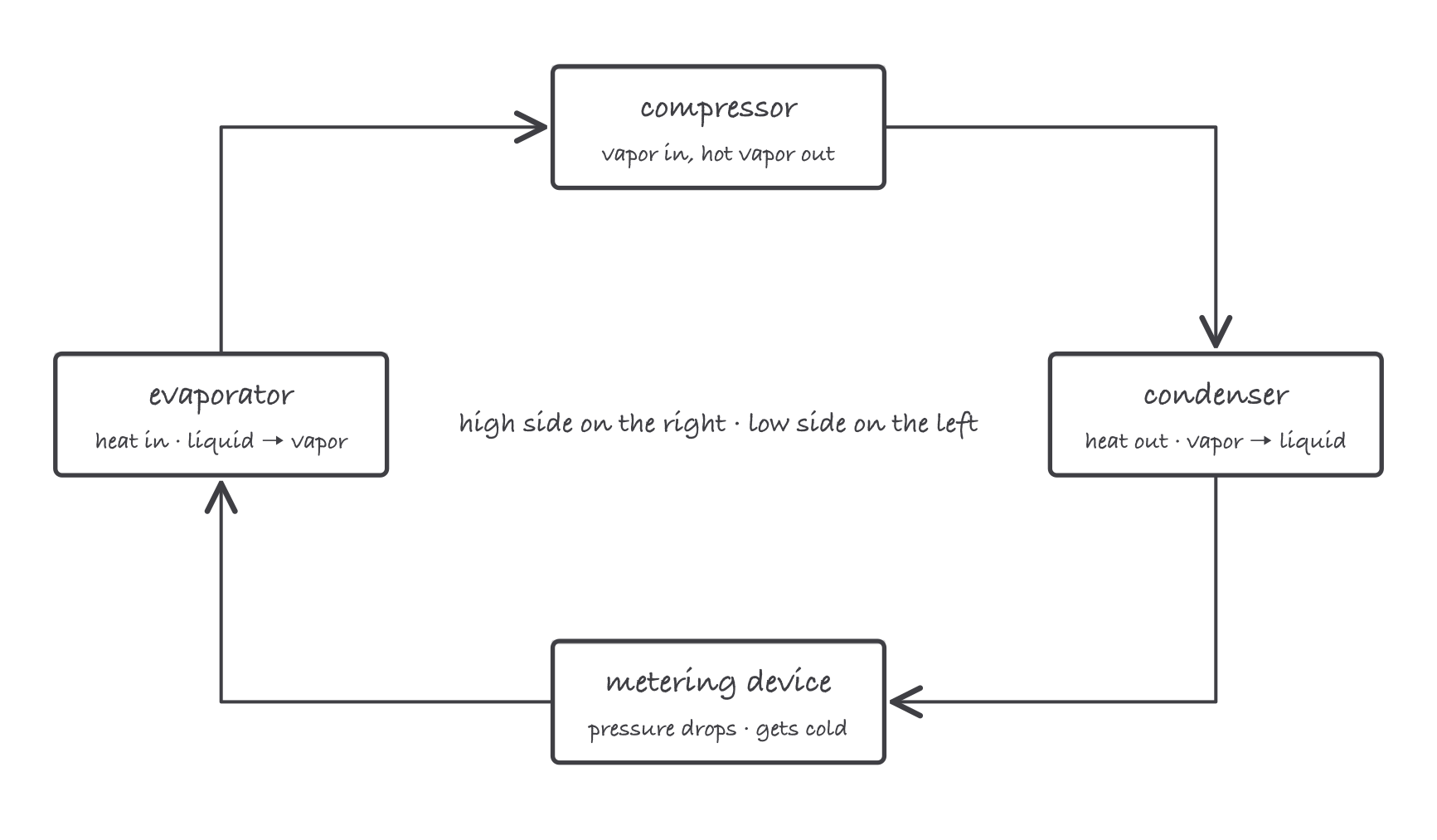
Every system you will ever touch is this loop in different clothes
Where it bites
- A heat pump is this loop with a reversing valve, swap which coil plays evaporator and condenser and you are heating instead of cooling. Same cycle, same numbers, opposite direction.
- Every component failure has a cycle signature. Starved evaporator: high superheat. Flooded condenser: high subcooling. Learn the loop and the signatures come almost free.
Exam relevance
The cycle is the backbone of EPA 608 Core, NATE Fundamentals, and every trade-school exam. Expect to name components, order them, and say what state the refrigerant is in at each point, in both cooling and heat-pump modes.