Learn · HVAC/R
Diagnosing Airflow Problems
Part of HVAC Technician from Zero · step 43 of 49 · next: Diagnosing Electrical Problems
In learning paths: HVAC Technician from Zero
Assumes you know: Static Pressure, A Diagnostic Method That Works
Airflow problems are the most common faults in forced-air systems and the most commonly misdiagnosed, because weak airflow wears a refrigerant costume: low suction pressure, icing coils, poor cooling. The static pressure probes and the temperature split are how you strip the costume off before the gauges mislead you.
Why it matters on the job
Every capacity number a system promises assumes design airflow, roughly 400 CFM per ton in cooling. Starve the airflow and the evaporator runs colder than design, capacity falls, coils ice, furnace limits trip, and gauge readings drift into patterns that imitate charge faults. A Diagnostic Method That Works ordered you to check airflow before refrigerant; this lesson is how that check actually goes.
The instrument: static pressure
Static Pressure taught the concept; here it becomes a vital sign. With a manometer and two test ports you read the pressure the blower fights against:
- Return side, between filter and blower: a negative reading, the suction the blower pulls.
- Supply side, above the coil or heat exchanger: positive, the push into the ductwork.
Total external static pressure, TESP, is the sum of the two magnitudes, compared against the blower’s rating on the nameplate. High TESP means the system is choking; where the pressure drops is who is choking it, and individual pressure drops across filter and coil name the suspect.
Worked example: finding the choke point
A 3-ton system, blower rated for 0.50 in. w.c. TESP. Complaint: weak cooling. Split check first: return 75 °F, supply 53 °F: 22 °F, higher than the healthy 20 °F neighborhood, the signature of low airflow (the same heat removal concentrated in less air), where low charge would show a low split.
Static readings:
- Return side: −0.32 in. w.c. Supply side: +0.58 in. w.c.
- TESP = 0.32 + 0.58 = 0.90 in. w.c. against a 0.50 rating: the blower is fighting nearly twice its design resistance. The airflow hypothesis is confirmed: now find where.
- Pressure drop across the filter: 0.28 in. w.c., several times what a clean filter of this type should cost. Prime suspect.
- Pressure drop across the indoor coil: 0.30 in. w.c.: also high, matted with dust on inspection, the filter’s history written on the coil.
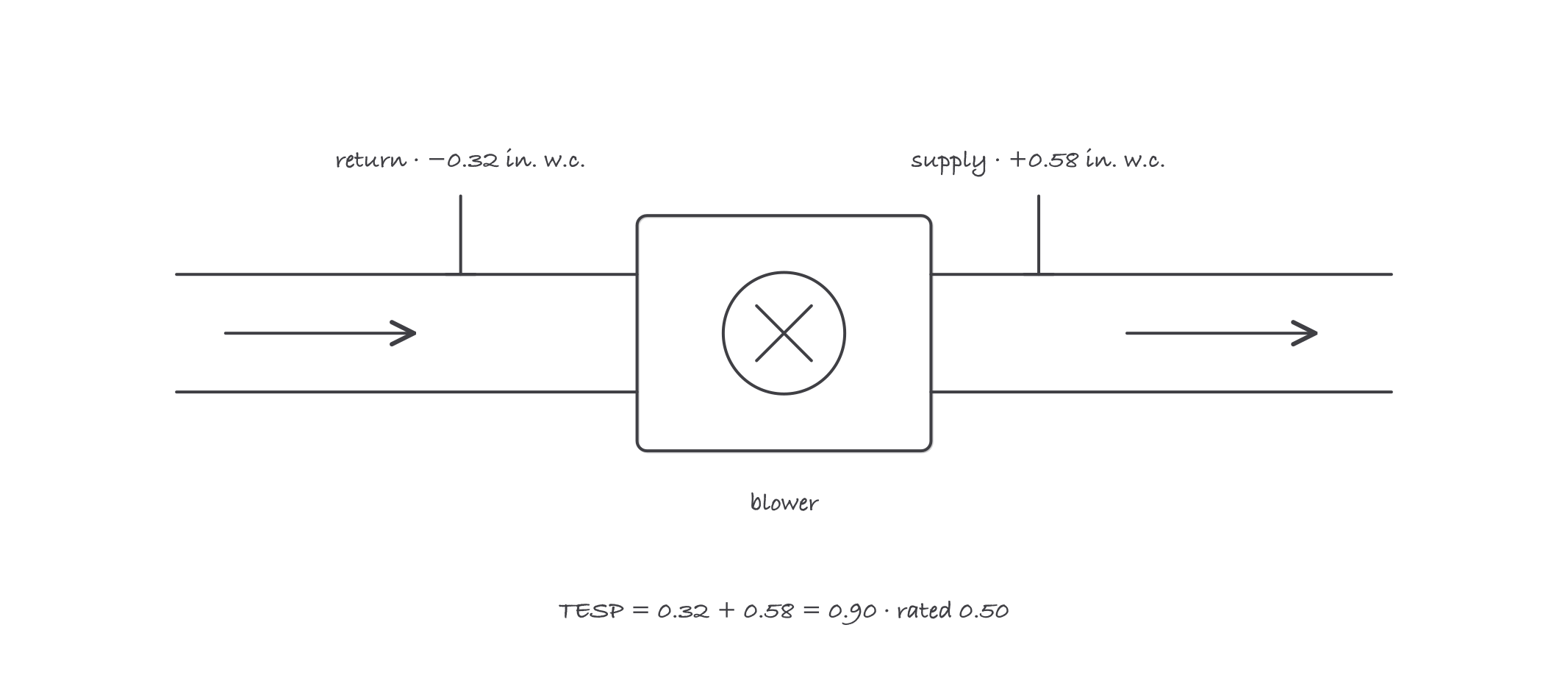
Two probe points bracket the blower: the sum is the resistance it fights, and the rating on the nameplate says what it was built to fight
Clean filter, clean coil, re-measure: TESP 0.52 in. w.c., split 19 °F. Numbers back in range, repair proved, and no refrigerant was harmed in the making of this diagnosis.
The usual suspects
In rough order of frequency: loaded filters, and filters too restrictive for the blower; matted evaporator coils; crushed, disconnected, undersized or flat-out missing ducts; closed or blocked registers; blower problems, a slipping belt, a wrong speed tap, a failing ECM ramping against impossible static; and iced coils, where the ice is the result of an airflow fault as often as its cause. Duct sizing sins are covered in Duct Design Basics; the field symptom is a system that has “never cooled right since it was installed”.
Where it bites
- High split does not mean healthy. Homeowners and rookie techs read a big return-to-supply drop as strong performance. Past the design range it means the same cooling is squeezed into too little air: capacity is down, and ice is coming.
- An iced coil must melt before you can diagnose anything. Ice blocks airflow, which makes more ice, and every measurement on an iced system reads catastrophe. Thaw fully, then find whether airflow or refrigerant started the spiral.
- The filter that fixes the static can expose the duct. A system running quietly with a loaded filter may roar through undersized ducts once the filter is clean. Re-measure TESP after every change; the second-largest resistance becomes the new story.
- Upgrading the filter downgrades the airflow. High-efficiency filter media in a slot sized for a builder-grade filter is a self-inflicted choke. Match filter pressure drop to blower capability, not to the marketing on the box.
- ECM blowers hide the symptom and pay for it in watts. A constant-airflow ECM ramps up against high static, holding the split normal while consuming extra power and wearing itself out. Static pressure, not the split alone, catches the problem on ECM equipment.