Learn · HVAC/R
Combustion Analysis
Part of HVAC Technician from Zero · step 33 of 49 · next: Commercial Refrigeration Systems
In learning paths: HVAC Technician from Zero
Assumes you know: Furnace Sequence of Operation
Combustion analysis is measuring what actually comes out of a flame (oxygen, carbon monoxide, flue temperature) instead of judging it by eye. A digital analyzer pulls a sample from the flue and turns “the flame looks fine” into numbers you can compare against the manufacturer’s targets, and it is the only honest way to commission or condemn gas equipment.
Why it matters on the job
Perfect combustion turns fuel and air into carbon dioxide, water vapor and heat. Real combustion is never perfect, and when it goes wrong it makes carbon monoxide, an odorless, invisible gas that kills people in their sleep. Eyes cannot see CO and cannot judge efficiency. A tech with an analyzer knows; a tech without one is guessing about the two things that matter most, safety and fuel cost. Furnace Sequence of Operation told you when the flame runs; this lesson judges how well it burns. Senior techs are expected to analyze, not eyeball.
What the analyzer reads
The probe goes into the flue through a small sampling hole, upstream of any draft hood or dilution point so the sample is undiluted flue gas. The core readings:
- Oxygen (O2). What is left of the excess air, the air supplied beyond the theoretical minimum. Some excess air is necessary; too much carries heat up the flue, too little starves the flame and breeds CO.
- Carbon monoxide (CO). The direct evidence of incomplete combustion. The reading to watch, and the one that makes a furnace unsafe.
- Flue temperature. Heat leaving the building. Together with O2, it drives the analyzer’s computed combustion efficiency.
- CO2 and efficiency are computed by the analyzer from the measured values and the selected fuel.
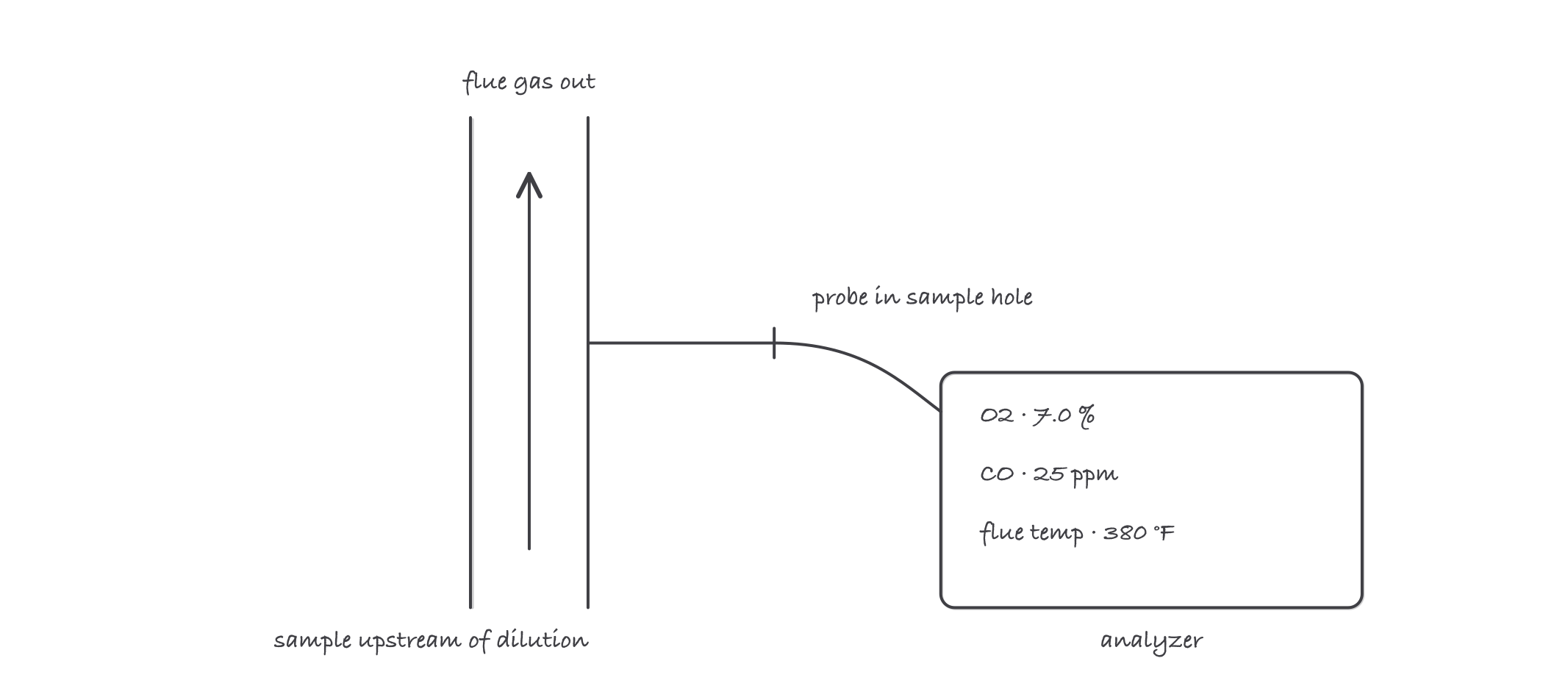
Sample the undiluted flue gas: three numbers replace every guess about the flame
The targets those numbers must hit come from the equipment manufacturer’s literature for that model and fuel. Analyze against the published targets, not folklore.
Worked example: CO air-free
Raw CO readings mislead, because extra excess air dilutes the sample: the same sick flame reads lower CO simply because more air is flowing past it. The air-free correction removes the dilution and states CO as if there were no excess air, which is how limits are commonly expressed:
CO air-free = CO measured × 20.9 ÷ (20.9 − O2 measured)
where 20.9 is the percentage of oxygen in ambient air.
A furnace sample reads CO 25 ppm and O2 7.0 %:
- Denominator: 20.9 − 7.0 = 13.9
- Correction factor: 20.9 ÷ 13.9 = 1.504
- CO air-free = 25 × 1.504 = 37.6 ppm
Now suppose a different furnace reads the same 25 ppm CO but at 14.0 % O2: factor = 20.9 ÷ 6.9 = 3.03, CO air-free = 75.7 ppm. Same raw CO, twice the corrected value: the second flame is producing far more CO per unit of fuel burned, hidden behind dilution. This is why analyzers compute air-free CO and why you compare corrected numbers, never raw ones.
Where it bites
- A stable CO reading is as important as a low one. Healthy combustion gives low CO that holds steady through the run. CO that climbs steadily as the furnace runs points to a developing problem, recirculation, impingement, or a failing exchanger, even if the number is still “low” when you leave.
- Sample location decides whether the numbers mean anything. Downstream of a draft hood or dilution air, the sample is watered down and every reading is fiction. Undiluted flue gas, upstream of dilution, always.
- Zero the analyzer in fresh air and keep the sensors in calibration. An analyzer zeroed in a mechanical room already containing CO reads low all day. Fresh-air zero, and calibration on the maker’s schedule, are part of the measurement.
- Ambient CO is a different measurement with different stakes. Flue CO tells you about the flame; CO in the room tells you about venting and exchanger integrity. High ambient CO is an evacuate-and-shut-down finding, not a tune-up data point.
- The analyzer proves repairs. Any change to gas pressure, combustion air, or venting gets a before-and-after analysis. “It sounds better” is not a commissioning standard.