Learn · HVAC/R
Packaged Units and RTUs
Part of HVAC Technician from Zero · step 29 of 49 · next: Gas Furnaces
In learning paths: HVAC Technician from Zero
Assumes you know: Split System Air Conditioners
A packaged unit puts the entire system (compressor, both coils, both fans, and usually the heat source) in one factory-built cabinet. The building’s supply and return ducts connect straight to the box. The rooftop unit, the RTU, is the packaged unit’s dominant form, and it is the workhorse of light commercial buildings: strip malls, offices, restaurants, small warehouses.
Why it matters on the job
Commercial service work is largely RTU work. The refrigeration circuit inside is the same one you know from Split System Air Conditioners, but the context changes everything: the whole machine lives outdoors in the weather, you work on a roof, and the unit carries systems a residential split does not, economizers, multiple compressors and belt-drive blowers among them.
One box on a curb
An RTU sits on a curb, a raised frame flashed into the roof, and its supply and return air openings pass straight down through the curb into the duct system below. Everything is reachable through service panels: compressor and controls in one section, blower in another, gas heat section on a gas-electric unit (“gas pack”), condenser coil wrapped around the outside.
Because there is no field-installed refrigerant piping, the circuit is factory-charged and factory-tested. Refrigerant problems on an RTU are almost always leaks that developed in service, not installation errors, which changes how you approach Leak Detection on them.
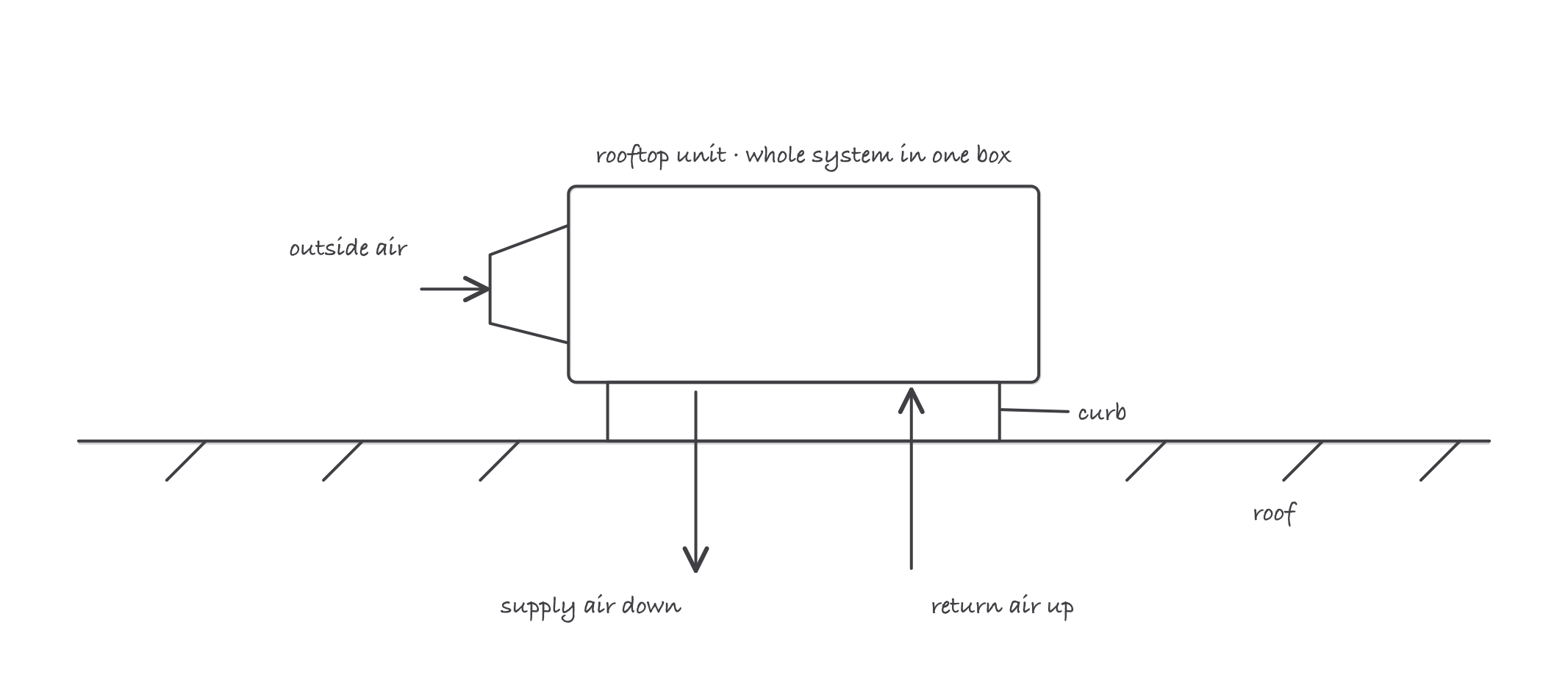
The whole system in one cabinet: ducts connect through the curb, and the outside air hood feeds the economizer
The economizer
Commercial buildings need cooling even in mild weather, and an economizer exploits that: when outdoor air is cool and dry enough, dampers open and the unit cools the building with outside air instead of running compressors, free cooling. A sensor decides when outdoor air qualifies, dampers modulate to mix outdoor and return air, and the compressors stage in only when outside air cannot carry the load. Economizers are also where fresh-air ventilation enters the building, so a failed one is both an energy problem and an air quality problem. Left seized, wide open in summer or closed all year, they are among the most common defects found on neglected roofs.
Worked example: airflow across a 10-ton unit
Cooling airflow runs at roughly 400 CFM per ton, so a 10-ton RTU should move about:
- 10 × 400 = 4,000 CFM
- Sanity check with the temperature split: return air 76 °F, supply air 56 °F, split = 20 °F
- Sensible cooling = 1.08 × 4,000 × 20 = 86,400 BTU/h
A 10-ton unit is nominally 120,000 BTU/h total capacity; 86,400 BTU/h sensible with the balance as latent moisture removal is a believable healthy reading. If the split were 28 °F instead, suspect low airflow first: slipping belt, dirty filters, or a coil packed with debris, and Diagnosing Airflow Problems applies unchanged on a roof.
Where it bites
- Multiple circuits, staged. Larger RTUs carry two or more independent refrigeration circuits that stage with load. Half a unit can be dead while the building barely notices until a hot day. Check every circuit, not the first one that shows a healthy pressure.
- Belt-drive blowers need belt service. Many RTU blowers are belt-driven. Belts stretch, glaze, and snap; a unit “running” with a snapped belt moves no air while every motor hums happily.
- The curb is part of the machine. Leaking curb flashing, crushed duct connections, or a unit set on the wrong curb after replacement create airflow and water problems no panel-side diagnosis will find. Look down, not just inside.
- Weather is a component. Condenser coils see cottonwood, leaves and grease-laden kitchen exhaust; controls see rain and UV. Coil cleaning and panel integrity are real service items, not cosmetics.
- Roofs change the rules of safety. Fall protection, ladder discipline and two-person lifts are part of the job description on packaged equipment, before any tool comes out.