Learn · HVAC/R
How Subcooling Works
Part of EPA 608: All Four Exams · step 9 of 20 · next: Refrigerant Types and Designations
Part of HVAC Technician from Zero · step 9 of 49 · next: Airflow Fundamentals
In learning paths: EPA 608: All Four Exams · HVAC Technician from Zero
Assumes you know: Condensers, Pressure-Temperature Relationships
Subcooling is superheat’s mirror twin. Where superheat asks how far the vapor has climbed above its boiling point, subcooling asks how far the liquid has dropped below its condensing point, and it is your proof that the condenser has finished its job and full liquid is heading to the metering device.
Why it matters on the job
A metering device fed with bubbles instead of solid liquid cannot meter. Subcooling is the number that says “solid liquid here”: too little means the condenser is not finishing the condensation (undercharge, or heat it cannot reject); a lot means liquid is stacking up in the condenser (overcharge or restriction). And on TXV systems, subcooling is the charging number, the valve controls superheat itself, so charge is set to the manufacturer’s subcooling target instead.
The concept
In the condenser, hot vapor cools to its condensing temperature, condenses at that temperature, and then, with the phase change complete, the liquid keeps cooling below it. That further drop is subcooling:
Subcooling = saturation temperature at liquid-line pressure − measured liquid-line temperature
Same two tools as superheat, other side of the system: liquid-line pressure (converted to saturation temperature on the correct refrigerant scale) and a probe strapped to the liquid line.
Worked example
An R-410A system in cooling. At the liquid line leaving the condenser you measure:
- Liquid-line pressure: 365 psig → R-410A saturation about 110 °F.
- Liquid-line temperature: 100 °F.
- Subcooling = 110 − 100 = 10 °F.
Ten degrees of subcooling says the condenser condensed everything and then cooled the liquid ten degrees further, a healthy figure on many systems, and if the data plate asks for 10, the charge is right. A reading of 2 °F with the same equipment would say vapor is likely reaching the metering device; 25 °F would say liquid is backing up.
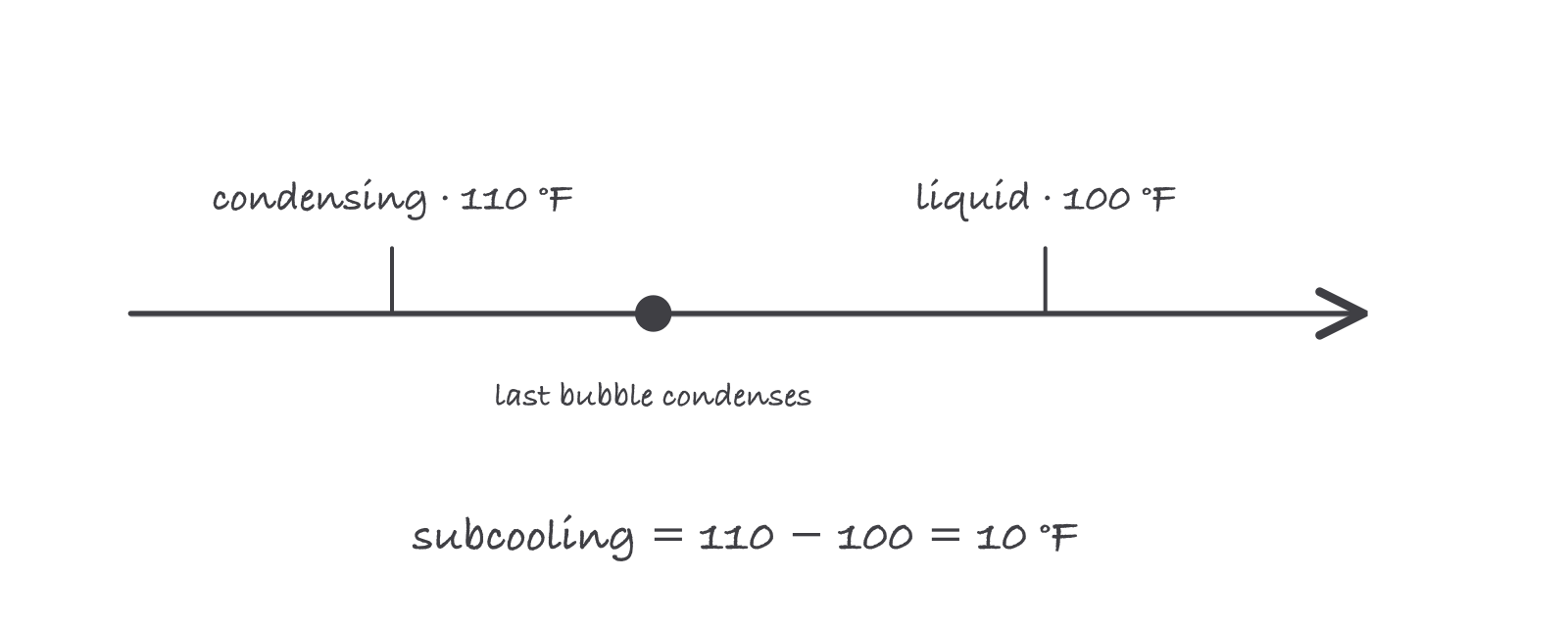
Superheat’s mirror: proof that solid liquid is heading to the metering device
Where it bites
- Charging by the wrong number is the classic error: fixed-orifice systems charge by superheat, TXV systems by subcooling. Applying the wrong procedure “works” and leaves the system quietly wrong.
- Measure at the condenser outlet, before long liquid lines and driers add their own effects, and insulate the probe like you mean it.
- Same refrigerant caveat as always: 365 psig is 110 °F only on the R-410A scale.
Exam relevance
Paired with superheat in every diagnostic exam scenario: given pressures and temperatures, compute both, then say which component is misbehaving. If you can run both calculations cold, the diagnosis questions turn into arithmetic.