Learn · HVAC/R
Pressure-Temperature Relationships
Part of EPA 608: All Four Exams · step 2 of 20 · next: How the Refrigeration Cycle Works
Part of HVAC Technician from Zero · step 2 of 49 · next: How the Refrigeration Cycle Works
In learning paths: EPA 608: All Four Exams · HVAC Technician from Zero
Assumes you know: Heat Transfer Basics
For a refrigerant at saturation, pressure and temperature are locked together: fix one and you have fixed the other. That single fact is why gauges exist. When you read 118 psig on an R-410A system, you are not just reading pressure, you are reading the temperature at which that refrigerant is boiling or condensing, without touching a thermometer to it.
Why it matters on the job
Every gauge reading you will ever take gets translated, instantly, into a saturation temperature, from the printed scale on the gauge face or a PT chart. Superheat, subcooling, charging, diagnosis: all of them are comparisons between a saturation temperature (from pressure) and a measured line temperature. Without the PT relationship there is no such thing as HVAC diagnostics.
The concept
A liquid boils at the temperature where its vapor pressure equals the pressure on it. Water boils at 212 °F at sea level and about 202 °F in Denver, less pressure, lower boiling point. Refrigerants obey the same law, just at temperatures and pressures useful for moving heat.
Inside an operating system, wherever liquid and vapor refrigerant coexist, most of the evaporator, most of the condenser, the refrigerant sits at saturation, and the PT relationship holds exactly. That is why the trick works: measure the pressure of a saturated region and the chart hands you its temperature.
Two cautions build straight on this:
- The relationship is per-refrigerant. 118 psig means about 40 °F on R-410A and something entirely different on R-32 or R-454B. Wrong scale, wrong everything.
- It only holds at saturation. Pure vapor that has left the coil (superheated) or pure liquid past the condenser (subcooled) has broken free of the chart, which is exactly what superheat and subcooling measure.
Worked example
An R-410A system shows 118 psig suction pressure. The R-410A scale says saturation at 118 psig is about 40 °F, so inside the evaporator the boiling refrigerant is at 40 °F. No thermometer touched the refrigerant; the gauge told you. Now the high side: 365 psig on the same refrigerant reads about 110 °F saturation, that is the condensing temperature, again straight off the chart.
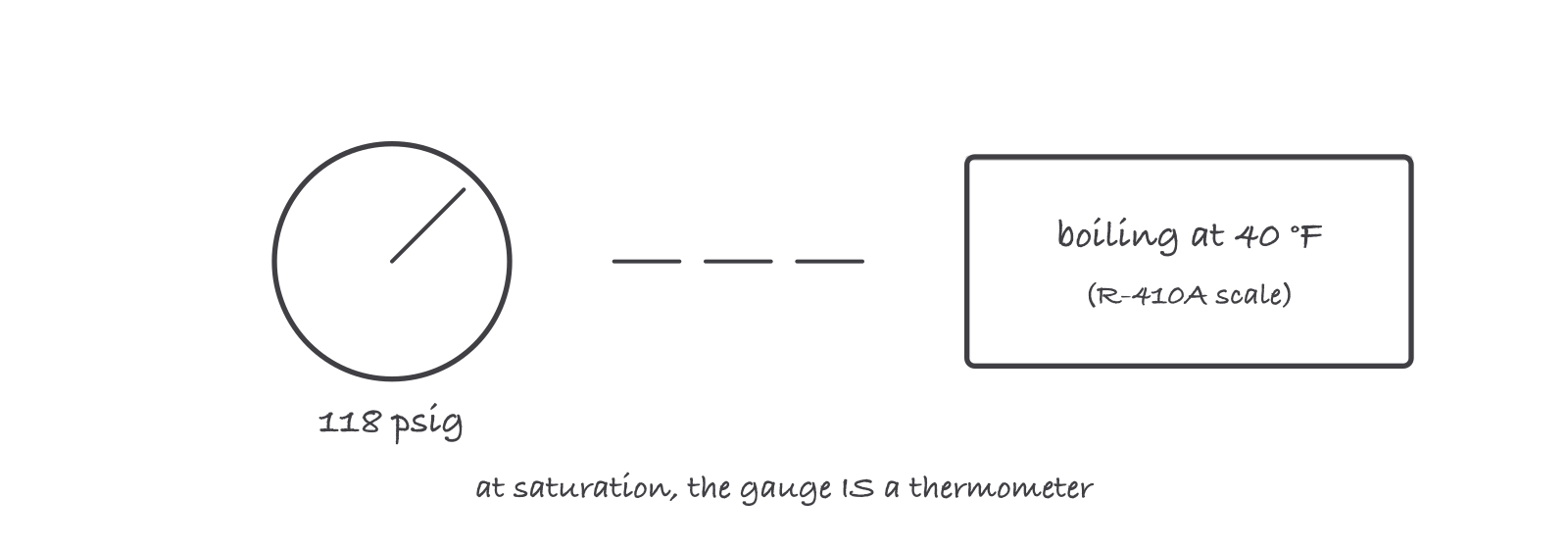
One pressure, one boiling point: the whole trick of gauges
Where it bites
- A2L transition raises the stakes: shops now run R-410A, R-32 and R-454B side by side, and the blends’ PT behaviour differs. Always confirm the refrigerant before trusting a scale.
- Trapped gauges lie. A reading taken before the system stabilises, or on a hose full of vapor from last week, is not the system’s pressure.
Exam relevance
PT-chart reading is tested directly on NATE and field exams, and indirectly everywhere: every superheat and subcooling question begins with converting a pressure to a saturation temperature.