Qualifications · HVAC/R
NATE Certification Explained
Part of HVAC Technician from Zero · step 48 of 49 · next: The CHP-5 Pathway: Five Exams, Five Domains
In learning paths: HVAC Technician from Zero
NATE, North American Technician Excellence, is the HVAC industry’s voluntary competence certification. Where EPA 608 is the legal floor everyone must hold, NATE is the professional ceiling employers pay for: proof that a technician understands systems, not just refrigerant rules.
*Learn the Trades is a free study resource. We are not a licensing body, an authorized training provider, or an exam administrator. Reading this page does not award any card, license, or certification. Always verify requirements with the issuing authority linked in the sources.*What NATE is and is not
NATE is an independent certification body, not a government agency and not a licensing board. No law requires it. Its value is market value: manufacturers, distributors and quality-focused contractors treat NATE certification as the hiring and pricing signal for real technical competence, and some manufacturer programs tie perks to NATE-certified staff.
The certification landscape
- Ready-to-Work, the entry certificate for people new to the trade: basic tools, safety, electrical and refrigeration awareness. A resume line for a first job, not a career credential.
- CHP-5 (Certified HVAC Professional), the modern flagship pathway: five focused exams covering the whole technician skill set. The next lesson covers it in detail.
- The traditional pathway, the older core-plus-specialty exam structure (a core exam plus a specialty such as air conditioning, heat pumps, or gas furnaces), still recognised across the industry.
NATE certification is a maintained credential, unlike EPA 608’s one-and-done card: check current recertification terms on natex.org when you plan.
Whether it is worth it
For a technician: yes, once the fundamentals are solid, it is the clearest wage-negotiation asset the trade offers short of a contractor license. For an employer: NATE staff are a marketable quality claim. The preparation itself is the hidden value: the exams force exactly the systems knowledge (airflow, controls, diagnosis) that separates parts-changers from technicians.
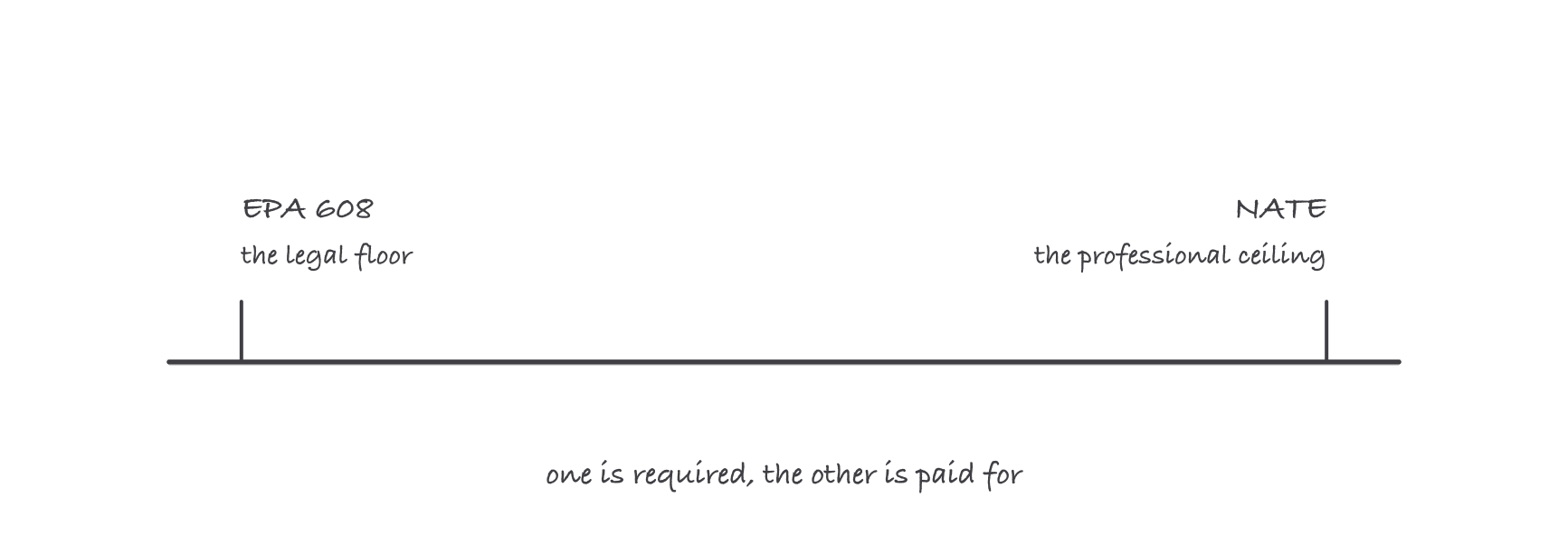
608 keeps you legal; NATE is what employers pay extra for
Where it bites
- NATE tests understanding, not code lookup: a closed-book concept exam, the opposite skill set from a licensing exam.
- Certification does not substitute for EPA 608 or any state license; it stacks on top.
Sources
- NATE, certification pathways (natex.org)