Learn · HVAC/R
Refrigerant Types and Designations
Part of EPA 608: All Four Exams · step 10 of 20 · next: Refrigerant Oils
Part of HVAC Technician from Zero · step 14 of 49 · next: Refrigerant Oils
In learning paths: EPA 608: All Four Exams · HVAC Technician from Zero
Assumes you know: How the Refrigeration Cycle Works
Every refrigerant carries two designations that matter: a chemical family that tells you its era and its environmental story, and an R-number that tells you exactly what is in the jug. Read both correctly and you know how the refrigerant behaves, what oil it needs, and what rules govern it, before you ever connect a gauge.
Why it matters on the job
You will work on systems spanning forty years of refrigerant chemistry, often in the same week. The family tells you what you can legally do with it, the number tells you which PT scale to read and whether the jug holds a blend, and the safety class tells you what precautions the machine demands. Guessing at any of the three is how refrigerants get mixed, charges get ruined, and violations get written.
The four families
- CFCs (chlorofluorocarbons), like R-12: carbon, chlorine, fluorine. Heavy ozone depleters. Production ended decades ago; you will meet them only in antique equipment.
- HCFCs, like R-22: hydrogen added, so less chlorine survives to reach the ozone layer. Phased out for new equipment; existing R-22 systems run on recovered and reclaimed supply.
- HFCs, like R-410A and R-134a: no chlorine at all, so no ozone depletion, but high global warming potential (GWP). This is most of today’s installed base.
- HFOs, like R-1234yf: short-lived molecules with very low GWP, used pure or blended with HFCs (R-454B is an HFC/HFO blend).
The pattern behind the parade: chlorine came out first, for the ozone layer. GWP is coming down second, for the climate. Each step changed oils, pressures, and handling rules, which is why the family name is working knowledge and not trivia.
Reading the number
- Pure compounds (R-22, R-32, R-134a) get numbers derived from their chemical structure. Treat the number as a name; the derivation is not field knowledge.
- 400 series means a zeotropic blend: components that boil at slightly different temperatures. The blend has a temperature glide, and it leaves the cylinder as liquid so the mix stays true. R-410A, R-407C, and R-454B live here.
- 500 series means an azeotropic blend that behaves like a single compound.
- 700 series means naturals: R-717 is ammonia, R-744 is carbon dioxide. Propane is R-290, a pure hydrocarbon.
- A capital letter suffix (R-407A, R-407B, R-407C) means the same ingredients in different proportions. The letter is part of the name; the wrong letter is the wrong refrigerant.
Every refrigerant also carries an ASHRAE safety class: a letter for toxicity (A lower, B higher) and a number for flammability (1 none, 2L mildly flammable, 3 highly flammable). R-410A is A1, R-32 is A2L, R-290 is A3. The safety lesson covers what those classes demand of you.
Worked example
You pick up a cylinder labeled R-454B and read it like a technician:
- The 400-series number says zeotropic blend, so it has a glide (small on this one, under 2 °F) and it charges as liquid.
- The data sheet says it is a blend of R-32 (an HFC) and R-1234yf (an HFO): a transition-era refrigerant built to cut GWP.
- Its safety class is A2L: low toxicity, mildly flammable, so A2L handling practices apply.
Three facts from one label, and every one of them changes what you do next.
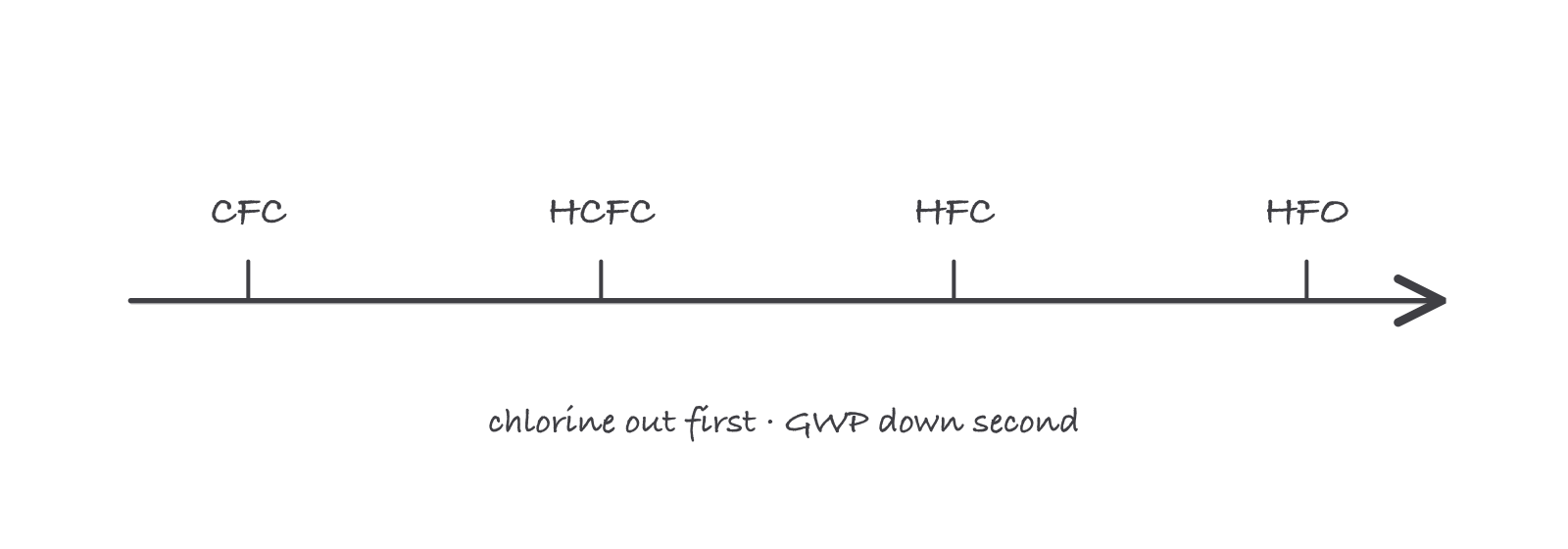
Forty years of refrigerant chemistry in one line: chlorine out first, GWP down second
Where it bites
- There is no such thing as a casual drop-in. Family sets oil compatibility and operating pressure. Putting a new refrigerant into an old system is a conversion with a manufacturer procedure, not a top-off.
- Blends leave the cylinder as liquid. Vapor-charging a 400-series blend fractionates it: the components leave at different rates and the composition shifts. Invert the cylinder or use a dip-tube cylinder, and meter liquid in carefully.
- The letter suffix is not decoration. R-407A and R-407C are different refrigerants with different PT behavior.
- Same fitting, different chemistry. Gauges connect to almost anything; that proves nothing about what is inside. Confirm the refrigerant from the equipment nameplate before trusting any scale.
Exam relevance
EPA 608 leans on the families: which refrigerants contain chlorine, what ozone depletion and GWP mean, and why the classifications exist. Expect questions pairing a refrigerant with its family and its rules. NATE and field exams add the practical layer: glide, fractionation, and liquid charging of blends.
Verified requirements
| Where | Expires | Renewal | Continuing education |
|---|---|---|---|
| United States (federal) | No | Confirm with issuer | Confirm with issuer |
Information comes from issuing-authority sources. Confirm current rules, fees and eligibility with the authority before acting.