Learn · HVAC/R
Defrost Controls
Part of HVAC Technician from Zero · step 24 of 49 · next: Thermostats and Low-Voltage Controls
In learning paths: HVAC Technician from Zero
Assumes you know: Contactors and Relays
A heat pump in heating mode runs its outdoor coil below freezing on purpose, so frost on that coil is a design consequence, not a malfunction. Defrost control is the logic that decides when the frost has become a problem and fixes it by running the machine backwards: the board flips the reversing valve into cooling, sends hot gas through the outdoor coil, and melts the ice from the inside out.
Why it matters on the job
Defrost complaints arrive in disguise. Steam rolling off the outdoor unit, a whooshing valve, cold air at the registers for a few minutes: all normal defrost, all regularly reported as failures. Meanwhile a genuinely stuck defrost, a coil turning into a block of ice, quietly destroys capacity and can slug the compressor. You need to know the logic well enough to say which is which.
Time and temperature: the two-condition test
The classic scheme is time-temperature defrost, and its heart is an AND decision. Two things must both be true before the board initiates:
The timer says enough running. The board accumulates compressor run time and offers a trial every 30, 60, or 90 minutes, set by a pin or jumper on the board. The interval counts run time, not clock time.
The coil says frosted. A defrost thermostat or sensor clamped to the outdoor coil closes when the coil drops below its rating, commonly in the neighborhood of 31 °F. Below that, frost is possible; above it, frost cannot exist and defrost would be pointless.
Timer elapsed while the coil sensor sits open: no defrost. Coil cold but the interval not yet reached: no defrost, yet. Both true: the board initiates. It energizes the reversing valve solenoid into cooling, keeps the compressor running, stops the outdoor fan so coil heat melts ice instead of blowing away, and typically brings on auxiliary heat so the indoor air does not go cold.
Termination mirrors initiation: defrost ends when the coil sensor opens, showing the coil has warmed and shed its ice (termination points around 50 to 80 °F are typical, per the board), or when a fail-safe timer, commonly about 10 minutes, expires first. A defrost that always runs its full fail-safe is a defrost that is not finishing its job.
Demand defrost, on newer boards, replaces the fixed interval with measurement: sensors compare outdoor air and coil temperatures and initiate only when the spread says ice is actually building. Fewer, smarter defrosts; same two-condition idea underneath.
Worked example: reading one defrost decision
A heat pump heating on a 26 °F morning. You watch the board through one cycle:
- Coil sensor: closed at a measured coil temperature of 24 °F. Condition one is true and standing.
- Board pin set to 60. At 60 minutes of accumulated compressor run, the board takes its trial: both conditions true, defrost initiates.
- Reversing valve energizes, outdoor fan stops, steam rises off the coil. At the registers, aux heat covers the temporary cooling.
- After about 6 minutes the coil hits the sensor’s termination point, the sensor opens, and the board flips back to heating. The 10 minute fail-safe never fired: healthy.
Same morning, a failed (stuck open) coil sensor would mean step 1 is never true: the timer offers its trial every 60 minutes forever, no defrost ever runs, and ice grows until the machine chokes.
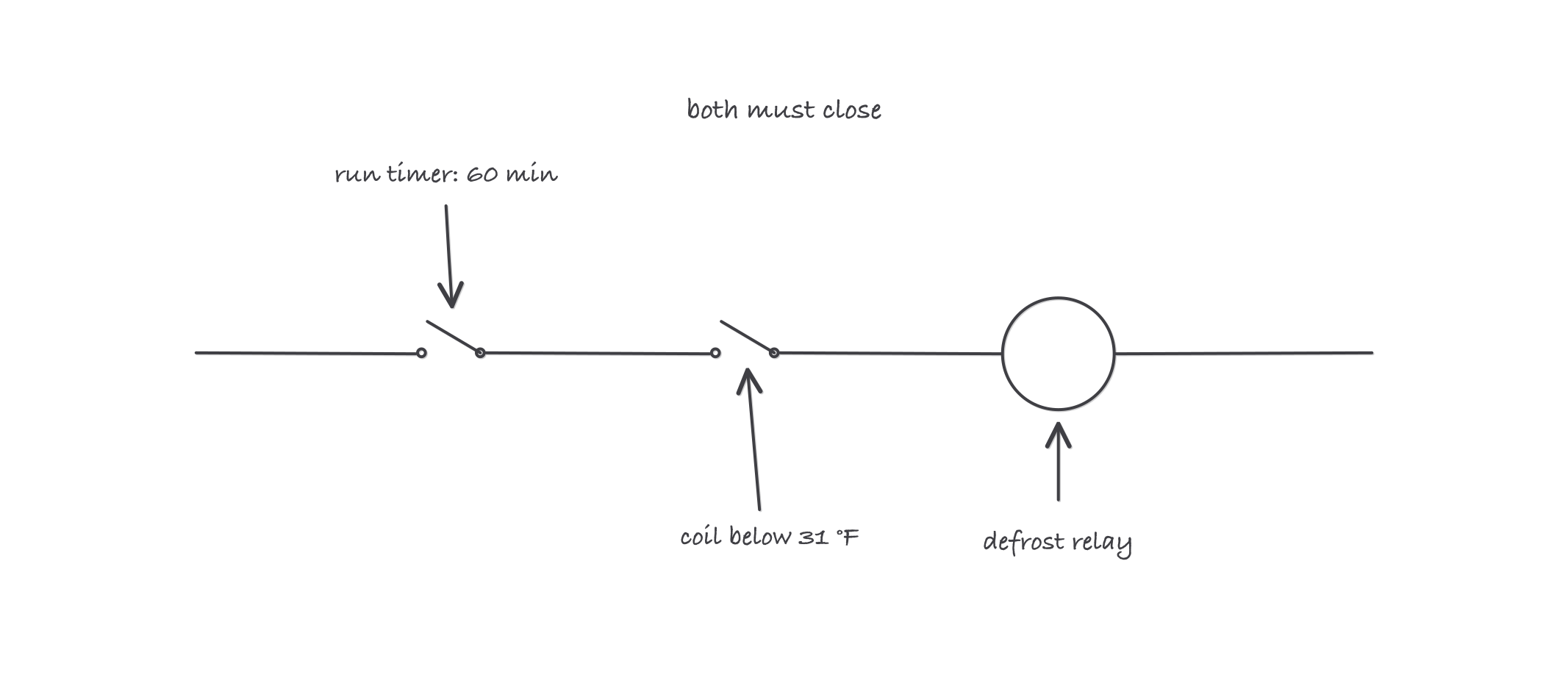
Time-temperature defrost as a series circuit: the timer and the coil sensor both have to say yes before the board acts
Where it bites
- Steam is not smoke. A cloud of vapor and a hiss at the valve is a machine doing its job. Educate the homeowner before someone kills the disconnect mid-defrost.
- Force the cycle instead of waiting for it. Boards provide test pins or a speed-up jumper that compresses the timer. Shorting the test pins per the manufacturer’s procedure lets you watch a full defrost in minutes.
- A fan that keeps running melts nothing. If the outdoor fan stays on during defrost, the cycle drags to fail-safe every time. Check the board’s fan-off logic before blaming the sensor.
- Sensor placement is part of the circuit. A defrost thermostat clamped to the wrong tube, or hanging loose in the air, reads the wrong temperature and wrecks the whole logic. Match the manufacturer’s specified location.