Learn · HVAC/R
Ductless Mini-Splits
Part of HVAC Technician from Zero · step 28 of 49 · next: Packaged Units and RTUs
In learning paths: HVAC Technician from Zero
Assumes you know: How Heat Pumps Work
A ductless mini-split is a heat pump with no ductwork at all: a small outdoor unit feeds refrigerant directly to one or more indoor heads, each of which conditions the room it hangs in. The duct system, the thing that moves comfort around a conventional house, simply is not there.
Why it matters on the job
Mini-splits are the fastest-growing equipment category a residential tech touches: additions, garages, older homes with no duct space, and increasingly whole houses. They look like simple machines and are not. Inverter drives, electronic controls, and manufacturer-specific everything mean the techs who read the service literature win and the ones who treat them like a small conventional split lose afternoons.
What is different from a ducted split
No ducts. Each indoor head has its own coil, its own blower, and its own filter, and it treats only the air in its space. No duct losses, but also no mixing: every conditioned room needs a head or a path to one.
Inverter-driven compressor. How Heat Pumps Work assumed a compressor that is on or off. Mini-split outdoor units vary compressor speed continuously, ramping capacity up and down to match the load instead of cycling. Long, quiet, low-speed runs are normal operation, not a fault.
Electronic metering. Refrigerant flow to each head is metered electronically under board control, coordinated with compressor speed. Diagnosis leans on the manufacturer’s fault codes and service data far more than on gauges.
The umbilical. Each head connects to the outdoor unit by a small bundle: liquid line, insulated vapor line, power and communication wiring, and a condensate drain. The drain is gravity or a small pump, and it is the single most common source of callbacks: a wall head with a blocked drain drips on the wall it hangs on.
One outdoor unit, several heads
Multi-zone outdoor units serve two to five or more heads, each independently controlled.
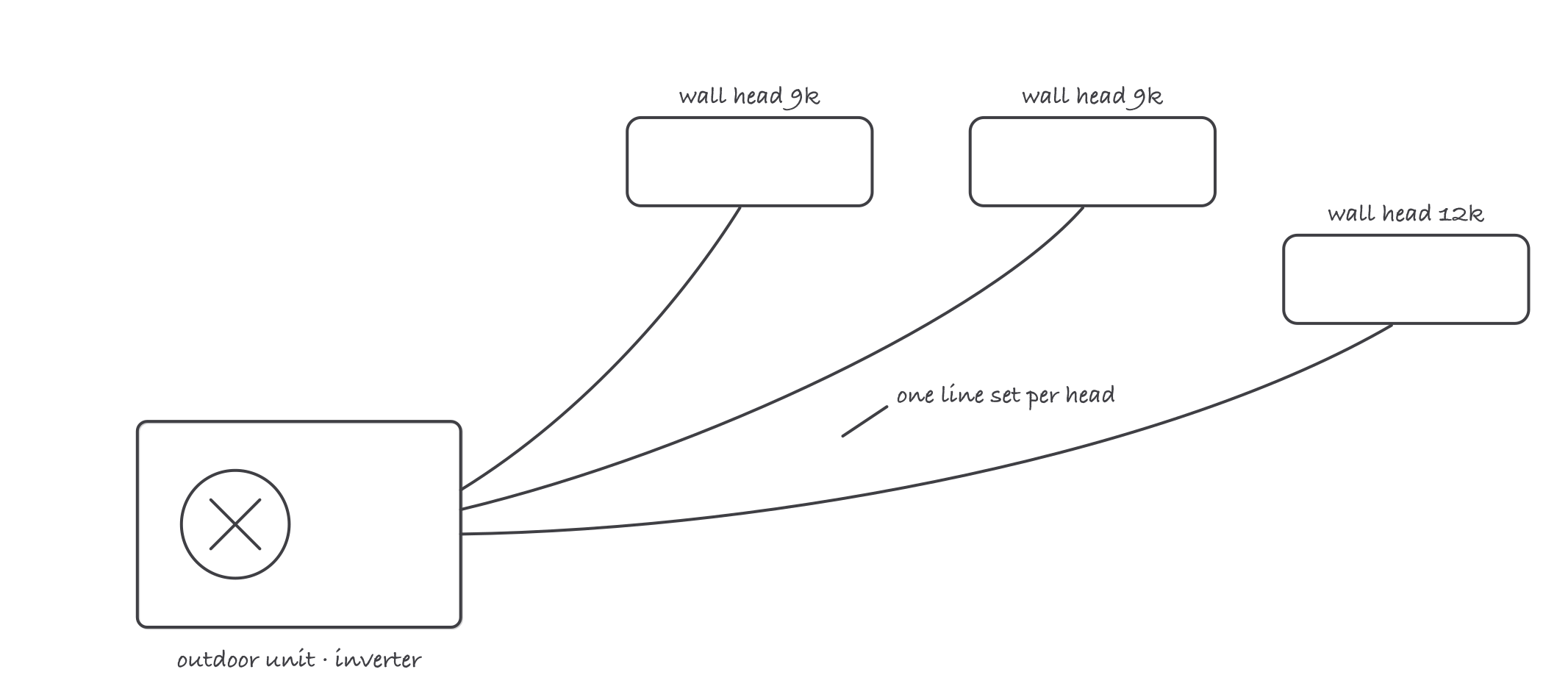
Multi-zone layout: every head gets its own line set, its own control, and its own condensate drain
Worked example: connected capacity
Multi-zone systems are routinely connected to more indoor capacity than the outdoor unit can deliver at once, on the bet that not every room peaks together. That bet is called diversity, and manufacturers publish exactly how far you may push it.
Three heads on one outdoor unit rated 24,000 BTU/h:
- Connected indoor capacity: 9,000 + 9,000 + 12,000 = 30,000 BTU/h
- Connected ratio: 30,000 ÷ 24,000 = 125 %
Whether 125 % is allowed, and what happens to each head’s output when all three call at once, comes from that outdoor unit’s engineering table, not from a rule of thumb. The pattern to keep: connected ratio is a designed number, the manufacturer’s table governs it, and a system someone “just added a head to” may be outside it.
Where it bites
- “Mini-split” does not mean cooling-only. Most are full heat pumps, and many are the primary heat source for the building. Winter diagnosis, defrost included, applies.
- Manufacturer-specific is the rule, not the exception. Line set limits, charge adjustments per foot of line, fault codes, and test modes differ by brand and model. The service manual is not optional reading here; guessing from another brand’s habits causes real damage.
- Charge is by weight, not by gauges. Factory charge covers a stated line length; longer runs get a published adjustment per foot. Inverter systems rarely give you a stable “textbook” gauge reading to charge against, which is why weighing dominates. Charging by Superheat and Subcooling explains what gauge methods assume, and those assumptions fail here.
- Filters are in the room, so they clog with the room. Wall heads pull unfiltered room air through washable screens a homeowner has usually never opened. Weak airflow and coil icing on a mini-split start there.