Learn · HVAC/R
Diagnosing Refrigerant Circuit Problems
Part of HVAC Technician from Zero · step 45 of 49 · next: EPA 608: What It Is and Why It Exists
In learning paths: HVAC Technician from Zero
Assumes you know: A Diagnostic Method That Works
Refrigerant circuit diagnosis is reading four numbers together, suction pressure, head pressure, superheat, and subcooling, and matching the pattern they make against the signatures of known faults. No single reading convicts anything. The pattern does.
Why it matters on the job
The circuit is sealed and invisible; those four numbers are the only story it can tell. A tech who reads one gauge and reaches for a refrigerant cylinder is treating a symptom in a story they have not read. A tech who takes all four, on a system already cleared for airflow per A Diagnostic Method That Works, can separate an undercharge from a restriction from a weak compressor without opening anything.
The four numbers and the healthy picture
From the gauge manifold and two line probes: suction pressure (as saturated suction temperature), head pressure (as saturated condensing temperature), superheat at the evaporator outlet, subcooling at the condenser outlet. The healthy comfort-cooling picture, from the fundamentals lessons: evaporator saturating around 40 °F, condenser saturating a designed margin above outdoor air, superheat and subcooling both moderate, near their targets.
Faults pull the picture in characteristic directions:
- Undercharge or leak: both pressures sag, superheat climbs (starved coil), subcooling shrinks (no liquid stacked).
- Overcharge: head pressure and subcooling climb; on fixed-orifice systems superheat drops toward flooding.
- Liquid-line restriction (plugged drier, crimped line, starving TXV): the tell is the contradiction, high superheat like an undercharge, but normal-to-high subcooling: liquid is stacked behind the blockage, not missing.
- Weak compressor (worn valves, bypassing scroll): pressures collapse toward each other, high suction, low head, and current draw runs low. The machine circulates less than it should.
- Dirty condenser or non-condensables: head pressure and subcooling-side symptoms climb while the low side stays roughly sane.
Worked example: undercharge or restriction
R-410A system, TXV, airflow verified, outdoor ambient 95 °F. Readings:
- Suction 98 psig → saturates at 30 °F (low: healthy would sit near 118 psig, 40 °F).
- Suction line at evaporator outlet 64 °F → superheat = 64 − 30 = 34 °F (very high: coil starving).
- Head 340 psig → saturated condensing 105 °F, just 10 °F over the 95 °F ambient (low side of normal).
- Liquid line 102 °F → subcooling = 105 − 102 = 3 °F (very low: almost no liquid reserve).
High superheat plus low subcooling: the coil is starving because the system is short of refrigerant everywhere. Verdict: undercharge, which on a sealed system means a leak to find before a cylinder comes out.
Now the same complaint with one number different: subcooling 18 °F instead of 3. Liquid is plentiful, stacked in the condenser, yet the coil still starves: the refrigerant cannot get through. That is the liquid-line restriction signature: check the filter-drier’s temperature drop, a restricted drier chills or frosts at its outlet, and the TXV’s inlet screen.
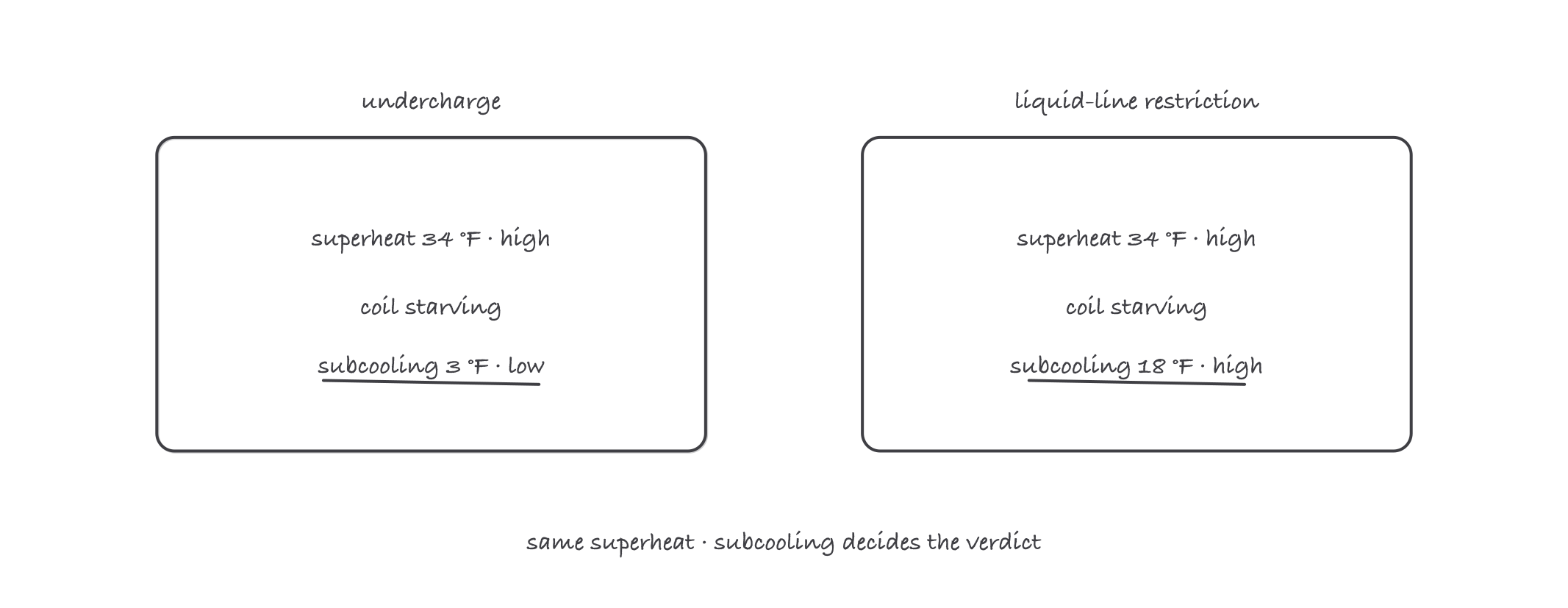
Same starving coil, opposite subcooling: the fourth number is the difference between adding charge and replacing a drier
Where it bites
- Airflow first, forever. A starved-airflow coil produces low suction and can ice, imitating undercharge. This lesson’s patterns are only valid on a system whose airflow has already been proved; Diagnosing Airflow Problems is the gatekeeper.
- Superheat alone convicts nobody. High superheat with low subcooling is undercharge; with high subcooling it is a restriction. Adding refrigerant to a restricted system stacks the condenser higher and fixes nothing: the drier gets a bigger backlog.
- Know the metering device before reading the pattern. A TXV actively fights to hold superheat, so charge faults show up in subcooling first; fixed orifices let both numbers swing. The same four readings mean different things behind different valves, exactly as Charging by Superheat and Subcooling drew the line.
- Saturation temperatures, not raw pressures, are the language. 98 psig is only meaningful as 30 °F on this refrigerant. On another refrigerant the same psig is a different temperature and a different verdict: the PT conversion is not optional bookkeeping.
- Let it run. Ten minutes minimum before readings mean anything, and longer after any change. Snapshots of a system still equalizing have sent countless healthy machines to the operating table.