Learn · HVAC/R
How Heat Pumps Work
Part of HVAC Technician from Zero · step 27 of 49 · next: Ductless Mini-Splits
In learning paths: HVAC Technician from Zero
Assumes you know: Split System Air Conditioners
A heat pump is a split system that can run its refrigeration cycle in either direction: the same compressor, coils and lines that cool the house in summer pull heat out of outdoor air and deliver it inside in winter. One extra component makes it possible, the reversing valve.
Why it matters on the job
Heat pumps are taking a growing share of installs, and they double your service season: the same machine generates winter no-heat calls and summer no-cool calls. To troubleshoot one you must know which coil is doing which job in the current mode, because every pressure and temperature you learned on Split System Air Conditioners swaps sides when the valve shifts.
The reversing valve
The reversing valve is a four-port slide valve on the discharge side of the compressor. It decides which coil receives hot discharge gas first:
- Cooling mode: discharge gas goes to the outdoor coil, which condenses; the indoor coil evaporates and absorbs heat from house air. Exactly the split system you already know.
- Heating mode: the slide shifts, discharge gas goes to the indoor coil, which now condenses and heats house air; the outdoor coil evaporates, absorbing heat from outdoor air.
The compressor never changes direction. Only the path of the refrigerant does. A small pilot solenoid, driven by the thermostat, shifts the slide using the system’s own pressure difference.
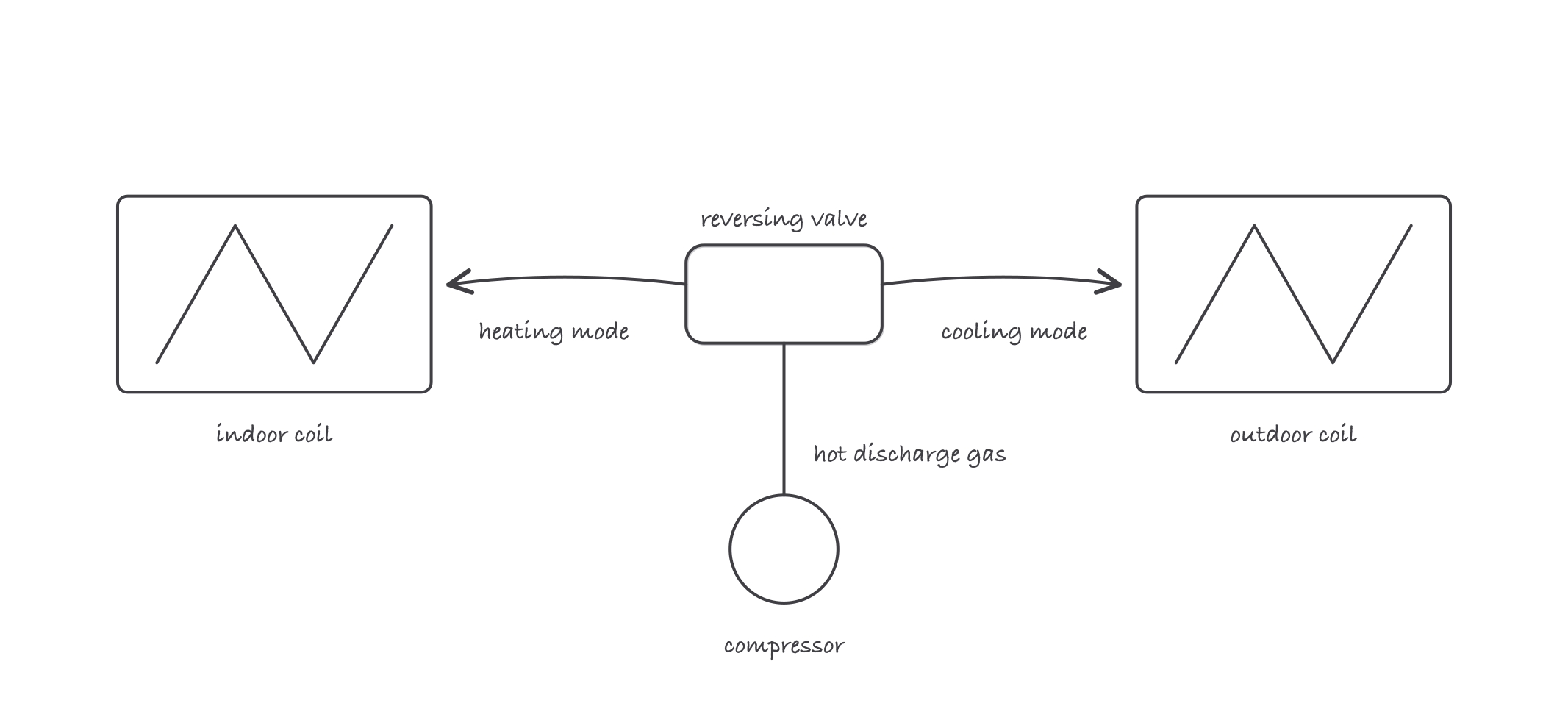
One machine, two directions: the reversing valve decides which coil condenses and which evaporates
Because either coil can be the evaporator, each coil needs its own metering path, and heat pump line sets are named by what the pipes carry in a chosen mode. The insulated line is called the vapor line rather than the suction line, because in heating mode it carries hot discharge gas.
Cold weather, defrost and backup heat
There is real heat in outdoor air even when it feels cold; the outdoor coil just has to run colder than the air to collect it. Run the outdoor coil below freezing in moist air and it grows frost, so heat pumps periodically reverse briefly into cooling to melt the coil. Defrost Controls covers that logic. As outdoor temperature falls, the heat available shrinks while the house’s demand grows; the crossover is the balance point, and below it supplemental heat, usually electric strips, makes up the difference.
Worked example: why pumping beats making heat
Electric resistance heat converts every watt to heat: 3,412 BTU/h per kW, and no more. A heat pump moves heat instead of making it.
A heat pump delivering 36,000 BTU/h of heat while drawing 3.5 kW:
- Input as heat: 3.5 × 3,412 = 11,942 BTU/h
- Coefficient of performance, COP = output ÷ input = 36,000 ÷ 11,942 = 3.0
The same 3.5 kW in electric strips would deliver 11,942 BTU/h. The heat pump delivers three times that, because roughly two-thirds of its output is heat collected from outdoor air for free. As outdoor temperature drops, output and COP both fall, which is exactly why the balance point and backup heat exist.
Where it bites
- A frosted outdoor coil in winter is normal; an iced one is not. Light frost between defrosts is expected operation. A solid block of ice says defrost has failed, and homeowners will report the “broken” steam cloud of a normal defrost as a fault too.
- “It’s blowing cold” in heating mode is relative. Heat pump supply air runs cooler than furnace supply air, warm enough to heat the house, cool enough to feel like a draft on skin. Verify with a thermometer, not a wrist.
- Gauge readings mean nothing until you know the mode. High side and low side trade coils when the valve shifts. Confirm the mode, then interpret.
- The reversing valve can fail in-between. A valve stuck mid-shift bypasses hot gas straight to suction and mimics a dead compressor: little heating, little cooling, and temperature checks across the valve’s ports find it.