Learn · HVAC/R
Air Terminals and Room Air Distribution
Part of Commercial HVAC Systems · step 8 of 10 · next: Mechanical Ventilation and Exhaust
In learning paths: Commercial HVAC Systems
Assumes you know: Duct Design Basics
Air terminals are the grilles, registers, and diffusers where the duct system meets the room. Supply terminals deliver air; return and transfer openings provide a path back. Their size and placement decide whether design airflow becomes comfortable room air.
Why it matters on the job
A balancing report can show the correct cfm while occupants still feel drafts, noise, hot spots, or stagnant air. Those complaints live in air velocity and distribution after the air leaves the duct.
Throw, spread, and room mixing
Throw is how far a supply air pattern travels before slowing to a stated terminal velocity. Spread is how the pattern widens. Terminal type, neck velocity, blade or core pattern, mounting surface, temperature difference, and nearby surfaces all influence the result.
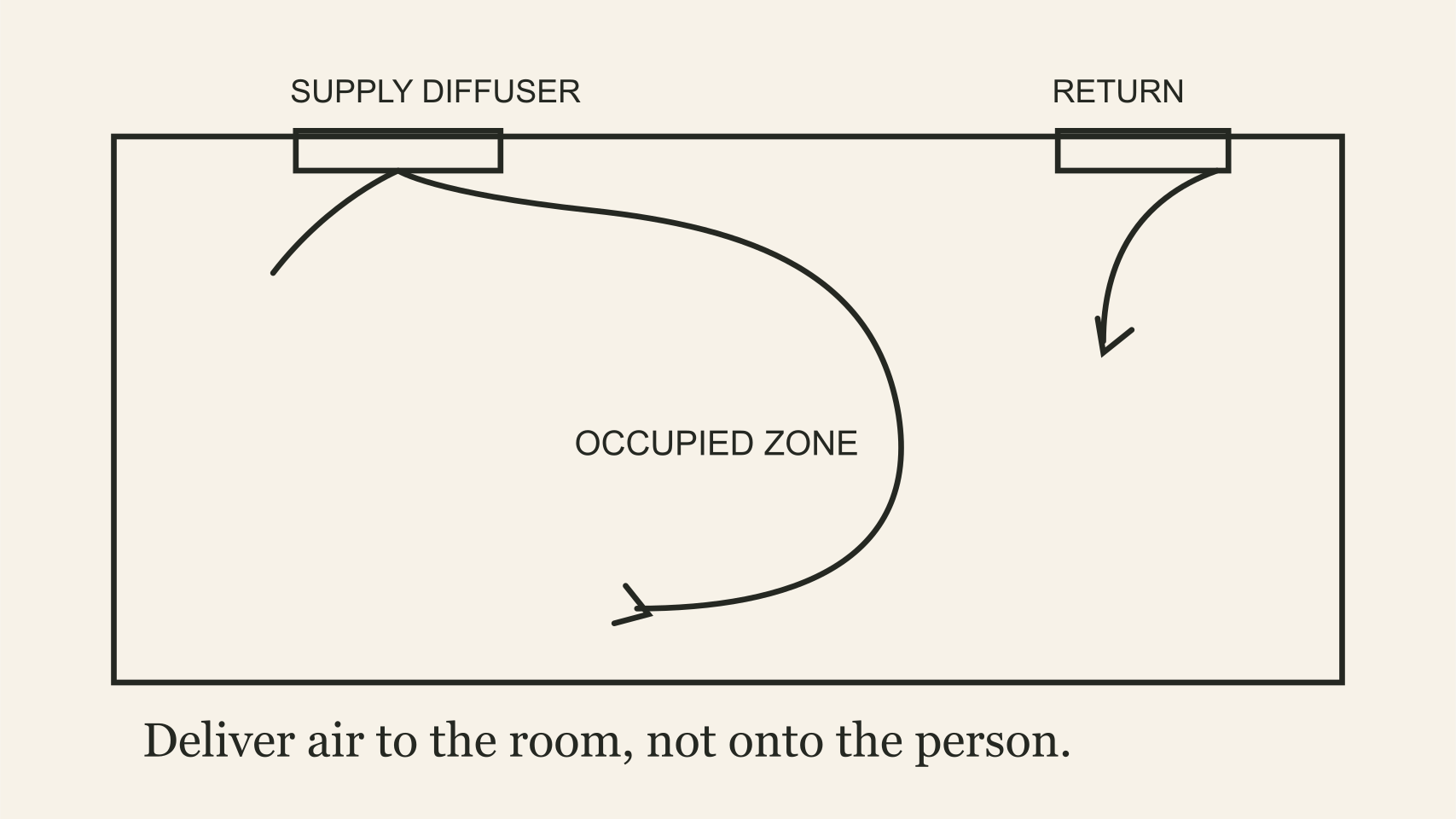
Good distribution mixes the room without dropping a high-velocity jet onto people
The return opening does not pull room air from long distances like a vacuum nozzle. The supply jet creates most room motion. A return needs a clear low-resistance path and placement that does not short-circuit supply air before it serves the occupied zone.
Worked example
An illustrative branch delivers 400 cfm through a terminal with 2.0 ft² of free area.
- Face velocity: 400 cfm ÷ 2.0 ft² = 200 fpm
- Replacing it with a terminal having 1.0 ft² free area at the same flow gives 400 ÷ 1.0 = 400 fpm
- The free area was halved, so the face velocity doubled.
That does not predict the final room pattern or noise by itself. Manufacturer performance data ties actual neck size and airflow to throw, spread, pressure drop, and sound.
Where it bites
- Nominal size is not free area. Use the terminal’s actual performance data.
- More velocity is not automatically more comfort. It may add throw, draft, noise, and pressure loss.
- Furniture and partitions change the room after balancing. Verify the occupied layout.
- A blocked return path starves supply. Closed doors and undersized transfer paths can depressurize rooms.