Learn · HVAC/R
Refrigerant Recovery
Part of HVAC Technician from Zero · step 40 of 49 · next: Leak Detection
In learning paths: HVAC Technician from Zero
Assumes you know: Gauges and Manifolds, Refrigerant Safety and Handling
Recovery is removing refrigerant from a system into an approved cylinder using a recovery machine, instead of letting it escape to the atmosphere. Federal law is blunt here: knowingly venting refrigerant during service, maintenance, repair or disposal is prohibited under Section 608 of the Clean Air Act, and EPA’s regulations spell out how refrigerant must be handled and how deeply systems must be evacuated before opening. Recovery is not a courtesy. It is the law of the trade.
Why it matters on the job
Any repair that opens the refrigerant circuit, a compressor swap, a coil replacement, a brazed joint, starts with recovery, so it sits in the critical path of most major repairs. It is also where the trade’s environmental obligation gets physical: the machine, the cylinder and the scale are how “do not vent” becomes an actual procedure. Working on refrigerants also requires certification under EPA’s technician rules, earned through certifying organizations that EPA has approved; the certification lessons cover the types and exams.
The equipment
The recovery machine is a compressor in a box: it pulls refrigerant from the system, and pushes it into the recovery cylinder.
Recovery cylinders are the gray-body, yellow-shoulder tanks rated for recovered refrigerant. Never recover into a disposable virgin cylinder: they are not rated to be refilled, and overfilled tanks of any kind are hydrostatic bombs, because a cylinder filled solid with liquid has no room for thermal expansion.
The scale lives under the cylinder for the entire job. Fill is controlled by weight, and standard practice caps the cylinder at 80 % of its rated capacity, leaving expansion room.
Two ways to move the refrigerant:
- Vapor recovery: slow and simple, pulling vapor off the system while liquid boils away inside it.
- Liquid or push-pull recovery: for large charges, moving liquid to the cylinder first with the machine driving the pressure difference, then finishing on vapor. Faster, because a pound of liquid moves in a fraction of the time a pound of vapor does.
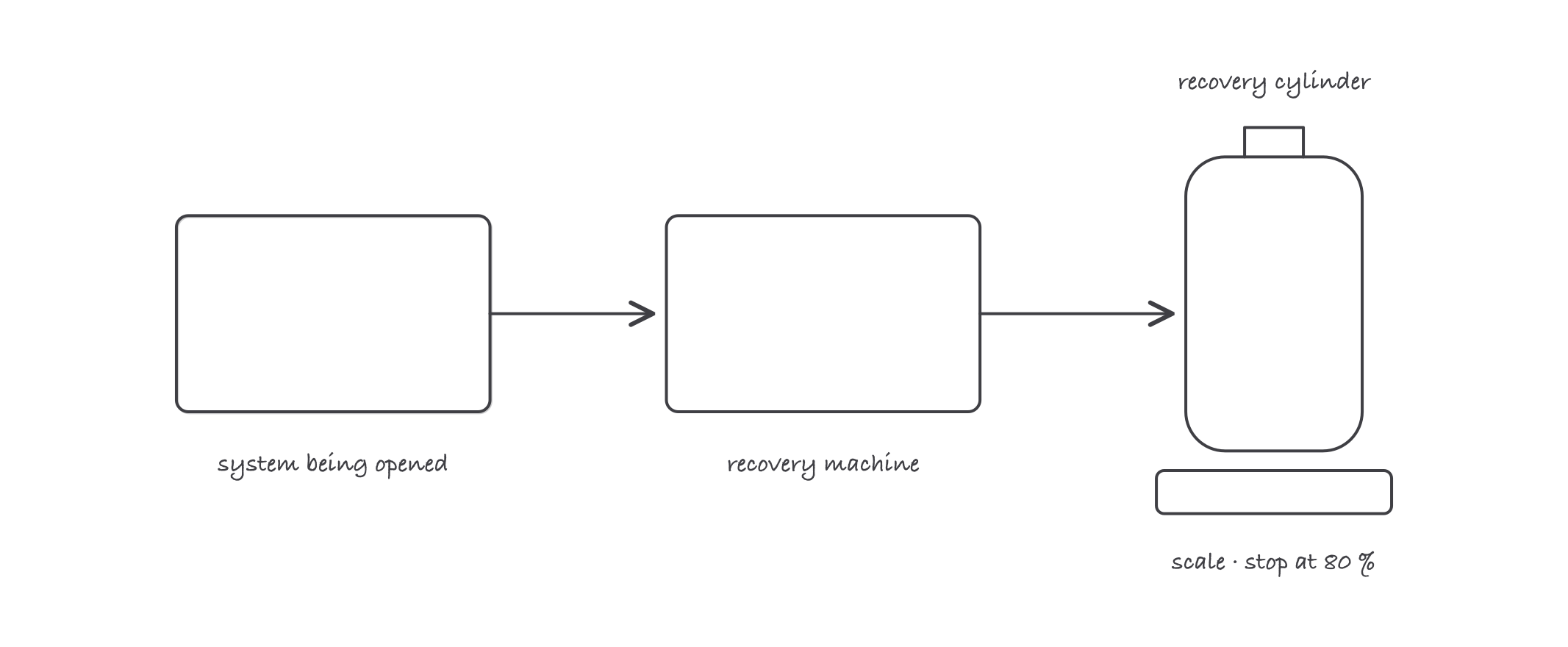
The recovery train: system to machine to cylinder, with the scale watching the fill the whole time
How deeply you must pull the system down before opening it, the required recovery vacuum level, depends on the appliance category, its charge size, and your recovery machine’s rating: the figures live in EPA’s Section 608 regulations and your machine’s documentation. The pattern to keep: bigger high-pressure systems must go deeper, small appliances have their own gentler rule, and the regulation’s table, not memory, is the reference.
Worked example: the 80 % fill line
A recovery cylinder is stamped with its water capacity, the weight of water it would hold: this one is 47.7 lb WC, tare weight 24.0 lb.
- Maximum refrigerant fill at standard practice: 0.80 × 47.7 = 38.2 lb
- Maximum gross weight on the scale: 24.0 + 38.2 = 62.2 lb
- The system you are recovering holds 12 lb, and the cylinder already reads 51.5 lb gross: it contains 51.5 − 24.0 = 27.5 lb. After the job it would hold 39.5 lb, over the 38.2 lb line. Start a second cylinder.
Strictly, 80 % of water capacity is the base practice; the precise fill limit varies with the refrigerant’s density, which is why the arithmetic is done per refrigerant on real jobs. The discipline is what transfers: fill is a calculated number watched on a scale, never “until it feels full”.
Where it bites
- Recovered, recycled and reclaimed are three different words with legal weight. Recovered refrigerant is removed and stored, nothing more. Recycling cleans it on site or in the shop; reclamation processes it back to purity specification at a certified reclaimer. What you may do with recovered refrigerant, and whose system it may go back into, follows EPA’s rules, not shop custom.
- Non-condensables ride along. A system contaminated with air gives you a cylinder contaminated with air. Mixed or unknown refrigerants go to their own clearly labeled cylinder for reclamation, never on top of clean product: one careless transfer ruins the whole tank.
- The machine needs its own service. Recovery machines have filters, oil (on oil-lubricated models) and their own small refrigerant circuit. A neglected machine recovers slowly, and slow recovery gets skipped, and skipped recovery is venting.
- Cold cylinders fill deceptively. Pressure in the cylinder falls as it chills during recovery, tempting a tech to keep pushing past the weight line. The scale, not the pressure gauge, ends the fill.
- Refrigerant Safety and Handling still applies. Liquid refrigerant freezes skin, cylinders are pressure vessels, and A2L refrigerants add flammability handling rules. Recovery concentrates all of it at one hose manifold.