Learn · HVAC/R
Condensers
Part of EPA 608: All Four Exams · step 5 of 20 · next: Metering Devices and TXVs
Part of HVAC Technician from Zero · step 5 of 49 · next: Metering Devices and TXVs
In learning paths: EPA 608: All Four Exams · HVAC Technician from Zero
Assumes you know: How the Refrigeration Cycle Works
The condenser is where the system exhales. Every unit of heat picked up indoors, plus the heat of the compression that moved it, leaves through this one coil. Vapor goes in hot; liquid comes out warm; the difference is the building’s heat, dumped outdoors.
Why it matters on the job
Condenser problems masquerade as everything else. A coil matted with cottonwood fluff shows up as high pressures, poor cooling, tripping on hot days, complaints that get misread as charge problems. Meanwhile “wash the condenser” remains the highest-value ten minutes in residential service. Know what the coil is doing and the pressures tell you the story.
The concept
The condenser does three jobs in sequence along one coil:
- Desuperheat, the incoming vapor is hotter than its condensing temperature (compression superheat); the first passes cool it down to saturation.
- Condense, the main event: at saturation temperature (set by discharge pressure, per the PT relationship) the vapor gives up its latent heat and turns to liquid.
- Subcool, with condensation finished, the liquid cools a few degrees below saturation. This is the subcooling you measure, and the proof of solid liquid to the metering device.
For all of it to work, the condensing temperature must sit above the outdoor air temperature, typically by 15 to 30 degrees on a healthy air-cooled system. That gap is the driving force pushing heat out.
Worked example
An R-410A system on a 95 °F day shows 365 psig discharge: saturation about 110 °F, so the coil condenses 15 degrees above ambient, healthy. Now block the coil with dirt: the same heat needs a bigger push, so condensing temperature climbs to 125 °F and pressure follows to about 445 psig. Nothing failed. The system is telling you, in psi, that its exhale is blocked, and the compressor pays for it in power and strain until someone brings a hose.
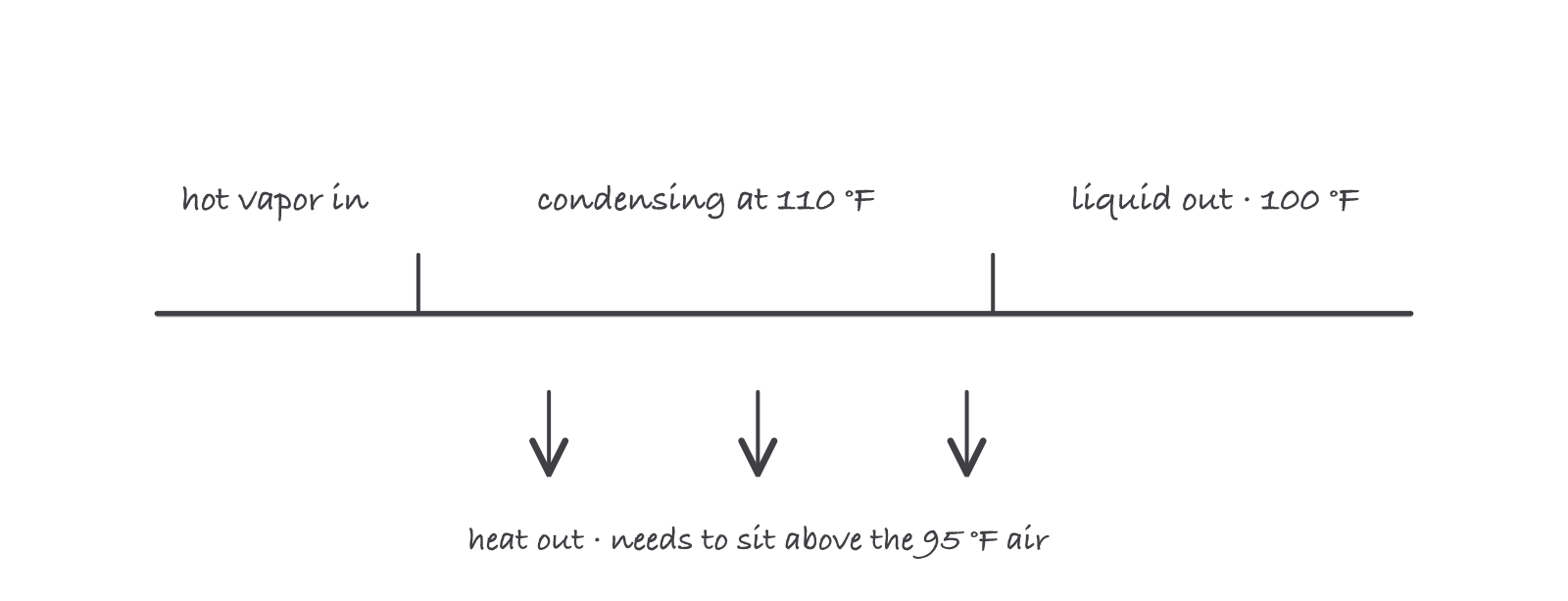
One coil, three jobs: desuperheat, condense, subcool
Where it bites
- High head pressure is a symptom with a short suspect list: dirty coil, failed condenser fan, overcharge, air in the system, or genuinely brutal ambient. Coil and fan first, they are free to check.
- Airflow is half the component. The fan and clean fins are as much “the condenser” as the tubing is.
- Recirculation counts: a unit tucked against a fence re-breathes its own hot discharge air and behaves like it is a 110 °F day.
Exam relevance
The three zones (desuperheat, condense, subcool), the relationship of condensing temperature to ambient, and the high-head diagnostic list are all standard exam and field-test territory.