Learn · HVAC/R
HVAC Motors: PSC, ECM and Beyond
Part of HVAC Technician from Zero · step 20 of 49 · next: Reading HVAC Schematics
In learning paths: HVAC Technician from Zero
Assumes you know: Capacitors in HVAC
Two motor families move most of the air and refrigerant in this trade, and they fail in completely different ways. The permanent split capacitor (PSC) motor is an electromagnetic machine you diagnose with an ohmmeter. The electronically commutated motor (ECM) is a computer wrapped around a motor, and ohming its windings tells you almost nothing. Knowing which one you are standing in front of decides your whole test plan.
Why it matters on the job
Blower motors, condenser fan motors, and single-phase compressors are daily service items. Condemning a good ECM because it “failed” a PSC-style test wastes hundreds of dollars; nursing a dying PSC because you never measured its windings wastes a callback. The motor type dictates the method.
PSC: the workhorse
A PSC motor has two windings: a run winding of heavy wire and a start winding of finer wire, joined at a common point. A run capacitor sits permanently in series with the start winding, shifting its current out of phase to create the rotating field. No relay, no switch, no electronics: that simplicity is why PSC motors are cheap, tough, and everywhere.
The cost of simplicity is a fixed design speed, or a handful of speed taps, and modest efficiency. A PSC blower on low static pressure or high static pressure just runs its speed and delivers whatever airflow results.
Because it is all copper and iron, a PSC motor tests honestly with a meter: winding resistances, capacitor microfarads, and running amps against nameplate tell you nearly everything.
ECM: the computer
An ECM is a brushless DC motor driven by an electronic module. The module rectifies incoming AC, then fires the stator windings in sequence around a permanent-magnet rotor. Because the module controls the firing, it controls speed continuously, and many ECMs are programmed to hold a constant airflow: as duct static rises, the motor works harder to move the same CFM.
The payoff is efficiency and control. The diagnostic consequence is bigger: the windings are driven by the module, so a winding-resistance reading at the motor plug does not prove the motor good or bad. You test an ECM by verifying its inputs: line voltage present at the module, and a control signal (24 V thermostat logic or serial communication from the board) telling it to run. Good power plus a good command plus no rotation points at the motor and module; missing inputs point upstream. Manufacturer testers and procedures take it from there.
Worked example: naming PSC compressor terminals with an ohmmeter
A single-phase compressor’s three terminals are common (C), start (S), and run (R), and the resistances always obey one relationship: the two windings in series, S to R, read the sum of the other two readings.
Measured cold, power off, wires removed:
- Terminal pair A-B: 4.1 Ω
- Terminal pair B-C: 15.2 Ω
- Terminal pair A-C: 19.3 Ω
The largest reading, 19.3 Ω, skips common, so A and C are start and run, making B common. The smaller of the two remaining readings is the run winding (heavier wire, less resistance): A-B at 4.1 Ω makes A run, and C, with 15.2 Ω to common, is start. Check: 4.1 + 15.2 = 19.3. The arithmetic must close; if it does not, remeasure.
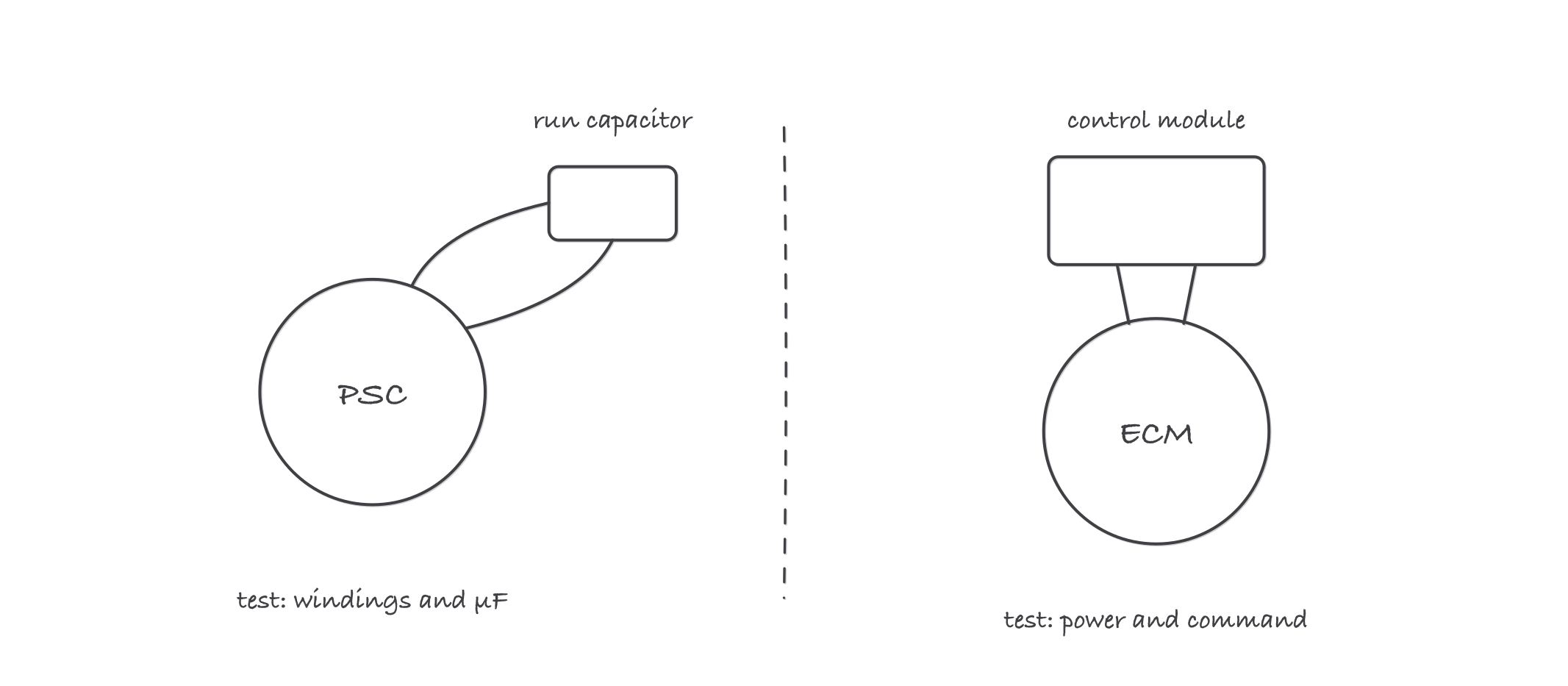
Two families, two methods: the PSC answers to an ohmmeter, the ECM answers to its power and its command signal
Where it bites
- Never ohm an ECM and call it dead. The module is in the way. Prove power and command first; use the manufacturer’s test procedure for the module itself.
- A weak capacitor imitates a bad PSC motor. Hum, overload trips, high amps. Test the capacitor before condemning the motor; it is the cheaper part and the more common failure.
- Continuity to the shell means stop. A healthy winding reads infinite ohms to the motor case; any winding showing continuity to the motor case is a grounded motor. On a compressor, that is also a warning the refrigerant circuit may be acidic; check the oil before installing the replacement.
- ECMs hate high static. A constant-airflow ECM ramps up against dirty filters and crushed ducts, running hot and loud. The fix is the duct problem, not the motor.