Learn · HVAC/R
Manual S: Selecting the Equipment
Part of HVAC Design Fundamentals · step 7 of 9 · next: Manual D: Sizing the Ducts
In learning paths: HVAC Design Fundamentals
Assumes you know: Manual J: Calculating the Load
Manual S is the step between the load and the purchase order: it selects equipment against the Manual J loads using the manufacturer’s performance data, and it is an ANSI-approved standard covering 11 equipment types. The nominal tonnage on the box is a label, not a capacity, and Manual S is the discipline of finding out what the machine actually delivers in the house being worked on.
Why it matters on the job
A three-ton condenser does not produce 36,000 Btu/h. It produces whatever the expanded performance table says it produces at the outdoor temperature, the indoor entering conditions and the airflow this installation will actually run. That number can sit well below or above the nameplate, and the sensible portion of it, which is what answers the thermostat, moves independently of the total. Selecting on the label instead of the table is how a correctly calculated load still ends up with the wrong machine.
Reading expanded performance data
Manufacturer data is published as a grid of operating conditions rather than a single figure. Entering it needs the outdoor dry bulb at your design condition, the indoor entering wet bulb and dry bulb, and the airflow the system will deliver. The table returns total capacity and sensible capacity at that intersection; the difference between them is the latent capacity, the moisture the coil removes.
The ratio of sensible to total capacity is the sensible heat ratio (SHR). A dry climate load wants a high SHR; a humid climate load wants a lower one. A machine with the right total capacity and the wrong SHR either leaves the house clammy or overshoots on temperature while the moisture load is still there.
Heating is a different table
For a furnace, the number that matters is output capacity, not input: input multiplied by efficiency gives the heat that reaches the house. For a heat pump, capacity falls as it gets colder, so the selection has to be read at the winter design temperature rather than at rating conditions, and the point where declining capacity crosses the rising heating load is the balance point that decides how much supplemental heat is needed.
Worked example
Cooling design load from Manual J: 24,000 Btu/h total, of which 19,800 is sensible and 4,200 is latent. A candidate unit’s expanded performance table, read at this location’s outdoor design temperature and the design entering conditions at 1,000 CFM, gives:
- Total capacity: 27,600 Btu/h
- Sensible capacity: 20,700 Btu/h
- Equipment SHR = 20,700 / 27,600 = 0.75
- Load SHR = 19,800 / 24,000 = 0.825
- Sensible margin = 20,700 - 19,800 = 900 Btu/h; latent capacity = 27,600 - 20,700 = 6,900 against a 4,200 latent load
- Total capacity as a share of load = 27,600 / 24,000 = 115%
The machine covers both halves. Note what the comparison exposes: its SHR of 0.75 is wetter than the house needs at 0.825, so it is spending capacity on moisture removal this load does not demand. Whether 115% is an acceptable oversize is not a judgment call: the standard states a limit, and that limit lives in the manual.
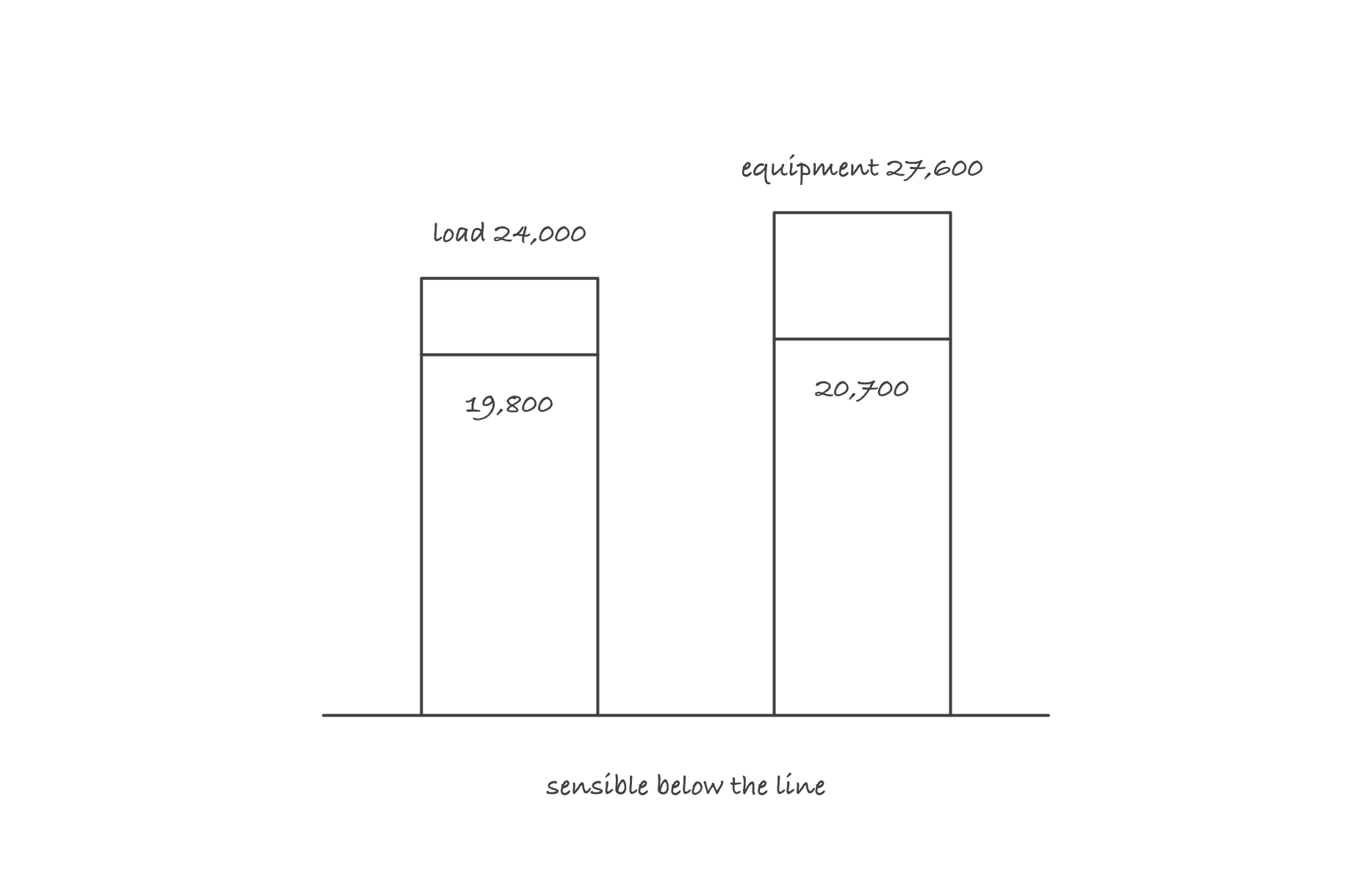
Both halves have to be covered, and the split is what the nameplate never tells you
Where it bites
- Nominal tonnage is a marketing size. Two nominally identical units from different manufacturers can differ by thousands of Btu/h at the same conditions.
- AHRI rating conditions are not your design day. Ratings are published at a standard outdoor temperature. A hotter design condition means less capacity than the rating implies, and the table already knows that.
- The indoor coil is part of the selection. Capacity data applies to a matched combination of outdoor unit, indoor coil and air handler. Mixing an unmatched coil invalidates the number the selection was made on.
- Furnace input is not furnace output. Selecting a furnace on its input rating overshoots the load by the whole inefficiency of the appliance.
Where the detail lives
The selection limits and the full procedure sit inside the purchased standard. What is free is the other half of the job and the half most selections get wrong anyway: the manufacturer’s expanded performance data for the exact model and coil combination, published on every equipment data sheet, read at this job’s conditions before anything is ordered.